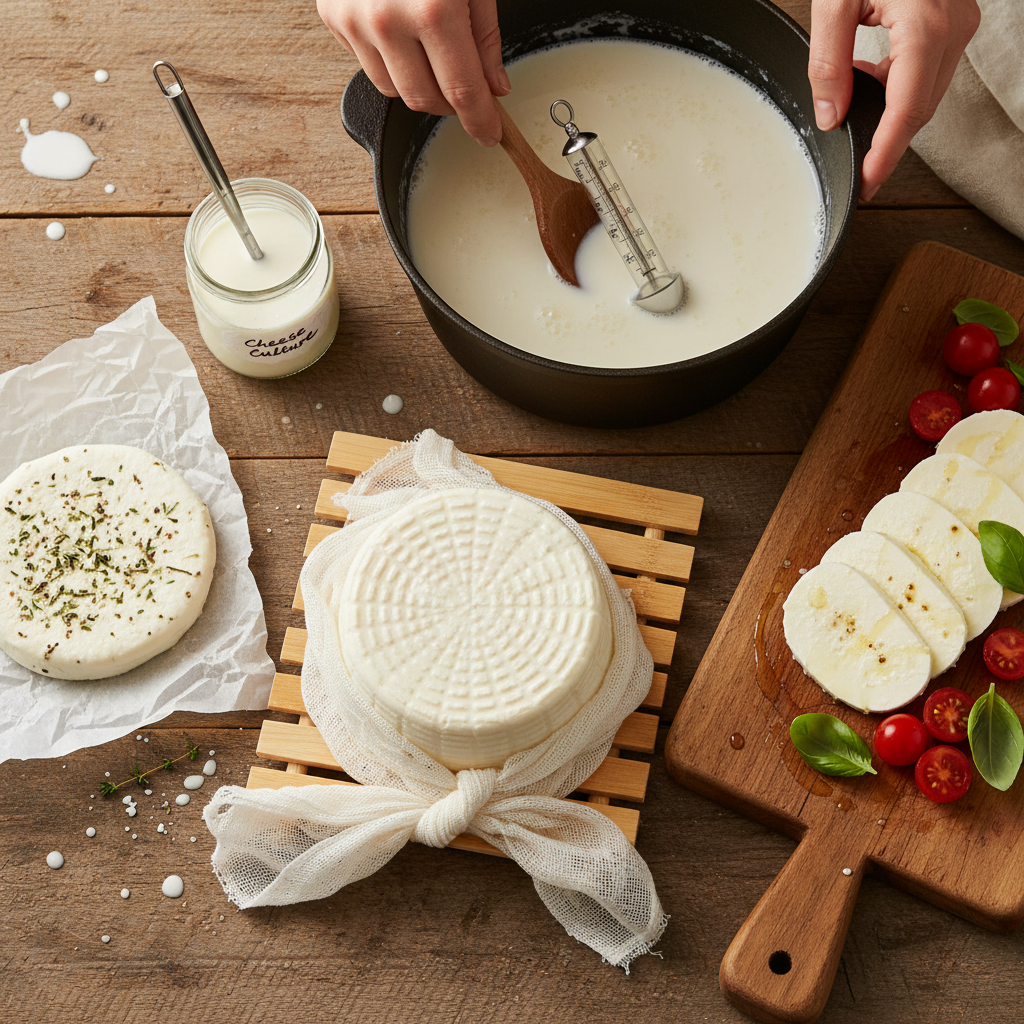
Homemade Cheese for Beginners: 5 Easy Recipes with Grocery Store Ingredients
- You can make 5 delicious cheeses with just grocery store milk, vinegar or lemon juice, and salt — no special equipment needed
- Ricotta takes 30 minutes from start to finish. Mozzarella takes about an hour. Chèvre takes 24 hours (mostly waiting).
- One gallon of milk makes about 1–1.5 lbs of cheese — less than half the cost of buying artisan cheese
- You need only 3 basic tools to start: a large pot, a thermometer, and cheesecloth
- Goat milk, cow milk, and even store-bought whole milk all work — just avoid ultra-pasteurized
Homemade cheese sounds intimidating until you actually try it. The truth? Ricotta takes less time to make than it takes to drive to the store and buy it. And the taste difference between fresh, warm ricotta you made yourself and that plastic tub from the dairy aisle? It’s not even close.
Cheese making is one of those homesteading skills that seems advanced but is actually one of the easiest places to start. If you can boil milk and stir, you can make cheese today.
What You Need to Get Started
Equipment (You Probably Already Own)
| Tool | What It Does | Cost |
|---|---|---|
| Large pot (4+ quarts) | Heating milk | Have it |
| Instant-read thermometer | Temperature accuracy is key | $8–$15 |
| Cheesecloth or butter muslin | Straining curds from whey | $5–$8 |
| Colander | Holding cheesecloth for draining | Have it |
| Slotted spoon | Stirring and scooping curds | Have it |
Total startup cost: $13–$23 (just the thermometer and cheesecloth if you have a pot).
Choosing Your Milk
- Best: Fresh raw or pasteurized whole milk from a local farm
- Good: Store-bought pasteurized whole milk (not ultra-pasteurized)
- Works for some cheeses: Store-bought 2% (ricotta and paneer only)
- Avoid: Ultra-pasteurized (UHT) milk — the proteins are too damaged to form proper curds
How to tell: If the carton says “ultra-pasteurized” or “UHT,” skip it. Regular pasteurized milk works fine. If you have goats, their milk makes exceptional cheese with naturally higher butterfat.
From our homestead: The first cheese I ever made was ricotta. I stood in my kitchen stirring hot milk, added vinegar, and watched in genuine amazement as curds formed in seconds. I strained it, added salt, and ate it warm on toast with honey. That was the moment I became a cheese person.
Cheese #1: Ricotta (30 Minutes)
The absolute best starter cheese. It’s forgiving, fast, and delicious.
Ingredients
- 1/2 gallon whole milk
- 2 tablespoons white vinegar or lemon juice
- 1/2 teaspoon salt
Steps
- Heat milk in a pot to 190°F, stirring occasionally to prevent scorching.
- Remove from heat. Add vinegar and stir gently for 10 seconds.
- Let sit undisturbed for 10 minutes. You’ll see white curds separating from yellowish whey.
- Line a colander with cheesecloth over a bowl. Pour everything through.
- Let drain for 5–15 minutes (less time = creamier, more time = drier).
- Stir in salt. Eat warm or refrigerate for up to a week.
Yield: ~1 cup of ricotta from 1/2 gallon of milk.
Use it: On toast with honey, in lasagna, stuffed in pasta shells, with fruit, or on pizza.
Cheese #2: Paneer (45 Minutes)
An Indian fresh cheese that holds its shape when fried or cooked. Same process as ricotta but pressed firm.
Ingredients
- 1/2 gallon whole milk
- 3 tablespoons lemon juice or white vinegar
- 1/2 teaspoon salt
Steps
- Heat milk to 190°F. Add acid and stir gently.
- Once curds separate clearly, strain through cheesecloth-lined colander.
- Rinse curds briefly under cool water (removes the vinegar taste).
- Gather cheesecloth into a ball and squeeze out excess whey.
- Place the wrapped cheese on a plate, put another plate on top, and weigh it down with a heavy can or pot for 30–60 minutes.
- Unwrap, cut into cubes. Fry in butter until golden for saag paneer or palak paneer.
Yield: ~8 oz from 1/2 gallon of milk.
Cheese #3: Fresh Mozzarella (1 Hour)
The showpiece beginner cheese. Fresh mozzarella with tomato and basil is a summer revelation.
Ingredients
- 1 gallon whole milk (NOT ultra-pasteurized)
- 1 1/2 teaspoons citric acid dissolved in 1/2 cup cool water
- 1/4 tablet rennet dissolved in 1/4 cup cool water (or 1/4 tsp liquid rennet)
- 1 teaspoon salt
Steps
- Add citric acid solution to cold milk in pot. Heat slowly to 90°F, stirring gently.
- Remove from heat. Add rennet solution, stir for 30 seconds, then stop stirring.
- Cover and let sit 5 minutes. The milk should set into a soft gel (like yogurt).
- Cut the curd into 1-inch squares with a knife (cutting through to the bottom of the pot).
- Heat curds gently to 105°F, stirring slowly. Curds will shrink and firm up.
- Scoop curds out with a slotted spoon into a microwave-safe bowl.
- Microwave 1 minute. Drain whey, fold and press curds. Microwave 30 more seconds.
- Add salt. Stretch and fold like taffy until smooth and shiny (use gloves — it’s hot!).
- Form into a ball. Drop into ice water to set shape.
Yield: ~1 lb from 1 gallon of milk.
Where to buy rennet and citric acid: Amazon, cheese making supply stores (New England Cheesemaking Supply Co.), or many health food stores.
Cheese #4: Chèvre — Goat Cheese (24 Hours)
If you have access to goat milk (or can find it at the store), chèvre is incredibly easy and impressive.
Ingredients
- 1 quart goat milk
- 1 tablespoon lemon juice or white vinegar
- Pinch of salt
- Optional: fresh herbs, cracked pepper, honey
Steps
- Heat goat milk to 180°F.
- Add lemon juice, stir once. Remove from heat.
- Cover and let sit at room temperature for 2 hours (or overnight in the fridge for tangier flavor).
- Strain through cheesecloth for 4–8 hours in the fridge.
- Mix in salt and any herbs. Roll into a log, wrap in plastic, and refrigerate.
Yield: ~4–6 oz from 1 quart of milk.
Flavor ideas: Roll in fresh herbs and cracked pepper, drizzle with honey, mix in roasted garlic, or add sun-dried tomatoes.
Cheese #5: Queso Fresco (1 Hour)
A mild, crumbly Mexican cheese perfect for tacos, beans, and enchiladas.
Ingredients
- 1/2 gallon whole milk
- 3 tablespoons white vinegar
- 1 teaspoon salt
Steps
- Heat milk to 185°F.
- Add vinegar, stir gently for 10 seconds. Let sit 10 minutes.
- Strain through cheesecloth. Let drain 5 minutes (keep it moist — not too dry).
- Mix in salt. Press into a small bowl or mold for 30 minutes.
- Unmold. Crumble over tacos, salads, or black beans.
Yield: ~6–8 oz from 1/2 gallon of milk.
Cheese Comparison Chart
| Cheese | Active Time | Total Time | Difficulty | Special Supplies |
|---|---|---|---|---|
| Ricotta | 15 min | 30 min | Very Easy | None |
| Paneer | 15 min | 45 min | Very Easy | None |
| Queso Fresco | 15 min | 1 hour | Easy | None |
| Mozzarella | 45 min | 1 hour | Moderate | Citric acid, rennet |
| Chèvre | 15 min | 24 hours | Easy | Goat milk |
From our homestead: Don’t throw away the whey! That yellowish liquid leftover from cheese making is packed with protein. Use it in place of water when making sourdough bread, add it to smoothies, feed it to chickens (they love it), or water your compost pile — whey is an excellent compost activator.
Troubleshooting Common Problems
- Curds won’t form: Your milk is likely ultra-pasteurized. Check the label. Also make sure you’re hitting the right temperature.
- Cheese is rubbery (mozzarella): Overworked or overheated. Stretch only until smooth — stop as soon as it’s glossy.
- Cheese tastes sour: Too much acid. Use slightly less vinegar/lemon juice next time, or rinse curds under cool water.
- Low yield: Higher-fat milk = more cheese. Whole milk always outperforms 2%. Raw or lightly pasteurized milk gives the best results.
Frequently Asked Questions
Can I make cheese with store-bought milk?
Yes — as long as it’s not ultra-pasteurized (UHT). Regular pasteurized whole milk from the grocery store works well for all five cheeses in this guide. Check the label: if it just says “pasteurized,” you’re good. “Ultra-pasteurized” won’t form curds properly for most cheeses.
What’s the easiest cheese to make at home?
Ricotta is the easiest cheese for beginners. It requires only three ingredients (milk, vinegar, salt), no special equipment, and takes 30 minutes from start to finish. You’ll have fresh, warm, creamy ricotta that tastes nothing like the store-bought version.
How much cheese does one gallon of milk make?
One gallon of whole milk yields approximately 1–1.5 lbs of cheese depending on the type and the milk’s fat content. Higher-fat milk (especially goat milk or cream-top cow milk) yields more cheese. Ricotta yields the least; mozzarella yields the most.
Is homemade cheese cheaper than store-bought?
For artisan-style cheeses, yes. A gallon of whole milk ($4–$6) makes about 1 lb of fresh mozzarella, which retails for $8–$15 at a cheese shop. Ricotta is even more dramatic: about $2 of milk and vinegar makes what costs $5–$7 at the store. The savings are even greater if you use milk from your own goats or a local farm.
Do I need rennet to make cheese?
Not for most beginner cheeses. Ricotta, paneer, queso fresco, and chèvre all use acid (vinegar or lemon juice) to form curds — no rennet needed. Mozzarella is the one cheese in this guide that requires rennet, which is available online for about $8–$12 for enough to make dozens of batches.