How to Build a Backyard Smokehouse: DIY Plans for Every Budget
nn
Key Takeaways
n
- n
- Cold smoking (68-86°F) is for flavor only and requires separate curing; hot smoking (126-275°F) both cooks and flavors food in one step.
- You can build a functional smokehouse for under $50 with a cardboard box or plywood, under $200 with cinder blocks, or $500+ for a permanent wood or brick structure.
- Wood choice dramatically affects flavor — fruitwoods (apple, cherry) are mild and versatile, hardwoods (hickory, oak) are bold, and mesquite is intense and best used sparingly.
- Food safety is non-negotiable: meat must reach safe internal temperatures, and cold-smoked products must be properly cured before smoking.
- Start with simple projects like smoked cheese, nuts, or jerky before attempting large cuts of meat.
n
n
n
n
n
n
nn
There’s something deeply satisfying about smoking your own food. Maybe it’s the primal connection to one of humanity’s oldest preservation techniques, or maybe it’s just that a piece of salmon you caught and smoked yourself tastes about ten times better than anything from a store. Either way, building a backyard smokehouse is one of those projects that sounds complicated but really isn’t — especially if you start simple and scale up as your skills grow.
nn
You don’t need a timber-framed, stone-floored monument to smoked meat. Some of the best smoked food I’ve ever tasted came out of a plywood box with a hotplate inside. What matters is understanding the basic principles, choosing the right wood, and respecting food safety. The structure itself can be as simple or as elaborate as your budget and ambition allow.
nn
Understanding the Two Types of Smoking
nn
Before you build anything, you need to understand the fundamental difference between cold smoking and hot smoking, because the type of smokehouse you need depends on which method you plan to use.
nn
Cold Smoking
nn
Cold smoking happens at temperatures between 68°F and 86°F (20-30°C). At these temperatures, the food isn’t cooking — it’s absorbing smoke flavor while remaining essentially raw. Cold smoking is used for foods like bacon (before it’s cooked later), lox-style salmon, certain sausages, and cheese.
nn
Because the food stays in the “danger zone” (40-140°F) for extended periods — often 12-48 hours — cold smoking carries real food safety risks if done incorrectly. Meats and fish must be properly cured with salt (and often curing salts containing sodium nitrite) before cold smoking to inhibit bacterial growth. Cheese and nuts don’t carry the same risk since they’re not hospitable to dangerous bacteria in the same way raw meat is.
nn
A cold smoker needs a design that separates the fire from the smoking chamber, usually with a pipe or tunnel, so the smoke cools before reaching the food.
nn
Hot Smoking
nn
Hot smoking happens at temperatures between 126°F and 275°F (52-135°C). This both cooks the food and infuses it with smoke flavor simultaneously. Hot smoking is what most backyard smokers are doing when they smoke ribs, brisket, pulled pork, salmon, or jerky.
nn
Hot smoking is significantly simpler from a food safety standpoint because the food reaches safe internal temperatures during the process. It’s where I recommend beginners start. A hot smoker can be as simple as a box with a heat source and a wood chip tray inside.
nn
Build Option 1: The Budget Smoker ($30-$50)
nn
This is the “no excuses” build. It’s cheap, fast, and genuinely functional. Perfect for figuring out whether smoking is something you want to invest more time and money into.
nn
The Cardboard Box Smoker
nn
Yes, cardboard. It sounds absurd, but people have been smoking food in cardboard boxes for decades. The box doesn’t burn because the temperature inside stays well below cardboard’s ignition point (about 400°F) — you’re running at 150-225°F.
nn
Materials:
n
- n
- A large cardboard box (appliance boxes work great, or a wardrobe moving box)
- A single-burner electric hotplate ($15-$20)
- A small cast-iron skillet or foil pan for wood chips
- Metal oven racks or grill grates
- Wooden dowels pushed through the sides to support the racks
- A thermometer (probe style is best)
n
n
n
n
n
n
nn
Assembly: Set the hotplate on bricks or pavers at the bottom of the box. Place the cast-iron skillet of wood chips on the hotplate. Push dowels through the box walls at your desired smoking height and rest the racks on them. Cut a small vent hole near the top for airflow. Poke the thermometer through the side at rack height. That’s it.
nn
In my experience, this setup works shockingly well for small batches of jerky, fish, sausages, or anything else that doesn’t require long smoking times. It won’t last forever — the cardboard absorbs moisture and grease over time and needs replacing every few uses. But at near-zero cost, that’s fine.
nn
The Plywood Upgrade ($40-$50)
nn
Same concept as the cardboard box, but built from a sheet of untreated plywood. Build a tall, narrow cabinet — roughly 2 feet square and 4 feet tall. Use a jigsaw to make a door on one side with simple hinges. Drill holes for dowels or mount angle brackets for shelf support. Cut a vent in the top.
nn
Important: use only untreated, unpainted plywood. Pressure-treated lumber contains chemicals (typically copper azole) that release toxic fumes when heated. Standard exterior plywood glue (CDX grade) is fine — the formaldehyde in the glue off-gasses at temperatures well above what you’ll reach while smoking.
nn
Build Option 2: The Cinder Block Smokehouse ($150-$200)
nn
This is the sweet spot for most backyard smokers. It’s permanent (or at least semi-permanent), durable, holds temperature well thanks to the thermal mass of the blocks, and can handle both hot and cold smoking with the right configuration.
nn
Materials
n
- n
- 40-50 standard cinder blocks (8″x8″x16″) — about $1.50-$2 each
- Metal rebar or expanded metal for rack supports
- A solid metal or plywood door (or a simple frame with sheet metal)
- A metal plate or grate for the fire pit area
- A chimney cap or adjustable vent for the top
- A thermometer
- For cold smoking: 6-10 feet of stovepipe or aluminum dryer duct
n
n
n
n
n
n
n
nn
Design
nn
The basic design is a rectangular tower, roughly 3-4 feet square and 5-6 feet tall. No mortar is necessary — dry-stacked cinder blocks are heavy enough to stay in place, and the ability to disassemble the structure is actually an advantage.
nn
Stack the blocks in a standard overlapping pattern (like bricks) to create the walls. Leave a gap in the front for a door opening. Place metal rebar across the interior at multiple heights to support grill grates. The bottom level houses the heat source — either a hotplate with a chip pan or a small fire built directly on the ground.
nn
For a cold-smoking setup, build a small separate fire pit 6-10 feet away from the smoking chamber and connect them with stovepipe buried in a shallow trench or running along the ground. The distance allows the smoke to cool before entering the chamber. Gravity does the work — place the fire pit slightly lower than the chamber entrance, and the smoke will naturally draft upward.
nn
Cap the top with a piece of sheet metal with an adjustable opening, or install a simple chimney vent. You need airflow to keep the smoke moving through the chamber, but too much ventilation drops the temperature and wastes smoke. Start with the vent about one-quarter open and adjust from there.
nn
Build Option 3: The Permanent Smokehouse ($500+)
nn
If you’re serious about smoking and want a structure that will last for decades, a permanent smokehouse is a worthwhile investment. Think of it as a small outbuilding purpose-built for smoking food.
nn
Frame Construction ($500-$800)
nn
Build a simple stud-frame structure, roughly 4×4 feet and 6-7 feet tall, using standard 2×4 lumber. Sheath the exterior with plywood or board-and-batten siding. Line the interior with untreated cedar planks — cedar resists moisture, doesn’t impart off flavors, and looks beautiful as it ages. Install a metal roof.
nn
The floor should be concrete, pavers, or packed gravel — not wood, for obvious fire safety reasons. Build the fire pit into the floor or pipe smoke in from an external firebox. Install a chimney or vent at the peak of the roof.
nn
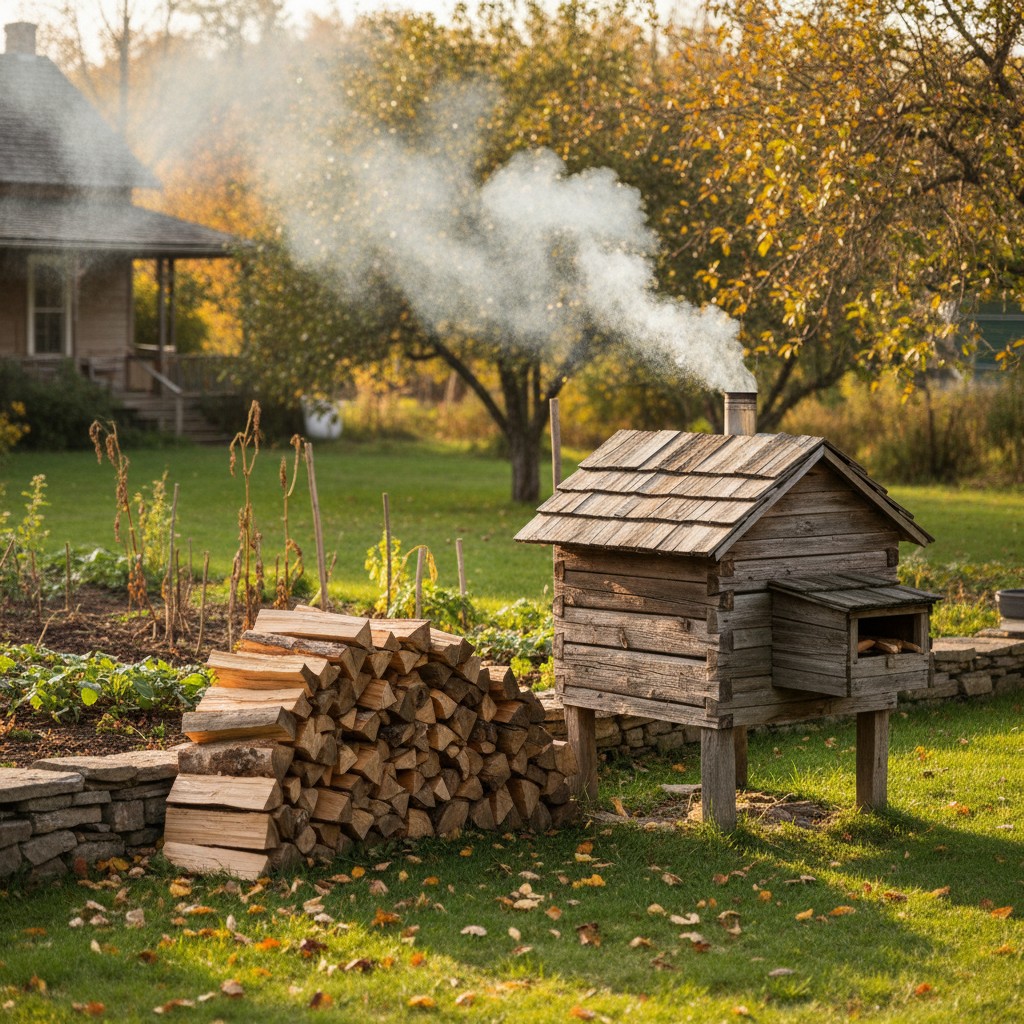
This style of smokehouse is traditional throughout Appalachia and the rural South, where families have used similar structures for generations to smoke hams, bacon, and sausages. A well-built one can last 30-50 years with minimal maintenance.
nn
Brick or Stone Construction ($800-$2,000+)
nn
The most permanent option. A brick smokehouse with a mortared foundation and walls is essentially a small masonry building. This is a significant construction project that may require a building permit depending on your local codes — check before you start. The thermal mass of brick or stone provides excellent temperature stability, and these structures are virtually maintenance-free once built.
nn
Choosing Your Smoking Wood
nn
The wood you burn is at least as important as the smoker you build it in. Different woods produce different flavor compounds, and matching wood to food is part of the art of smoking.
nn
Fruitwoods (Mild to Medium)
n
- n
- Apple: Sweet, mild, and slightly fruity. Outstanding with pork, poultry, and fish. The most universally liked smoking wood. Burns slow and steady.
- Cherry: Adds a beautiful mahogany color to meat along with a subtly sweet, fruity flavor. Excellent with pork and game birds. Mixes well with stronger woods like hickory.
- Peach and Pear: Similar to apple but milder. Great for delicate foods like fish and cheese.
n
n
n
nn
Hardwoods (Medium to Bold)
n
- n
- Hickory: The classic American smoking wood. Strong, bacon-like flavor. Perfect for pork, ribs, and brisket. Can become bitter if overused — combine with a fruitwood to mellow it out.
- Oak: Medium-strength, versatile, and consistent. A workhorse wood that pairs with almost everything. Red oak is slightly stronger than white oak.
- Maple: Mild and slightly sweet. Excellent with poultry, ham, and vegetables.
n
n
n
nn
The Bold Ones
n
- n
- Mesquite: The strongest common smoking wood. Intense, earthy, and slightly bitter. A little goes a long way. Traditional in Texas-style barbecue. Best used for quick, hot smokes — long mesquite smokes can overwhelm the food.
n
nn
Woods to Avoid
n
Never use softwoods (pine, spruce, cedar, fir) for smoking food. They contain high levels of sap and resin that produce acrid, unpleasant smoke and can deposit a tar-like residue on food. Also avoid any wood that has been painted, stained, treated, or comes from manufactured products like plywood or particle board.
nn
Use wood that has been seasoned (air-dried) for at least 6 months. Green wood produces excessive creosote and bitter smoke. Chunks or splits are better for long smokes; chips work well for shorter sessions and in electric smokers.
nn
Food Safety: The Non-Negotiable Rules
nn
Smoking is a preservation method, but it’s not a substitute for proper food handling. The USDA recommends the following internal temperatures for smoked meats:
nn
- n
- Poultry (all cuts): 165°F
- Pork, ham, and bacon: 145°F with a 3-minute rest
- Beef and lamb (whole cuts): 145°F with a 3-minute rest
- Ground meat: 160°F
- Fish: 145°F
n
n
n
n
n
nn
For cold-smoked products: meat and fish must be cured before cold smoking. This typically involves a salt cure (using a ratio of roughly 3-5% salt by weight) and, for meats, the use of curing salt #1 (containing 6.25% sodium nitrite) at the rate of 1 teaspoon per 5 pounds of meat. Curing salt inhibits the growth of Clostridium botulinum, the bacterium that causes botulism. This is not optional. If you’re new to cold smoking, start with cheese and nuts — they don’t require curing and carry much lower food safety risks.
nn
Always use a reliable meat thermometer. Don’t guess. A $15 instant-read thermometer is the single most important food safety tool in any smoker’s kit.
nn
Your First Smoke: Start Simple
nn
Resist the urge to start with a 12-pound brisket. Build your skills with forgiving projects first.
nn
Smoked Cheese (Cold Smoke, Beginner-Friendly)
n
Place blocks of cheddar, gouda, or mozzarella on the grate. Cold smoke at 80-90°F for 2-4 hours using a fruitwood. The challenge is keeping the temperature low enough that the cheese doesn’t melt — a cold smoking setup with a remote firebox helps. Afterward, vacuum seal or tightly wrap the cheese and refrigerate for at least 2 weeks before eating. This rest period allows the smoke flavor to mellow and distribute evenly throughout the block.
nn
Beef Jerky (Hot Smoke, Beginner-Friendly)
n
Slice lean beef (like eye of round) into 1/4-inch strips. Marinate in soy sauce, Worcestershire, garlic, and black pepper for 12-24 hours. Smoke at 160-180°F for 4-6 hours until the strips bend and crack but don’t snap. Hickory or mesquite pairs well here.
nn
Smoked Salmon (Hot Smoke)
n
Brine salmon fillets in a solution of 1 cup salt, 1 cup brown sugar, and 1 quart water for 8-12 hours in the refrigerator. Rinse, pat dry, and let the fish develop a tacky surface (called a pellicle) by resting uncovered in the fridge for 2-4 hours. Smoke at 200-225°F using alder or apple wood for 1-3 hours until the internal temperature hits 145°F.
nn
Smoked Nuts
n
Toss almonds, cashews, or pecans with a little oil and salt. Spread on a grate or in a foil pan. Smoke at 225°F for 1-2 hours, stirring occasionally. Use any mild wood. These disappear fast at parties.
nn
Frequently Asked Questions
nn
Do I need a building permit for a smokehouse?
n
It depends on your local building codes and HOA rules. In most jurisdictions, small structures under a certain size (often 100-120 square feet) don’t require permits. A typical backyard smokehouse at 4×4 feet (16 square feet) usually falls well under this threshold. However, permanent structures with foundations, electrical connections (for hotplates), or plumbing may trigger permit requirements. Check with your local building department before starting a permanent build. A cinder block smoker that can be disassembled typically doesn’t require a permit anywhere.
nn
Can I convert an old refrigerator into a smoker?
n
Old refrigerators and metal filing cabinets are popular smoker conversions. They’re already insulated (refrigerators) or at least fully enclosed (filing cabinets), and they have shelves built in. The key modification is adding a heat source at the bottom, a chip tray, and ventilation at the top. Be aware that older refrigerators may have interior plastic linings that can off-gas at smoking temperatures. Strip any plastic lining and, if possible, replace with bare metal or install a metal liner.
nn
How much wood do I need for a typical smoking session?
n
For a hot smoke session of 4-6 hours, expect to use 4-6 fist-sized chunks of wood or about 3-4 cups of wood chips (soaked in water for 30 minutes to slow combustion). For a longer smoke like brisket (10-14 hours), you’ll need 8-12 chunks. Start with less than you think you need — it’s easier to add wood than to deal with over-smoked food. The smoke should be thin and blue-gray, not thick and white. White billowing smoke means incomplete combustion, which deposits bitter creosote on the food.
nn
What’s the difference between smoke flavor and creosote?
n
Good smoke flavor comes from the thin, nearly invisible blue smoke produced by well-burning, seasoned wood with adequate airflow. Creosote is a bitter, tar-like residue produced by smoldering, oxygen-starved fires or green (unseasoned) wood. If your smoked food tastes bitter or has a dark, sticky coating, that’s creosote. The fix is better ventilation, drier wood, and a hotter, cleaner-burning fire. Always keep vents at least partially open so the smoke moves through the chamber rather than stagnating.
nn