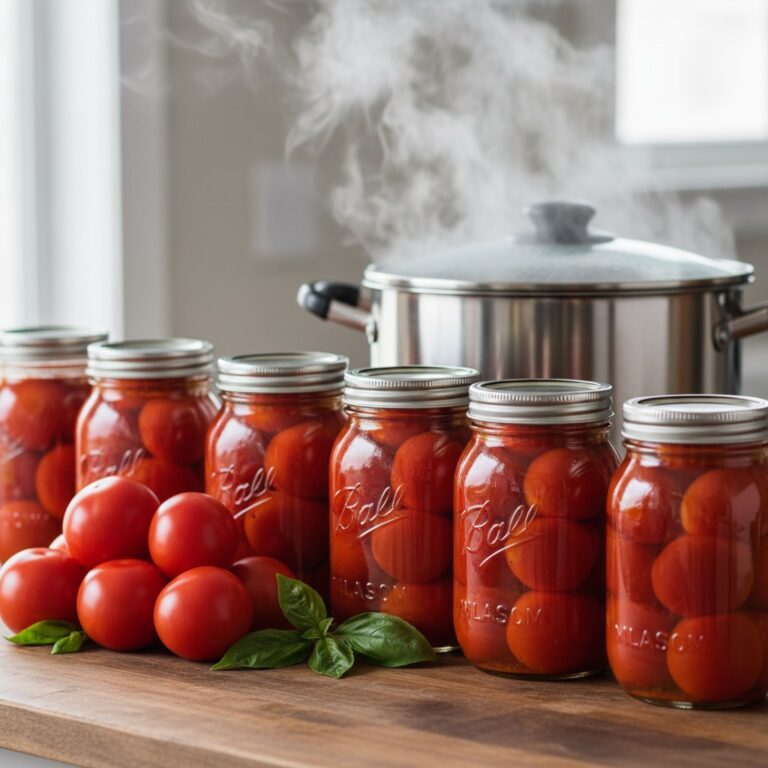
Canning Crushed Tomatoes: Step-by-Step Recipe with Processing Times
TL;DR: Canning crushed tomatoes is safe in a boiling-water canner when you add bottled lemon juice (or citric acid) to every jar and process at USDA-verified times: 35 minutes for pints, 45 minutes for quarts at 0–1,000 feet (NCHFP/UGA, 2015). Add 5 minutes for 1,001–3,000 ft, 10 minutes for 3,001–6,000 ft, and 15 minutes above 6,000 ft. A 22 lb box of paste tomatoes yields roughly seven quart jars, a pantry’s worth of sauce starter in one afternoon.
Key Takeaways
- Every jar needs acid: 1 Tbsp bottled lemon juice per pint, 2 Tbsp per quart (or ¼ / ½ tsp citric acid), per the 2015 USDA Complete Guide.
- Boiling-water processing times: 35 min pints, 45 min quarts at 0–1,000 ft, see the altitude chart below for higher elevations.
- Leave ½-inch headspace and use only bottled lemon juice (fresh lemons vary in acidity).
- Improperly home-canned foods are a common source of botulism in the US, follow tested recipes exactly (CDC).
Why can crushed tomatoes instead of whole or sauce?
Crushed tomatoes are the most versatile canned-tomato format a home pantry can stock. They break down into sauce, simmer into chili or soup, and stretch a pound of ground meat twice as far as diced tomatoes. If you can only pick one method, pick this one.
Compared to whole-packed or pureed styles, crushed tomatoes preserve more of the fruit’s natural pectin, which means thicker sauce with less reduction time at the stove six months from now. They’re also faster to process than sauce (no long simmer to thicken) and less fussy than whole-packed (no peeling needed if you work the skins through a food mill at the end).
If you want a walkthrough of all three methods side-by-side, whole, crushed, and pureed, see our full method overview. This guide goes deeper on just the crushed version.
What you need to can crushed tomatoes
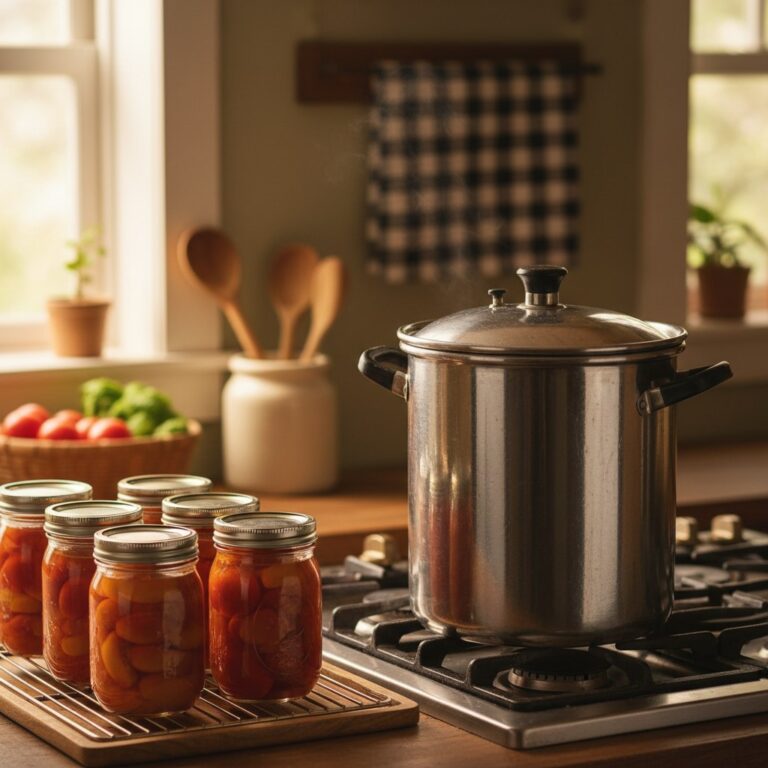
A 22-pound canner load yields about seven quart jars; 14 pounds yields about nine pints. A 53-lb bushel nets 17 to 20 quarts (NCHFP, 2015). Here’s the equipment checklist:
- Boiling-water canner with rack (or a stockpot deep enough for jars to be covered by 1 inch of water)
- Canning jars: quart or pint, Mason-style
- New two-piece lids (flats must be new every time; rings are reusable)
- Jar lifter, funnel, bubble remover/headspace tool, magnetic lid lifter
- Large stockpot for crushing/heating tomatoes
- Bottled lemon juice or citric acid, mandatory, not optional
- 22 lb paste tomatoes (Roma, San Marzano, Amish Paste) for best flavor, beefsteak types work but produce more liquid
One note on tomato variety: paste tomatoes have less water and more flesh, so the crushed texture is thicker straight out of the jar. Slicer tomatoes work, but expect an extra hour of drain time before packing if you want anything close to commercial “crushed” consistency.
How do you can crushed tomatoes step-by-step?
The USDA method is short and specific, deviating from it is the fastest way to wreck a batch. Here’s the sequence (NCHFP/UGA Complete Guide to Home Canning, 2015):
- Wash and blanch. Dunk tomatoes in boiling water for 30–60 seconds, then into ice water. Skins slip off. Remove cores.
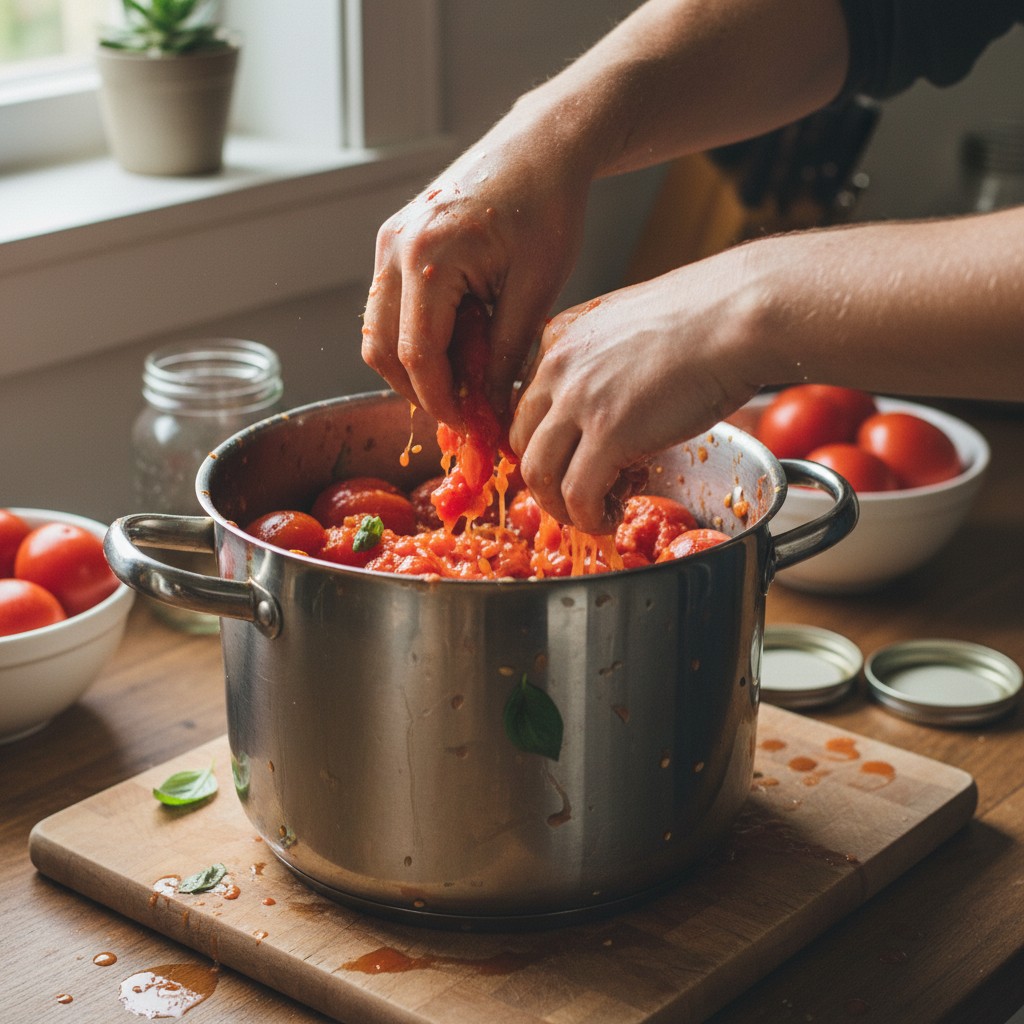
- Quarter and start crushing. Quarter about a sixth of your tomatoes and drop them into a large stockpot. Crush with a potato masher as you heat on medium-high. This is the critical moment, bring this first batch to a fast boil before adding any more.
- Add the rest, keep it boiling. Add the remaining quartered tomatoes a few handfuls at a time, stirring constantly. The pot must maintain a boil throughout. If you let it drop below boiling before all tomatoes are in, enzymes break down the pectin and you’ll end up with separated, watery jars.
- Boil 5 minutes after the last addition. No shorter.
- Add acid to each hot jar. For every pint: 1 Tbsp bottled lemon juice OR ¼ tsp citric acid. For every quart: 2 Tbsp bottled lemon juice OR ½ tsp citric acid. Sugar (1 tsp per quart) is optional to offset tartness.
- Pack hot. Ladle boiling crushed tomatoes into the jar, leaving ½-inch headspace. Run a bubble tool around the inside to release air pockets, then recheck headspace.
- Wipe, lid, ring. Wipe the rim with a damp cloth. Center the lid. Screw the ring on finger-tight.
- Process in boiling water. Lower jars onto the canner rack. Water must cover jars by 1 inch. When it returns to a rolling boil, start the timer, pints 35 min, quarts 45 min at sea level (see altitude chart below).
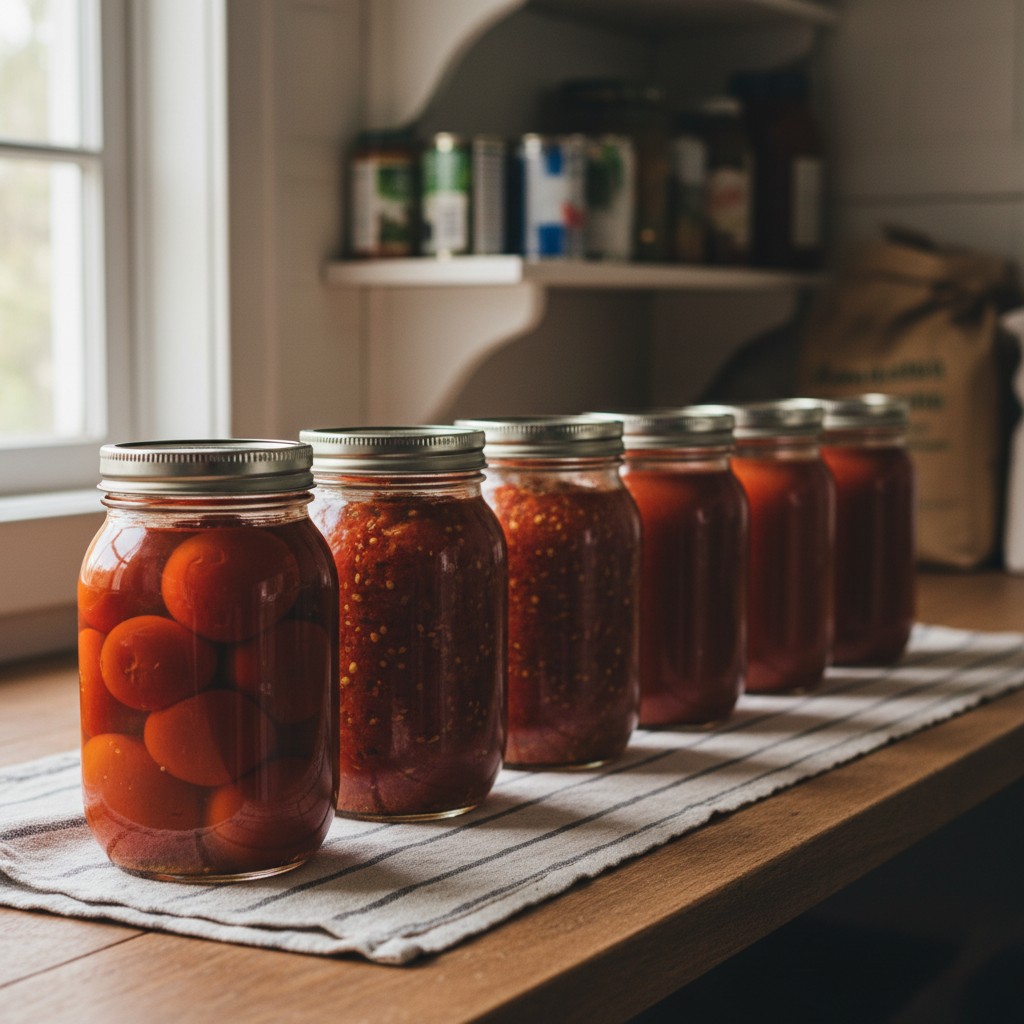
- Cool undisturbed 12–24 hours. Lift jars to a towel-lined counter. Don’t retighten rings. Listen for the "ping" as lids seal.
- Check seals. Press the center of each lid, it should be concave and not flex. Unsealed jars go straight to the fridge for immediate use.
What are the processing times at my altitude?
Processing times scale with altitude because water boils at a lower temperature as elevation rises. Under-processing at altitude is the single biggest safety risk in home canning, and it’s also the easiest mistake to avoid. Check your elevation online before you start, then match the chart below (NCHFP, 2015):
| Altitude | Pints | Quarts |
|---|---|---|
| 0 – 1,000 ft | 35 min | 45 min |
| 1,001 – 3,000 ft | 40 min | 50 min |
| 3,001 – 6,000 ft | 45 min | 55 min |
| Above 6,000 ft | 50 min | 60 min |
A shortcut that works anywhere in the continental US: pick the top of your altitude band, not the bottom. If you live at 1,800 ft, run the 3,001–6,000 column by accident and you’ve slightly over-processed, no harm done. Run the 0–1,000 column and you’ve under-processed, which is the one outcome you cannot fix.
Why is acidification non-negotiable?
Acidification is required for safe water-bath canning of tomatoes. NCHFP directs home canners to add bottled lemon juice or citric acid to every jar (NCHFP, 2015). The reason is pH: Clostridium botulinum spores cannot germinate below pH 4.6, but tomatoes sit near the boundary and vary by variety, so the added acid guarantees a safe jar. Improperly home-canned, preserved, or fermented foods are a common source of foodborne botulism in the US (CDC).
Added acid pushes every jar below 4.6 pH regardless of the specific tomato batch. Use bottled lemon juice, not fresh: bottled is standardized to 5.0% citric acid. Fresh lemons vary with variety and season, which is exactly the uncertainty we’re trying to remove. If you dislike the lemon flavor, citric acid is pH-neutral on the tongue, a ¼ teaspoon per pint disappears into the tomato entirely.
Do not substitute vinegar for lemon juice in this recipe. Vinegar works as a canning acid in other applications (pickles, salsas tested with vinegar), but crushed tomatoes are USDA-tested specifically with lemon juice or citric acid. Vinegar changes the flavor profile enough that the recipe is considered untested.
What are the most common mistakes?
- Skipping the first-batch boil. If you dump everything in the pot at once and bring the whole thing up to a boil slowly, enzymes separate the water from the solids and your jars liquefy. Always boil the first sixth before adding the rest.
- Using fresh lemon juice. Its acidity varies too much. Bottled only.
- Overpacking. Leave a full ½-inch headspace. Less, and the jar may not seal; more, and the vacuum is too weak.
- Not starting the timer when water returns to a boil. The clock starts when water is at a rolling boil with jars submerged, not when you lower the jars in.
- Retightening rings after processing. This can break the seal. Leave them alone for 24 hours, then remove them entirely for storage.
- Scaling up a tested recipe. Don’t double a batch without confirming the processing time still applies. Crushed tomatoes work as written; some recipes don’t.
How do you use canned crushed tomatoes?
A quart of crushed tomatoes is the starting point for almost every tomato-forward dinner: marinara simmered with garlic and basil, chili with beans and meat, minestrone, shakshuka, tomato soup, pizza sauce (reduced and seasoned), even curry. Open a jar, taste it first, if it’s noticeably tart from the added lemon, balance with a pinch of sugar or a splash of cream.
Pairs well with our homemade salsa recipe for the canned-salsa side of your pantry and our pressure canning guide for everything that needs a pressure canner instead (meats, beans, low-acid vegetables).
Frequently asked questions
Can I use a pressure canner instead of a boiling-water canner?
Yes. Pressure canning crushed tomatoes at 6 lbs pressure (weighted gauge) or 11 lbs (dial gauge) for 15 minutes is the USDA-approved alternative, you still add the same lemon juice or citric acid, but processing time drops from 35–45 minutes to 15. Worth the switch if you’re already pressure canning other foods the same day.
How long do home-canned crushed tomatoes last?
Stored in a cool, dark pantry (50–70°F), properly sealed jars stay at peak quality for about one year. NCHFP recommends canning no more than you’ll use within a year (NCHFP, 2015). Jars remain safe beyond that if the seal holds and storage stays below 95°F, but flavor, color, and texture degrade past the first year.
Do I have to peel the tomatoes first?
Yes. Skins are tough and concentrate pesticide residues even on organic fruit. The 30–60 second blanching step loosens them so they slip off with a finger. Skip peeling and you’ll get chewy strips in every jar, and possibly a less stable final pH if the skins contribute less acid than the flesh.
What’s the pH of home-canned crushed tomatoes?
With the USDA acidification (2 Tbsp bottled lemon juice per quart), finished crushed tomatoes measure around 4.1–4.3 pH, well below the 4.6 safety threshold for water-bath canning. If you skip acidification, modern cultivars often land at 4.4–4.8, which is inside the botulism risk zone.
Why can’t I substitute bottled lemon juice with fresh?
Bottled lemon juice is standardized to 5.0% citric acid; fresh lemons range from about 4.0% to 6.0% depending on variety, season, and ripeness. The USDA recipe is calibrated to the standardized product. Fresh juice is fine for flavor, but for the acid calculation that makes the jar safe, use bottled every time.
The bottom line
Canning crushed tomatoes is one of the fastest wins in a home-canning year: a 22-lb flat from the farmers’ market, a free afternoon, and you have seven quarts of the most versatile pantry staple you can make. The safety rules are strict but simple, bottled lemon juice or citric acid in every jar, ½-inch headspace, and processing times matched to your altitude. Follow them exactly and every jar lasts a year-plus in a cool pantry.
Ready to do more with your harvest? See the full method overview for whole and sauce variants, or start building a broader preservation pantry with our beginner water-bath canning guide.