How to Get Rid of Chicken Mites and Lice Naturally
Virginia Cooperative Extension reports that a northern fowl mite infestation can begin with a single adult female and reach peak loads of more than 100,000 mites per bird within four to five weeks. That math is why a quiet flock can turn into a crisis between two coop checks. The good news is that university research now backs a small set of natural tools, sulfur, food-grade diatomaceous earth, dust baths, and a strict re-treatment schedule, that clear infestations without resorting to permethrin or off-label ivermectin.
This guide walks you through identifying which parasite you have, setting up the dust bath that does the daily work for you, applying targeted treatment to badly infested birds, and breaking the egg cycle so the mites do not bounce back. If you have just inherited a sick flock, jump to the deep-clean step. If you are stocking the coop ahead of trouble, the prevention tips at the bottom matter most.
For broader flock care context, our backyard chicken health guide covers the wider picture of common backyard problems. New keepers should pair this article with our complete beginner’s guide to backyard chickens.
How Do You Know if Your Chickens Have Mites or Lice?
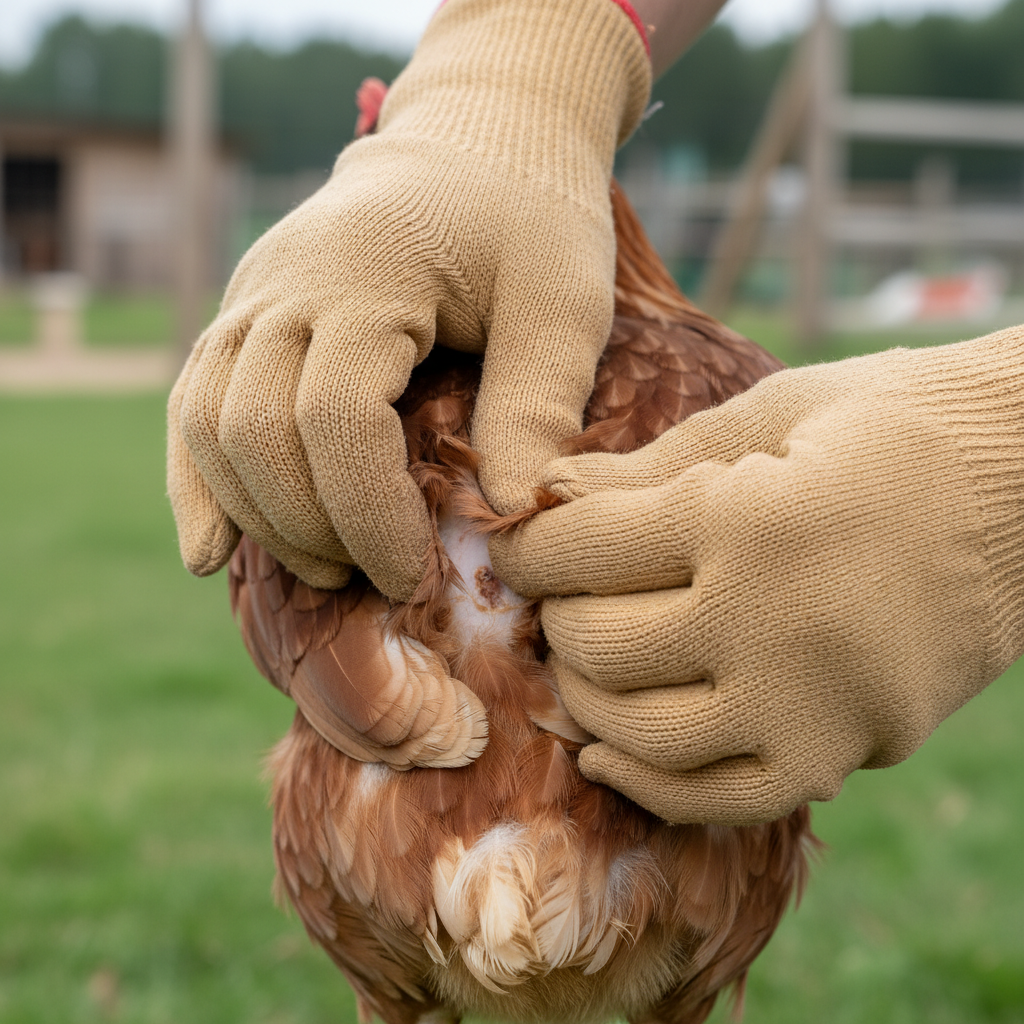
Look at the vent first. According to University of Kentucky Entomology, the clearest signs of mite or lice infestation are dirty-looking vent feathers, a pale comb, listlessness, dropped egg production, weight loss, feather-pulling, bald spots, and visible bugs or pale nits clumped at the base of feather shafts. Healthy hens are tidy around the rear; infested hens are not.
On our flock the first tell was a Buff Orpington who quit dust bathing and started squatting low when I reached under her. Lifting the tail feathers showed black, sticky residue around the vent. The University of Kentucky Entomology fact sheet on backyard chicken parasites describes this exact sign: “These dark red to black mites are most numerous around the vent (anal) area; feathers there become black with dried blood and mite excrement.” Catching it that early kept the spread to two birds out of fourteen.
Pale combs, pale wattles, and lethargy point to anemia from heavy blood loss. According to Virginia Cooperative Extension (APSC-190P), “at infestations of over 50,000 mites per bird, birds can lose 6 percent of their blood daily” — which is why a delayed response can kill weak birds.
What’s the Difference Between Chicken Mites and Lice?
Lice and mites are different enemies and demand slightly different tactics. The University of Kentucky Entomology fact sheet describes the chicken biting louse as having “six legs, a flat body, and wide head,” and notes lice “spend their entire life feeding and climbing around on the skin and feathers.” Mites, by contrast, are eight-legged arachnids; some species, such as the northern fowl mite, live full time on the bird, while red roost mites live in coop crevices and feed only at night.
That distinction changes where you treat. Lice and northern fowl mites require treating the bird itself, since killing only the coop will not clear them. Red roost mites require treating the coop hardware, every crack and roost end, because the bugs return to those hiding spots at dawn. A failed treatment is almost always the wrong target, not the wrong product.
| Trait | Poultry Lice | Northern Fowl Mite | Red Roost Mite |
|---|---|---|---|
| Legs | 6 | 8 | 8 |
| Color | Beige or straw | Dark gray to black | Gray, red after feeding |
| Lives on bird? | Yes, full time | Yes, full time | No, only at night |
| Treat | Bird | Bird | Coop and bird |
What Tools and Supplies Do You Need?
Gather everything before you handle a single hen. A treatment that stalls halfway through a flock leaves mites time to lay another generation. Tucci and colleagues (2008, Veterinary Parasitology) found the red mite egg-to-adult cycle compresses to about six days at 30 °C.
- Food-grade diatomaceous earth (less than 7 percent crystalline silica), 5 lb minimum
- Elemental sulfur dust (garden grade or wettable), 1 to 2 lb
- Coarse construction-grade sand, 20 lb
- Untreated hardwood ash (oak, maple, ash), 5 lb
- A shallow tub or galvanized pan for the dust bath, roughly 2 ft by 3 ft
- N95 or KN95 mask plus safety goggles
- Nitrile gloves
- A stiff-bristled brush, hot water, and dish soap
- Small muslin or gauze bags for sulfur dust bags
- A flashlight or headlamp for the night coop check
Skip permethrin-only routines. Entomology Today’s coverage of the 2016 sulfur dust-bag study (Murillo and Mullens, UC Riverside) reports that mite populations were resistant to permethrin in their trial, while sulfur cleared infestations to zero within two weeks. Sulfur has been used as a livestock parasiticide for centuries, with low acute mammalian toxicity (oral LD50 above 2,000 mg/kg). Sulfur is the natural backbone here, with diatomaceous earth as the supporting tool.
How Do You Inspect Chickens for Mites and Lice?
Inspect at dusk, when red roost mites climb out of the coop wood and onto birds to feed. Hold the hen in your lap, head tucked under your arm, and lift the feathers around the vent, under the wings, and at the base of the tail. Use a flashlight. Live mites scatter under direct light; live lice run sideways along the feather shaft.
The University of Kentucky Entomology fact sheet on backyard chicken parasites lists the classic vent-area cluster as the surest field diagnostic, alongside pale combs and dropped eggs. If you see crawling specks but no nits, you likely have red mites that boarded for a meal. If you see clumps of pale eggs glued to feather shafts, you have lice or northern fowl mites that breed on the bird.
Inspect every bird in the flock during one session. Skipping the calmest hens is how reinfestation starts. Mark the worst birds with a leg band so you can prioritize their treatments and watch them through the cycle.
How Do You Set Up a Natural Dust Bath That Kills Parasites?
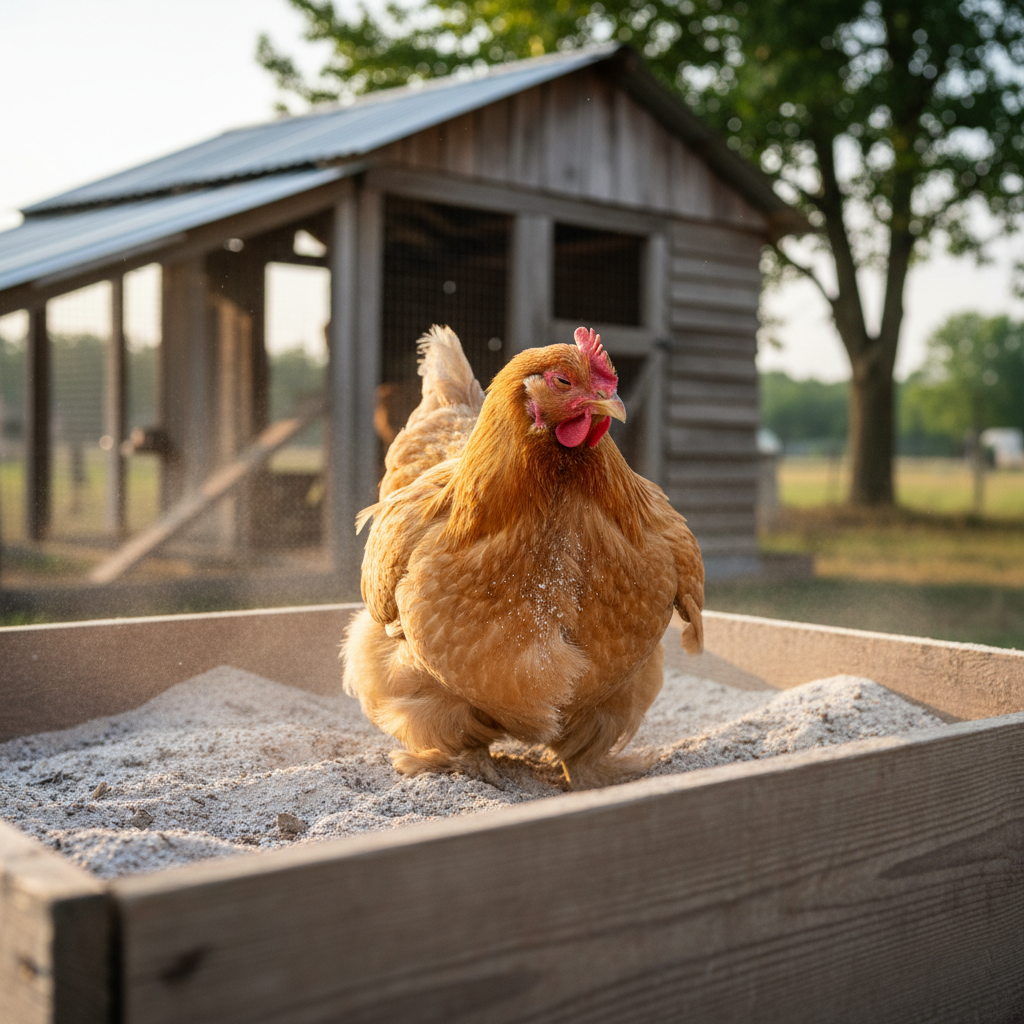
Fill a 2 by 3 foot tub with roughly 70 percent coarse construction sand and 30 percent dry topsoil, then top-dress with two cups of food-grade diatomaceous earth and one cup of hardwood ash mixed in. Oregon State University Extension confirms the principle directly: “Dust boxes with sand and acaricidal materials, such as inert dusts like diatomaceous earth or sulfur dust, are very effective for bird self-treatment of mites.”
Place the tub under cover so rain cannot wet it, since damp DE clumps and stops working. Refresh the top inch of dust every two weeks, or sooner if hens kick most of it out. Keep the dust bath in a low-traffic corner; chickens that feel watched dust bathe less, which means less self-treatment.
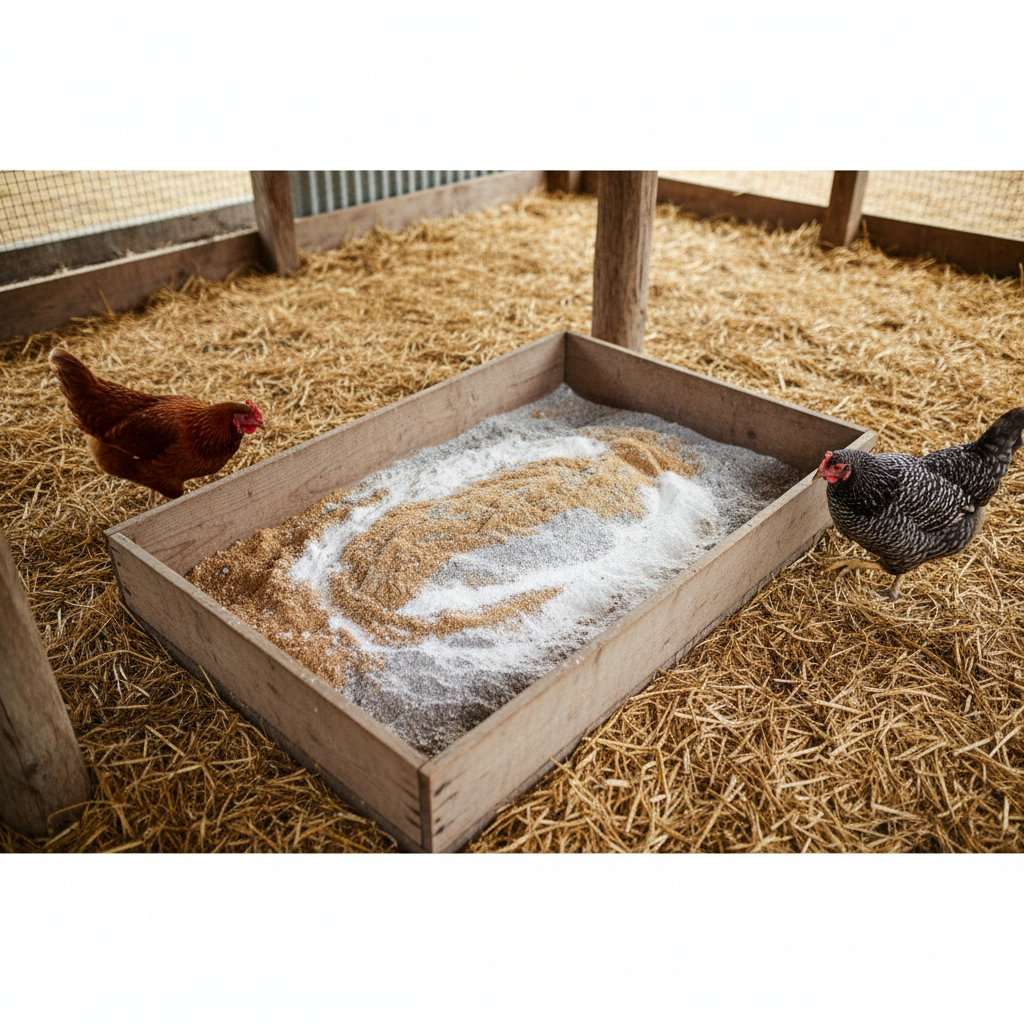
For new keepers building the run from scratch, our DIY chicken coop on a budget guide covers covered-run framing that protects the dust bath year-round.
How Do You Apply Diatomaceous Earth Safely?
Use only food-grade DE labeled as less than 7 percent crystalline silica, since respirable silica is the only real safety concern. Wear an N95 mask and goggles for application. A 2011 study published in Poultry Science (Bennett et al.) tested DE both as a feed supplement and as a dust treatment. Hens dusted with DE had a reduced number of mites compared with hens dusted with sand controls; in a separate part of the same study, hens fed dietary DE were significantly heavier and laid more eggs than control-fed hens. DE works mechanically, by absorbing the waxy outer cuticle of the parasite and causing death by desiccation.
To dust an individual hen, hold her on her back in your lap, fluff the feathers near the vent and under each wing, and shake DE down to skin level. Use about two tablespoons per hen. Avoid the eyes, beak, and nostrils. Brush it in with a gloved hand. Move methodically through the flock so no bird escapes the round.
DE does not penetrate eggs, which means a single application leaves the next mite generation alive. That is why DE is paired with the 7 to 10 day re-treatment schedule covered later.
How Do You Use Sulfur Dust to Eliminate an Active Infestation?
Sulfur is the most evidence-backed natural option for severe cases. A 2016 trial in the Journal of Economic Entomology (Murillo and Mullens) found sulfur in hanging dust bags reduced mites by 95-97 percent within one week of deployment, with mite counts reaching zero by two weeks post-treatment. A follow-up trial reported that a sulfur dust box “eliminated mites from all hens (including non-users) within 2-4 weeks, with residual sulphur controlling mites until the end of the experiment (up to 9 weeks).”
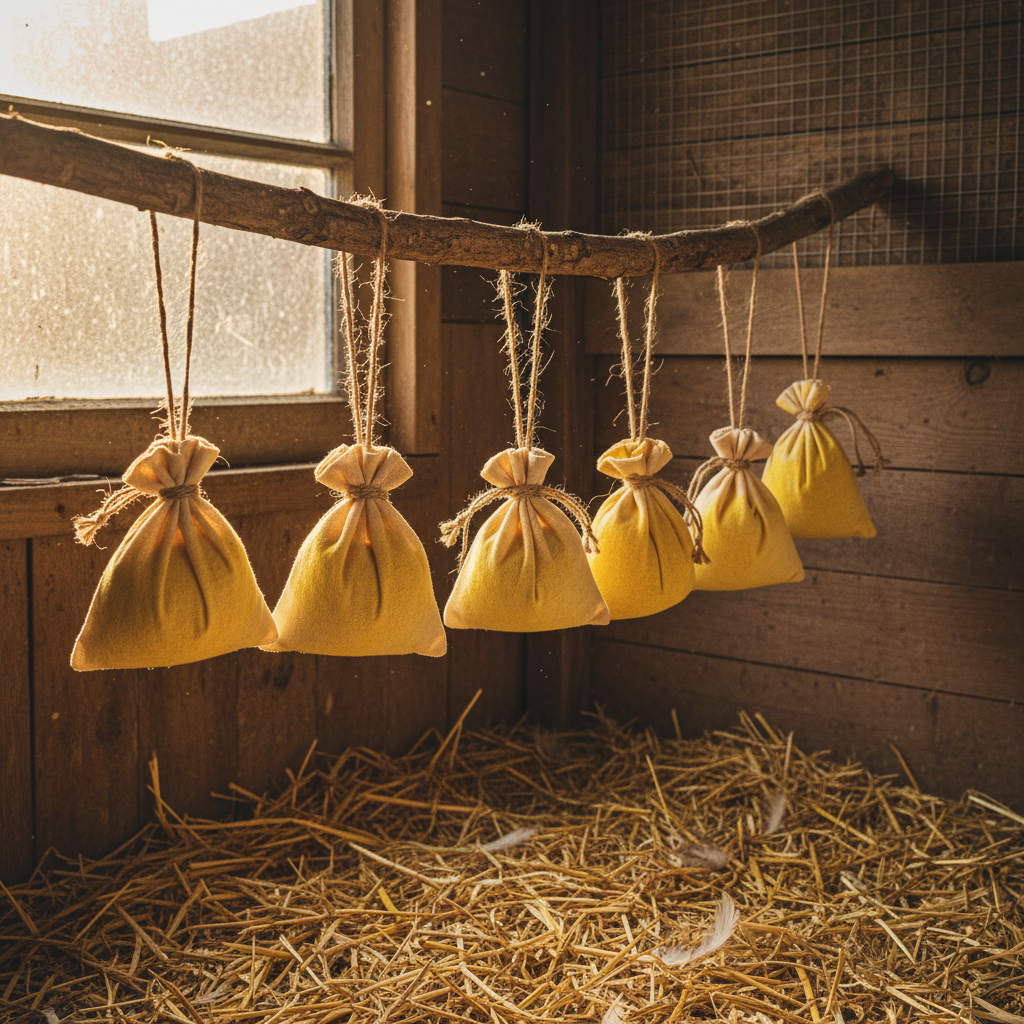
Apply elemental sulfur dust the same way as DE: about two tablespoons per hen, worked into vent, thigh, and underwing feathers, with mask and gloves on. For a hands-off backup, fill four to six small muslin bags with sulfur dust and hang them where birds brush against them, above the coop pop door, near the feeder, and over the roost ladder. Each bump shakes a small dose into their feathers.
Sulfur stains light feathers yellow for a few weeks. That is cosmetic, not harmful.
How Do You Deep-Clean an Infested Coop?
For red roost mites, the coop is the battlefield. Move the flock out for the day. Strip every scrap of bedding and burn it or seal it in a contractor bag for the trash. Scrub roosts, nest boxes, and every crack with hot soapy water; a stiff brush plus 130 °F water mechanically destroys mites and breaks the cuticle on eggs. Let surfaces dry fully in direct sun if possible, since UV speeds the kill.
Once the coop is dry, dust the seams of roosts, the underside of the perch bar, and the corners of nest boxes with food-grade DE or sulfur. The University of Florida IFAS publication on the chicken mite (Dermanyssus gallinae) emphasizes that red mites hide in tight crevices during the day and only emerge to feed at night, so the cracks are where you have to put the dust. Replace bedding only after the dust has settled for 24 hours.
Repeat the coop scrub in seven days. The first round kills adults; the second catches the freshly hatched nymphs from eggs you missed.
How Often Should You Re-Treat to Break the Mite Life Cycle?
Re-treat every 7 days, three times total, with no skipped sessions. The University of Kentucky Entomology fact sheet explains that “Development of either mite from egg to adult takes about 7 to 10 days under favorable conditions” and recommends to “check for live mites or lice in 7 to 10 days and make follow-up applications as needed.” Single-contact dusts kill adults but rarely penetrate eggs, so the second round catches the next hatch before it can lay.
According to Tucci, Prado and Araújo’s 2008 paper in Veterinary Parasitology, the red mite (Dermanyssus gallinae) can complete its life cycle in about six days (140 hours) at 30 °C, the optimal temperature for development. A 10 day gap risks letting the next generation breed before you treat again, especially in summer. Stick to the 7 day rhythm and mark the dates on a calendar near the coop. Three rounds covers the full egg-to-adult window.
| Day | Action | Why It Matters |
|---|---|---|
| 0 | Dust every bird, deep-clean coop | Kills adult mites and lice |
| 7 | Re-dust every bird, light coop scrub | Kills the first hatch from surviving eggs |
| 14 | Final dusting round | Catches stragglers and confirms the kill |
| 21 | Inspect; refresh dust bath | Confirms infestation is cleared |
What Common Mistakes Should You Avoid?
The single most common failure is stopping treatment after one round because the live mites disappear. They come back from the eggs every time. Mississippi State University Extension and Virginia Cooperative Extension both note that the egg-to-adult cycle can run as short as five days, which is why one round of dust never finishes the job.
Other costly mistakes worth naming:
- Using non-food-grade DE. Pool-filter DE has been heat-treated into crystalline silica and is unsafe to inhale. Always check the label.
- Wet diatomaceous earth. Damp DE is inert against parasites. Keep the dust bath under cover.
- Treating the coop and skipping the birds. Lice and northern fowl mites live entirely on the host; cleaning the coop will not touch them.
- Treating the birds and skipping the coop. Red roost mites live in cracks; dusting only the hen lets them recolonize that night.
- Garlic, apple cider vinegar, or essential oil only protocols. No university extension lists these as primary controls; they fail consistently in moderate-to-severe cases.
- Mixing sulfur with permethrin. Sulfur reacts with several synthetic pyrethroids and reduces efficacy; pick one route per cycle.
For broader flock-care prep, our DIY natural first aid kit walks through stocking the basics ahead of trouble.
What Are the Best Long-Term Prevention Tips?
Prevention is cheaper than treatment, and most of it is structural. Quarantine every new bird for 30 days before adding to the flock; Mississippi State University Extension notes that the northern fowl mite spends its entire life cycle on the host, feeding on blood throughout, which means a single infested newcomer is enough to seed an outbreak. Inspect quarantined birds at days 0, 7, 14, and 21 before clearing them.
Block wild bird access to the coop and run with quarter-inch hardware cloth on windows and vents. Wild sparrows and starlings carry northern fowl mites and red mites between properties. Keep the dust bath topped up with sand, ash, and a sprinkle of DE so hens self-treat year-round. Replace deep-litter bedding completely twice a year, and dust the bare floor with sulfur or DE before adding fresh shavings.
Healthier hens shake off light infestations faster. Heritage breeds with active foraging instincts dust bathe more, which is one reason our heritage breed chickens guide is worth a read for keepers planning a low-input flock.
Frequently Asked Questions
Does diatomaceous earth really kill chicken mites?
Yes, when applied dry and at skin level. A peer-reviewed study in Poultry Science found hens dusted with diatomaceous earth had significantly fewer mites and gained more weight than sand-dusted controls. DE kills by absorbing the waxy cuticle of the parasite and causing desiccation. It does not kill eggs, so you must repeat at 7 day intervals.
Is sulfur dust safe for laying hens?
Elemental sulfur has been used as a livestock parasiticide for centuries, with low acute mammalian toxicity (oral LD50 above 2,000 mg/kg). Eggs from treated hens remain safe to eat. Wear a mask during application to avoid respiratory irritation, and keep sulfur dust off direct food and water surfaces.
How long does it take to get rid of chicken mites naturally?
Three to four weeks for a moderate infestation, when you follow the 7 day re-treatment cycle. Sulfur trials in the Journal of Economic Entomology (Murillo and Mullens 2016) showed mite numbers drop to low levels within one week and reach zero by two weeks. Severe infestations with anemia signs can take longer and may need a veterinarian’s input.
Can chicken mites bite humans?
Red roost mites (Dermanyssus gallinae) will bite people if their preferred chicken host is unavailable, leaving itchy welts on the arms and torso. They cannot complete their life cycle on humans, so the bites stop once the coop is treated. Northern fowl mites and poultry lice rarely bite humans.
What is the fastest natural treatment for a severe mite infestation?
Sulfur dust applied to every hen on day 0, paired with a deep coop scrub and sulfur dusting in the cracks. The 2016 UC Riverside sulfur dust-bag study (Murillo and Mullens) reported infestations reduced by 95-97 percent in one week. Repeat at days 7 and 14 to break the egg cycle. For very heavy loads with weak birds, talk to your vet about supportive care.
Should I use ivermectin or permethrin instead of natural treatments?
Ivermectin is not labeled for poultry in the United States and requires a veterinarian’s prescription. Permethrin works but resistance is increasing, and Entomology Today notes that “an increasing number of mite populations are becoming resistant to permethrin, while sulfur is still a novel treatment.” For most backyard flocks, the natural sulfur and DE protocol clears infestations without resistance concerns.