Elderberry: How to Forage, Grow, and Turn the Berries Into Immune Syrup
Elderberry: How to Forage, Grow, and Turn the Berries Into Immune Syrup
One cluster of wild elderberry can weigh more than a pound, drip dark juice the moment you bend the stem, and stock a homestead first-aid shelf for next winter in a single August afternoon. That triple payoff (foraged food, homegrown medicine, pollinator habitat) is why elderberry shows up on so many homestead wish lists.
This guide covers field identification (without confusing elderberry for the deadly look-alikes that share its habitat), cultivar choice and planting for reliable harvests, and the cooking step that turns raw berries into shelf-stable immune syrup. After three seasons of running a small elderberry hedge on our property in zone 6b, I’ll share which cultivars actually pollinated each other and the syrup recipe I now make every September.
Two warnings first. Raw elderberries, leaves, stems, and unripe berries all contain cyanogenic glycosides that release cyanide during digestion; cooking destroys the toxin in the berries, but green plant parts never belong in your syrup pot. And elderberry’s closest field look-alike, water hemlock, is the most poisonous plant in North America. Both points are covered in detail below.
Where and When Can You Forage Wild Elderberry?
American elderberry grows wild across most of the eastern and central United States, ripening dark purple in late summer along sunny edges where soils stay damp. According to North Carolina State Extension, Sambucus canadensis is “a woody, deciduous shrub or small tree that is native to North, Central and South America” and “can be found in all areas of North Carolina along streams, marshes, moist forests, and disturbed areas.” That description holds for most of its native range: roadside ditches, fence lines, river bottoms, abandoned pastures, and the sunny margin between woods and field.
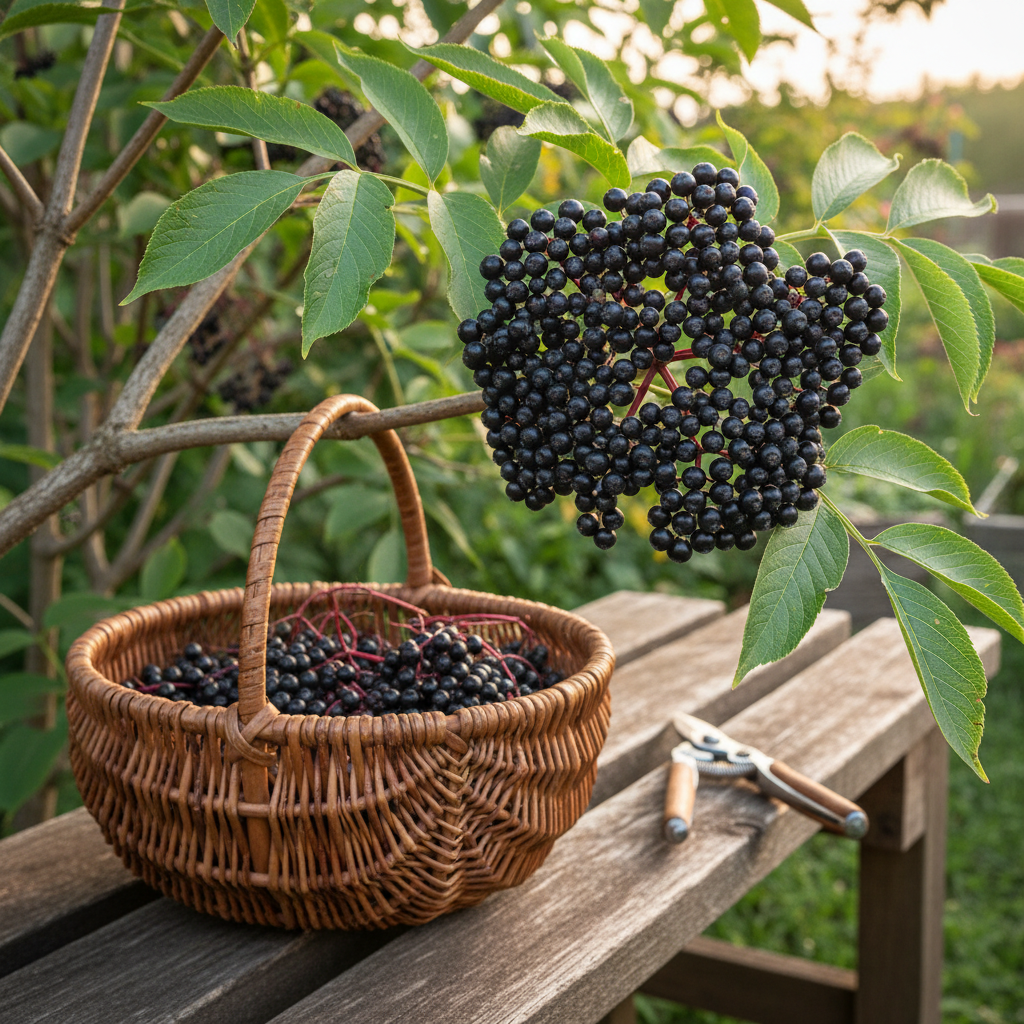
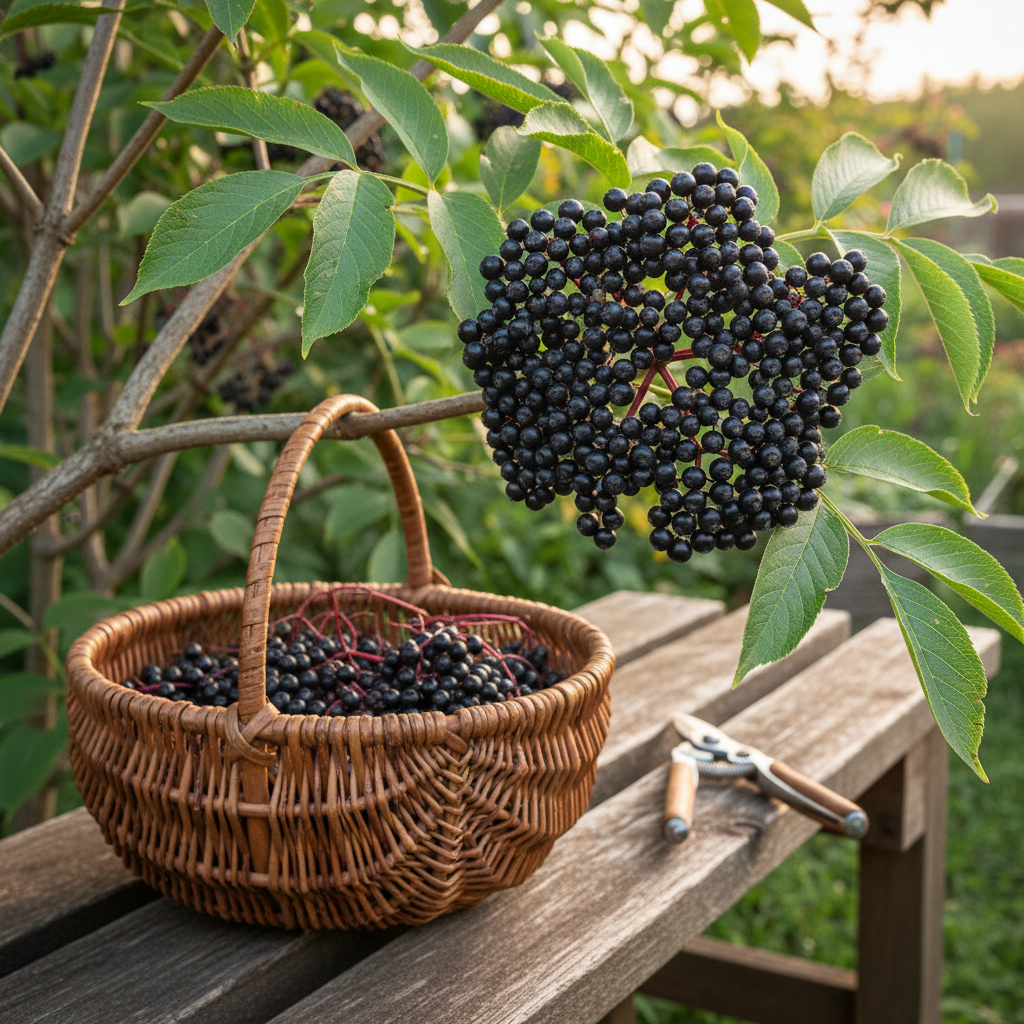
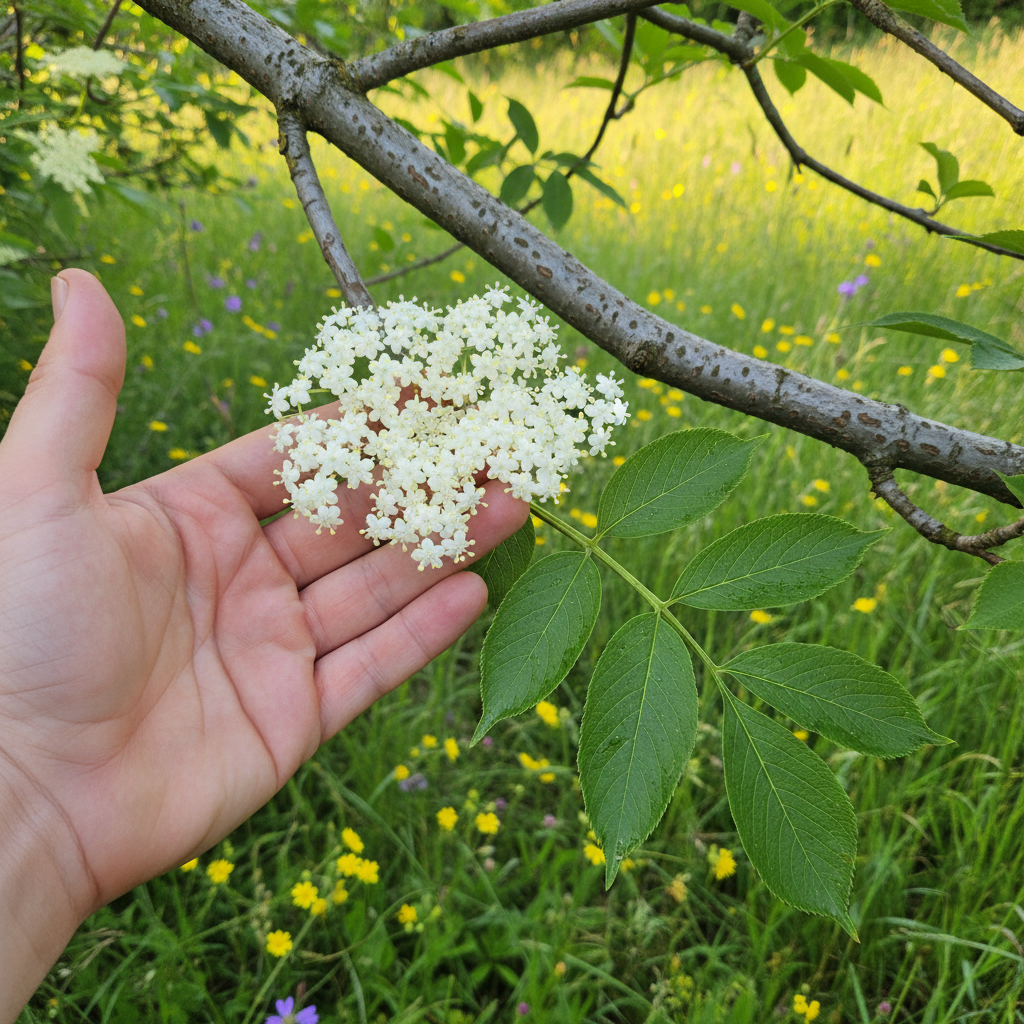
Two windows matter for foragers. Flowers open in flat, creamy white cymes from mid-June through mid-July, and the berries ripen dark purple to nearly black from mid-August through September across most of the country, according to University of New Hampshire Extension. Bring a tall basket, gloves (the purple stains everything), and pruners to clip whole clusters at the stem rather than picking individual berries.
How Do You Tell Elderberry From Water Hemlock and Pokeweed?
Three field cues separate edible elderberry from its dangerous look-alikes: woody bark, leaf arrangement, and the shape of the berry cluster. Oregon State University Extension warns that “elderberry fruit is edible, while the entire water hemlock is deadly,” and that water hemlock is often called “the most deadly plant in North America.” Confusing the two is the single highest-stakes mistake a beginning forager can make, and it usually happens in spring when both plants are leafing out and neither shows fruit yet.
The most reliable cue is bark. Mature elderberry is a woody perennial with grey, lenticel-dotted bark on stems and trunks. Oregon State Extension notes that “water hemlock… will never have true woody stems or bark.” If you cannot find bark on the lower stem, do not harvest. Leaf arrangement gives a second confirmation: elderberry has pinnate compound leaves with wider, opposite leaflets, while water hemlock has tripinnate leaves with narrower, alternate leaflets.
Pokeweed: the other purple-berry impostor
Pokeweed (Phytolacca americana) is the second look-alike worth memorizing, and the giveaway is cluster shape. Per Oregon State Extension, “pokeberries grow in a line called a ‘raceme’ whereas elderberries grow as a broad cluster called a ‘cyme.’ Pokeberry is an herbaceous perennial, so it never has bark.” Pokeweed berries hang in a vertical chain along a magenta stalk. Elderberries fan out in a flat-topped umbrella. If your cluster looks like a string of beads rather than a plate, walk away.
Should You Grow Elderberry at Home?
For most homesteads in USDA zones 3 through 9, the answer is yes. Two named cultivars in your own yard outproduce hours of foraging and let you control whether the bushes are sprayed. University of Tennessee Extension confirms that “elderberry can be grown in zone 3-9,” covering nearly the entire continental United States outside south Florida and the hottest deserts. The plants tolerate damp, heavy ground few other fruiting shrubs handle, fruit within two to three years from a bare-root start, and pull double duty as pollinator habitat when the June flowers open.
The catch is space and pollination. A mature elderberry can reach eight to twelve feet tall and as wide, and although the plants are partially self-fruitful, West Virginia University Extension reports that “fruit yields have been observed to be enhanced by cross pollination, so it is highly advisable to plant at least two cultivars within 60 feet of each other.” One bush gives you a backyard ornamental. Two cultivars give you reliable syrup-making volume.
Which cultivars cross-pollinate best?
According to West Virginia University Extension, “the Adams, York, Nova, and Johns cultivars were introduced several decades ago by the New York Agricultural Experiment Station and Agri-Food Canada in Nova Scotia.” York is a 1964 hybrid of Ezyoff and Adams No. 2 that “tolerates cold well and is suitable for growing in zones 4 through 8.” Nova is “an open-pollinated seedling of Adams No. 2, selected in 1946 and released by the AgCanada Research Station in Kentville, Nova Scotia, in 1959.” Pairing Adams with York is the most common starting combination; adding Nova or the newer Bob Gordon stretches the harvest window by two to three weeks.
How Do You Plant and Care for Elderberry Bushes?
Plant bare-root elderberry cuttings in early spring while the canes are still dormant, spacing two cultivars within sixty feet for cross-pollination. North Carolina State Extension notes American elderberry “tolerates a wide variety of wet to dry soils but prefers rich, moist, slightly acidic soil in sun to partial shade.” Aim for at least six hours of direct sun, dig the hole twice as wide as the root ball, and set the crown at the same depth it grew in the nursery pot.
Water deeply through the first season. Elderberry is shallow-rooted and wilts fast in droughty weather, so mulch three inches deep with shredded hardwood to hold moisture and suppress weeds. Skip fertilizer in year one; a top dressing of compost in spring of year two is plenty. Plants begin fruiting in their second or third year and hit full production around year four.
Pruning, pests, and the cane-renewal cycle
Each elderberry cane lives roughly three years, so pruning is about constant renewal rather than precise shaping. In late winter while dormant, cut any cane older than three years at ground level, leaving a roughly equal mix of one-, two-, and three-year canes. New canes fountain up from the crown each spring. Birds will take a share once berries color up, so plan to net the bushes or accept the share-out as a fair trade for pollinator service. On our place I net two of three bushes and leave the third for cedar waxwings, which keeps most of the harvest intact.
When Are Elderberries Ready to Harvest?
Ripe elderberries are deep purple-black with a powdery bluish bloom, hang heavy enough to bow the cluster downward, and detach with gentle pressure. UC Agriculture and Natural Resources notes that “when the berries develop a white, dusty bloom, this is an indicator that the berries are ripe. As they continue to ripen on the tree, the white bloom will fade and the berries will change to a dark blue-black color.” A single cluster ripens unevenly, which is why most growers harvest whole clusters at the stem and process at home.
Cut clusters with pruners, drop them stem-up into a wide basket, and refrigerate within two hours if the day is hot. UC ANR’s recommended method: “the easiest way to harvest the fruit is to clip the entire berry cluster from the shrub, and then gently remove the berries from the cluster.” The fastest stripping method is to chill the cluster overnight, then run a dinner fork down the stem over a bowl. Freezing the cluster makes the berries pop free with even less effort.
How much should one bush yield?
A mature, well-pollinated cultivar produces roughly eight to twelve pounds of berries per year, with standout plants topping fifteen pounds. Translate that into syrup: one pound of fresh berries yields about a pint and a half of finished honey syrup at a 1:1 ratio, so two bushes are usually enough to cover a family’s winter immune kit with extra to gift. Strip the berries off the stems before weighing, since stems alone can account for a quarter of cluster weight.
Why Must You Cook Elderberries Before You Eat Them?
Raw elderberries, leaves, stems, and unripe green berries contain cyanogenic glycosides that release cyanide in the gut, and cooking is the only practical way to make the berries safe. Oregon State University Extension states plainly that “eating raw elderberries or drinking raw elderberry juice can cause nausea, and in some instances has led to serious illness and hospitalization. Cyanogenic glycosides are naturally occurring plant molecules… During digestion, these compounds release cyanide, which goes into the bloodstream and prevents proper oxygen utilization.” That is documented chemistry, not folk caution.
The case to remember happened in 1983. According to the CDC’s Morbidity and Mortality Weekly Report, eight people in Monterey County, California were airlifted to a hospital after drinking homemade juice “made using wild elderberries crushed with their leaves and branches.” Symptoms started within fifteen minutes: nausea, vomiting, abdominal cramps, dizziness, numbness, and in one case stupor requiring hospitalization. Two lessons: never include leaves or stems in any preparation, and never serve elderberry juice raw.
What cooking actually does to the toxin
Heat breaks down sambunigrin, the cyanogenic glycoside concentrated in elderberry seeds, leaves, and stems. Oregon State Extension confirms that “elderberry leaves, stems, and seeds contain a cyanogenic glycoside called sambunigrin” and that “cooking the berries destroys the toxins in the seeds.” A peer-reviewed analysis reported fruit-tissue cyanogenic glycoside levels in American elderberry ranging “between 0.12 and 6.38 µg/g,” with seeds the highest. The University of Maine Cooperative Extension protocol resolves it: “bring to a boil, then reduce the heat and simmer until the liquid is reduced by about half.” Skip the warm-honey-only recipes you see on social media.
How Do You Make Elderberry Syrup at Home?
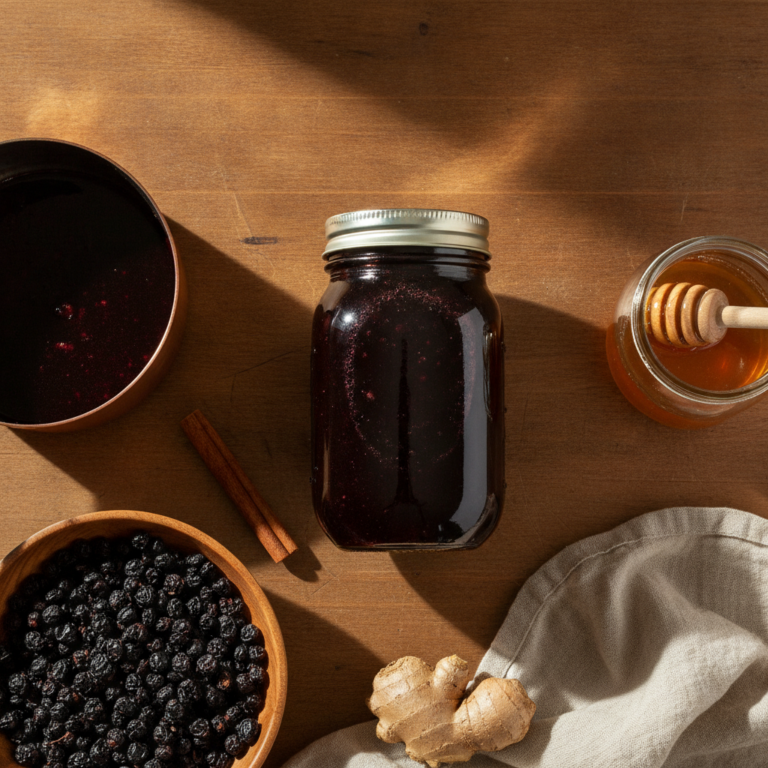
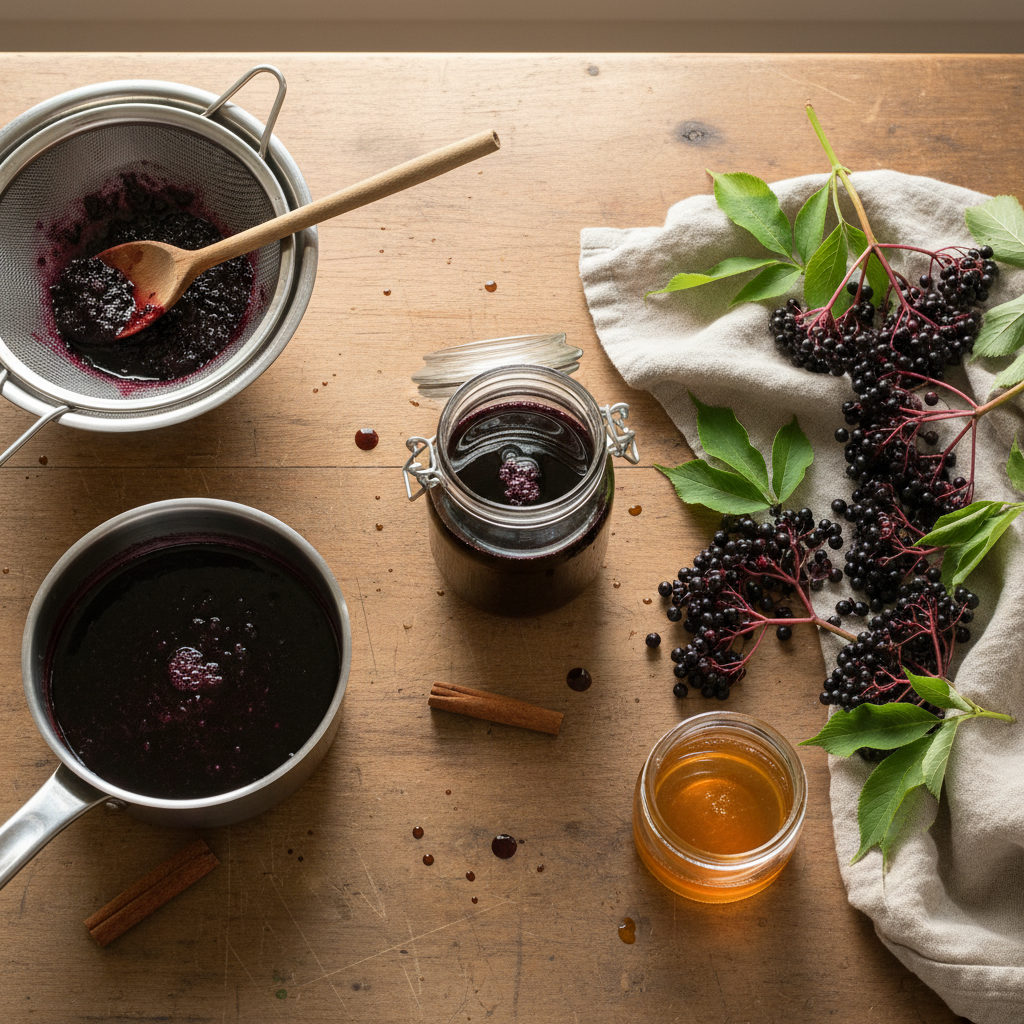
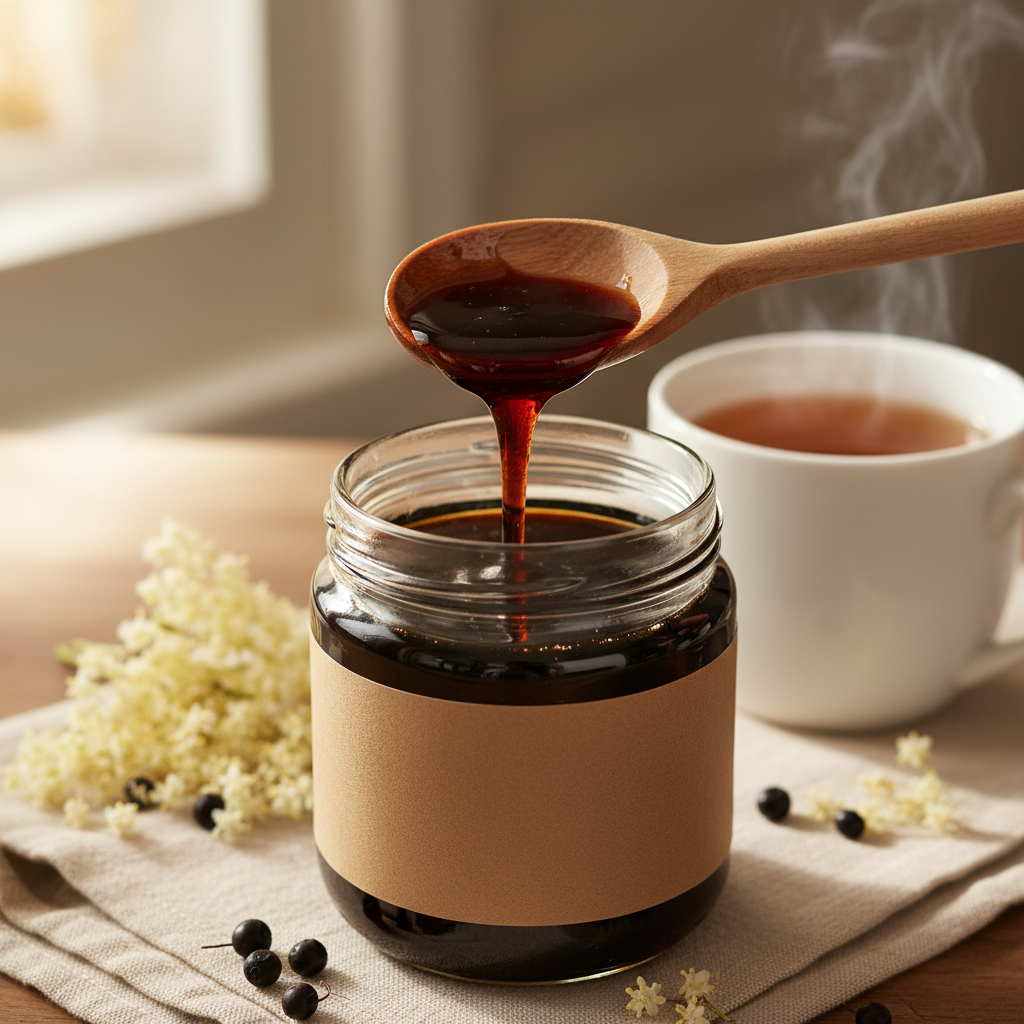
The classic homestead recipe is a 1:1 cooked elderberry juice and honey blend. Plan on 2 weeks in the refrigerator, which is University of Maine Extension’s figure and a good deal shorter than the two or three months repeated on remedy blogs. Raw honey is antimicrobial, but it does not drop the pH of the juice far enough to make the syrup shelf stable, so freeze what you will not use inside a fortnight. Strip one pound of ripe berries off the stems, combine with four cups of water plus optional aromatics (cinnamon, ginger, cloves, a strip of orange peel), and bring to a boil. The University of Maine Cooperative Extension method then says to “reduce the heat and simmer until the liquid is reduced by about half.” Crush the berries against the pan as they soften, strain through fine mesh while hot, and let the juice cool below 115 degrees Fahrenheit before stirring in an equal volume of raw honey.
Sterilize your storage jar first. UMaine Extension instructs: “sterilize a glass pint or quart jar by boiling the jar, fully submerged in water, for 10 minutes.” Pour the cooled syrup into the sterile jar, cap, label with the date, and refrigerate. An adult short-term immune dose runs about a tablespoon up to four times daily; a child’s dose drops to a teaspoon. For a deeper home-medicine setup, see our DIY natural first aid kit and homemade herbal tea blends.
Honey syrup or vinegar tincture: which keeps longer?
The two main preservation routes push shelf life in different directions. A honey syrup tastes good enough that kids take it without complaint, but it stays in the refrigerator. A vinegar oxymel or alcohol tincture trades flavor for room-temperature stability. The table below compares them so you can pick the route that fits your storage and use case.
| Preservation method | Typical ratio | Shelf life (refrigerated) | Shelf life (room temp) | Best for |
|---|---|---|---|---|
| Honey syrup | 1 cup juice : 1 cup honey | 2 weeks (8 months frozen) | Not recommended | Daily family use; kids over age 1 |
| Apple cider vinegar oxymel | 1 juice : 1 vinegar : 1 honey | 6 to 12 months | 3 to 6 months | Sour palates, long-term pantry |
| Alcohol tincture | 1 berry : 2 parts 80-proof spirit | Not needed | 2 to 5 years | Adults only, shelf-stable |
| Frozen syrup cubes | 1:1 juice:honey, ice cube trays | N/A | 6 to 12 months (freezer) | Bulk harvest batches |
Does Elderberry Syrup Actually Boost Immunity?
Three randomized clinical trials and one systematic review show modest but real benefits for cold and flu duration, though the evidence base is small and outcomes are self-reported. The most cited study is the 2004 Zakay-Rones randomized double-blind placebo-controlled trial. According to that paper, “patients received 15 ml of elderberry or placebo syrup four times a day for 5 days… Symptoms were relieved on average 4 days earlier and use of rescue medication was significantly less in those receiving elderberry extract compared with placebo.” A 4-day reduction is meaningful when most influenza runs 7 to 10 days.
A 2016 randomized trial of 312 economy-class air travelers found that the supplemented group reported shorter cold duration and milder symptoms. A 2021 systematic review pulling together five trials concluded that “elderberry may reduce the duration and severity of colds, but the evidence is uncertain; it may reduce the duration of influenza but the evidence is uncertain.” Treat that as cautious encouragement, not a guarantee. The biochemistry backs it: a peer-reviewed analysis reported “an ORAC value of 100 g fresh elderberry being 10775 TE (Trolox equivalents), whereas it is only 5562 TE for blueberry,” putting elderberries among the highest-antioxidant edible berries. For a broader herbal apothecary, see our guide to growing a medicinal herb garden.
What Mistakes Should You Avoid With Elderberry?
Most elderberry problems trace back to four avoidable mistakes: harvesting unripe red berries, including stems or leaves in the cooking pot, skipping the simmer step, and assuming all elderberry species are interchangeable. Penn State Extension stresses that “elderberries must not be consumed raw,” yet every cold-and-flu season social media fills with raw smoothie recipes that violate this rule. The cooking step is not optional.
Two species-level warnings round out the list. Red elderberry (Sambucus racemosa) has higher toxin levels than the black Sambucus canadensis and Sambucus nigra most homesteaders grow; many extension services recommend avoiding it for syrup-making. And while ripe black elderberry seeds become safe after a full simmer, mature elderberry leaves and bark retain toxins regardless of cooking time. Strip the berries carefully and discard every leaf, stem, and green berry before the pot heats up. For more on safely identifying wild edibles, see our spring foraging guide and our piece on foraging dandelions.
Frequently Asked Questions
Can you eat elderberries raw if they are fully ripe?
No. Even fully ripe black elderberries contain cyanogenic glycosides in the seeds that release cyanide during digestion. Oregon State Extension is explicit that “elderberries must not be consumed raw,” and the 1983 CDC-documented poisoning case in California involved fresh wild berries. Always simmer elderberries before eating them or pressing for syrup. Cooked seeds are safe; raw seeds are not.
How long does homemade elderberry syrup last in the refrigerator?
Two weeks in a sterilized glass jar. That is University of Maine Extension’s guidance, and it is much shorter than the two to three months you will see quoted elsewhere. For anything beyond that, freeze it — up to 8 months — which is what the ice-cube-tray trick is really for. A splash of brandy is sometimes said to buy months in the refrigerator, but a quarter cup of 80-proof spirit per cup of syrup works out near 8 percent alcohol, and preservation by alcohol takes roughly 20 to 25 percent, so do not count on it. Vinegar oxymels last six to twelve months refrigerated; alcohol tinctures keep two to five years at room temperature.
Can children take elderberry syrup?
Yes for children over one year of age, with a smaller dose. A typical pediatric short-term immune-support dose is one teaspoon up to four times daily; adults take one tablespoon. Honey is not safe for infants under twelve months because of botulism risk, so syrup must be kept away from babies. Check with your pediatrician before use.
Which elderberry cultivars produce the best harvest in my zone?
For USDA zones 3 through 8, Adams paired with York is the most reliable cross-pollinating combination, with Nova as a partially self-fruitful backup for smaller yards. West Virginia University Extension confirms York “tolerates cold well and is suitable for growing in zones 4 through 8.” Bob Gordon, a newer cultivar with downward-facing clusters that resist bird damage, extends harvest by two to three weeks.
What does water hemlock look like compared to elderberry?
Water hemlock has hollow, ridged, herbaceous stems that die back every fall and never form true bark, while mature elderberry has woody, grey, lenticel-dotted bark. Per Oregon State Extension, water hemlock “will never have true woody stems or bark.” Elderberry leaves are pinnate with opposite, wider leaflets; water hemlock leaves are tripinnate with narrower, alternate leaflets. If a suspected elderberry has no bark, do not harvest it.
Can I substitute store-bought dried elderberries for fresh in a syrup recipe?
Yes. Use roughly half a cup of dried berries for every pound of fresh, and add an extra cup of water to rehydrate them. The full boil-then-simmer protocol still applies, since drying alone does not destroy cyanogenic glycosides. Source from a supplier that specifies Sambucus nigra or Sambucus canadensis (not red Sambucus racemosa) and discard any visible stems before cooking.
Bringing It Home
Elderberry rewards homesteaders who take the safety steps seriously. Identify the woody bark and flat cyme clusters before you ever harvest, cook every berry that goes into your jars, and pair two cultivars within sixty feet for a yearly winter syrup stash. The plants are forgiving once established, fruit in two to three years, and feed pollinators in June, then your family in August.
If you only do three things from this guide: rule out water hemlock before any wild harvest, simmer your juice until reduced by half before adding honey, and keep the green parts of the plant out of every preparation. For more home-medicine projects, our homemade herbal salves and balms beginner guide picks up where syrup leaves off.