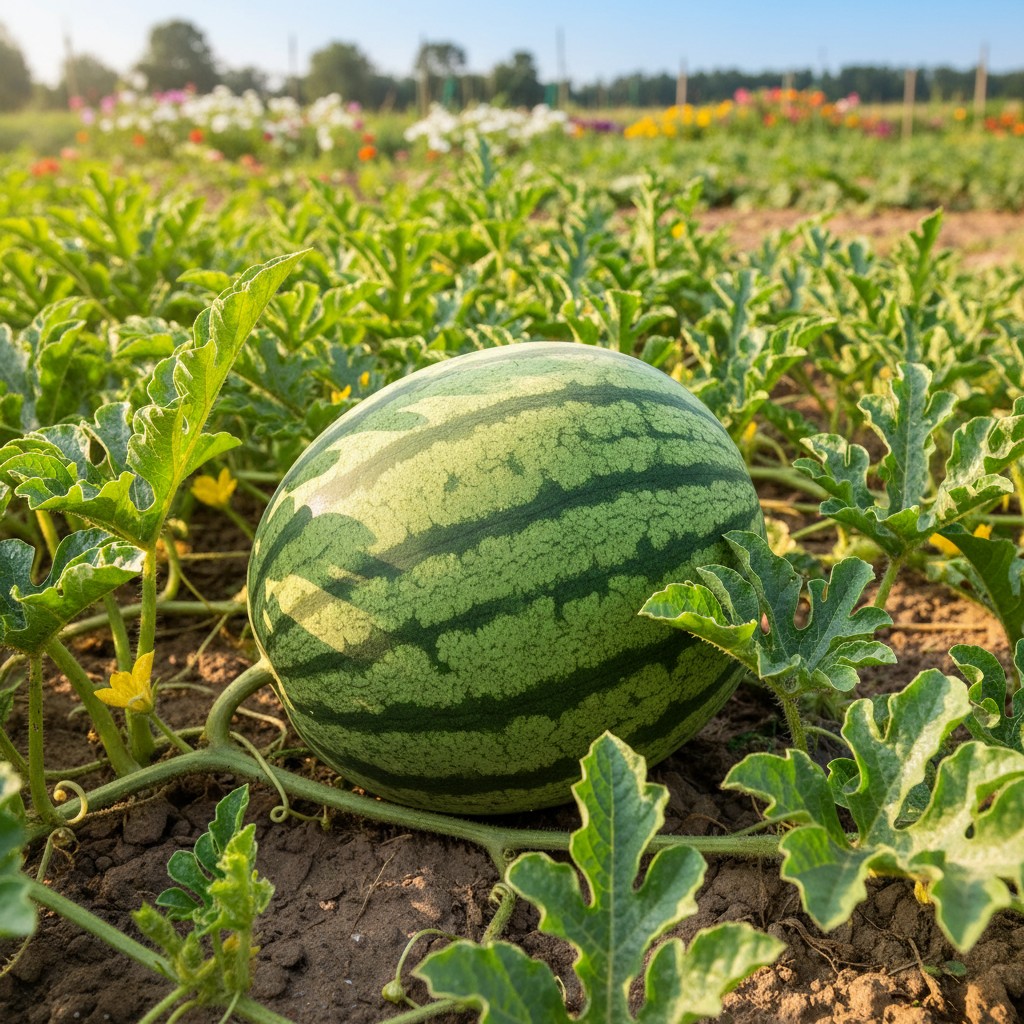
Large ripe watermelon on the vine in a sunny garden with lush green foliage

How to Grow Watermelon in Your Backyard

Key Takeaways

  • Watermelons need heat (soil temps above 70°F), space (each plant needs 20–30 square feet), and a long growing season of 70–90 days depending on variety.
  • Compact varieties like Sugar Baby and Bush Sugar Baby make backyard growing realistic even in smaller gardens.
  • Pollination requires bees and both male and female flowers — poor pollination is the most common cause of misshapen or absent fruit.
  • Reduce watering once fruit is sizing up to concentrate sugars. Overwatering at this stage produces bland, watery melons.
  • Check ripeness using three signs together: a dried tendril nearest the fruit, a creamy-yellow ground spot, and a hollow thump sound when tapped.

Growing your own watermelon feels like a small act of summer magic. There’s nothing at the grocery store that comes close to a sun-warmed melon picked at peak ripeness from your own backyard. Store-bought watermelons are bred for shipping durability, not flavor. Homegrown melons are bred for your mouth.

But watermelons have a reputation for being demanding, and they do need more from a garden than most crops. They want heat, they want space, and they want time. If you can give them those three things, the rewards are spectacular. Let me show you how to make it happen.

Choosing the Right Variety for Your Space

Variety choice might be the most important decision you make. The sprawling 30-pound picnic melons are thrilling, but they need serious real estate and a long, hot summer. Be honest about your space and your climate.

For Small to Medium Gardens

  • Sugar Baby — The classic small watermelon, producing 8–12 pound round fruits with dark green rind and deep red, sweet flesh. Matures in about 75–80 days. This is the variety I recommend for most backyard growers. It’s been a proven performer since the 1950s.
  • Bush Sugar Baby — A more compact version of Sugar Baby with shorter vines (3–4 feet instead of 6–8). Slightly smaller fruit but perfect for tight spaces.
  • Cal Sweet Bush — Compact vines with surprisingly large fruit (10–12 pounds). A good compromise between bush habit and full-size fruit.

For Larger Gardens and Hot Climates

  • Crimson Sweet — A widely adapted variety producing 20–25 pound melons with the classic striped rind. Excellent disease resistance. Needs 85–90 days.
  • Charleston Gray — Produces large, oblong melons up to 35 pounds. Outstanding in southern heat. The thick rind makes it great for pickling.
  • Moon and Stars — A gorgeous heirloom with dark green rind speckled with yellow “stars” and one large yellow “moon.” Produces large, exceptionally sweet melons. An absolute showpiece in the garden.

For Short Seasons

  • Blacktail Mountain — Developed in Idaho at 5,000 feet elevation, this variety matures in just 70 days and handles cooler conditions better than most. The 8–12 pound fruit is surprisingly sweet for such an early melon.
  • New Hampshire Midget — A small icebox type that matures in 68–75 days. Perfect for northern gardens.

Starting Seeds and Soil Temperature

Watermelon seeds won’t germinate in cold soil. The minimum soil temperature for germination is 65°F, but 75–85°F is where germination is fastest and most reliable. Planting into cold soil is one of the most common beginner mistakes — the seeds just sit there rotting.

Direct Sowing

In warm climates with long summers (zones 7+), direct sow seeds 1 inch deep after all danger of frost has passed and soil has warmed to at least 70°F. Plant 3–4 seeds per hill, spacing hills 4–6 feet apart in rows 6–8 feet apart. Thin to the strongest 2 plants per hill once they have their first true leaves.

Starting Indoors

For cooler climates, start seeds indoors 3–4 weeks before your transplant date. Use peat pots or soil blocks — watermelons resent root disturbance, so anything you can plant directly into the ground without pulling roots out of a container is ideal.

Harden off transplants for a week before planting out. Set them in the garden when nighttime temperatures are consistently above 55°F and daytime temps are reaching the 70s or 80s.

Using Black Plastic Mulch

Here’s what most guides won’t tell you: black plastic mulch is practically a cheat code for watermelons. It raises soil temperature by 5–10°F, suppresses weeds, and retains moisture. In my experience, black plastic can shave a week or more off maturity time and noticeably increase fruit sweetness. It’s standard practice for commercial growers and works just as well in a backyard.

Space Requirements — Let’s Be Honest

Watermelons need room. There’s no getting around this. Even compact varieties send vines out 3–4 feet in all directions. Full-size varieties can cover 8–10 feet.

A reasonable guideline: plan for about 20 square feet per plant for compact varieties, and 30–40 square feet for full-size varieties. That means a planting of four Sugar Baby plants needs roughly 80 square feet — about the size of a 8×10 area.

If space is truly tight, you can train watermelon vines up a sturdy trellis. Small-fruited varieties (under 10 pounds) can be grown vertically if you support each developing fruit with a sling made from old t-shirts, pantyhose, or mesh bags tied to the trellis. It looks a little ridiculous. It works.

Soil and Fertilization

Watermelons want rich, well-drained soil with a pH between 6.0 and 6.8. They’re heavy feeders, especially during vine growth and early fruit development.

Soil Prep

Before planting, work 3–4 inches of compost into the top 8 inches of soil. If you’re hill planting, make each hill about 12 inches high and 2 feet across, mixing in a generous shovel of compost and a handful of balanced organic fertilizer.

Fertilizing Through the Season

Watermelons have different nutritional needs at different growth stages:

  • Early growth (vine development): Higher nitrogen to fuel vegetative growth. A side-dressing of compost or fish emulsion every 2–3 weeks works well.
  • Flowering and fruit set: Switch to a lower-nitrogen, higher-phosphorus and potassium fertilizer. Too much nitrogen at this stage promotes vine growth at the expense of fruit. Bone meal and kelp meal are good organic options.
  • Fruit sizing: Continue with potassium-focused feeding. Potassium is directly linked to fruit sweetness and quality.

Watering: The Most Misunderstood Part

Watermelons need consistent, deep watering during vine growth and early fruit development — about 1–2 inches per week. Drip irrigation or soaker hoses are ideal because they keep water off the foliage, reducing disease risk.

But here’s the critical shift: once fruit is approaching full size (about a week or two before expected maturity), reduce watering significantly. Some experienced growers stop watering entirely for the final 7–10 days before harvest. This concentrates the sugars in the fruit and produces melons with noticeably better flavor and texture.

Overwatering late in the season is the number one reason for bland, watery watermelons. It’s also a leading cause of fruit cracking — the rind can’t expand fast enough to accommodate the sudden water uptake.

Pollination: Why Your Melons Might Not Be Setting Fruit

Watermelons produce separate male and female flowers on the same plant. Male flowers appear first, often a week or more before female flowers. Don’t worry if you see only male flowers for the first couple of weeks — the females are coming.

You can identify female flowers by the tiny swollen bulge (a miniature watermelon) at the base of the flower. Male flowers have a straight stem.

Bees do the actual pollination work, moving pollen from male to female flowers. Each female flower needs multiple bee visits to be fully pollinated. Poor pollination results in lopsided, misshapen fruit or fruit that starts to develop and then withers.

If you’re not seeing much bee activity, you can hand-pollinate. Take a small paintbrush or cotton swab, collect pollen from a male flower (rub it on the central stamen), and transfer it to the sticky center of a female flower. Do this in the morning when flowers are open. It’s oddly satisfying work.

Common Problems and Solutions

Blossom End Rot

Dark, sunken areas on the bottom of developing fruit. Caused by calcium deficiency, usually triggered by inconsistent watering. Maintain even soil moisture with mulch and drip irrigation. Adding crushed eggshells or gypsum at planting time can help.

Powdery Mildew

White, powdery coating on leaves, usually appearing in late summer. It’s almost inevitable in humid climates. Good air circulation helps. If it appears late enough in the season, existing fruit will still ripen fine. Neem oil or a baking soda spray (1 tablespoon per gallon of water) can slow the spread.

Cucumber Beetles

These small yellow-and-black striped or spotted beetles chew on leaves and flowers and can transmit bacterial wilt. Row cover early in the season keeps them off. Remove covers when plants start flowering so pollinators can access them. Hand-picking and yellow sticky traps also help.

Fruit Not Sweetening

Beyond the watering issue mentioned above, lack of sweetness can be caused by insufficient potassium, too much shade, or harvesting too early. Full sun, potassium-rich fertilization, and patience are the cure.

How to Tell When a Watermelon Is Ripe

This is genuinely one of the trickiest parts of growing watermelon. Unlike tomatoes, which wear their ripeness on the outside, watermelons keep their secrets hidden under that thick rind. Use all three of these indicators together:

1. The Tendril Check

Look at the curly tendril closest to where the fruit stem attaches to the vine. When the melon is ripe, this tendril turns brown and dries out. If it’s still green, the melon isn’t ready.

2. The Ground Spot

Turn the melon slightly to see the spot where it rests on the ground. This patch changes from white to a creamy, buttery yellow as the fruit ripens. A white ground spot means more waiting.

3. The Thump Test

Knock on the watermelon with your knuckles. An unripe melon sounds metallic and high-pitched. A ripe melon produces a deeper, hollow thump — almost a bass note compared to the unripe melon’s ping. This takes some practice, but once you hear the difference, it’s unmistakable.

When all three indicators line up — brown tendril, yellow ground spot, hollow thump — harvest with confidence. Cut the stem with a sharp knife rather than twisting or pulling, which can damage the vine.

Harvest and Storage

Watermelons do not continue ripening after harvest. What you pick is what you get. This is why getting the ripeness check right matters so much.

Whole watermelons store at room temperature for about a week, or in the refrigerator for up to two weeks. Cut melon should be refrigerated and eaten within 3–5 days. For a backyard harvest, this is usually not a problem — fresh watermelon tends to disappear fast.

A productive plant will produce 2–4 melons per vine for icebox types, or 1–2 for large varieties. Four plants of Sugar Baby can easily produce a dozen melons over the summer — more than enough for a family and some to share with the neighbors.

Frequently Asked Questions

Can I save seeds from my watermelon to plant next year?

Yes, if you’re growing an open-pollinated or heirloom variety (like Sugar Baby, Moon and Stars, or Crimson Sweet). Simply scoop out seeds from a fully ripe fruit, rinse off the pulp, and dry them on a paper towel for a week. Store in a cool, dry place. They’ll stay viable for 4–5 years. Don’t save seeds from hybrid varieties (labeled F1) — they won’t produce true to the parent plant.

Can I grow watermelon in a container?

Compact varieties like Bush Sugar Baby can produce in a large container — at least 5 gallons, though 10+ gallons is better. You’ll likely get one melon per plant in a container versus two to four in the ground. Use a rich potting mix, fertilize regularly, and ensure at least 8 hours of full sun. The vines will trail over the edges and need some ground space or a trellis.

Why are my watermelon vines flowering but not setting fruit?

The most common reason is a pollination problem. Either the female flowers aren’t being adequately visited by pollinators, or you’re only seeing male flowers (which appear first). Wait another week for female flowers to show up, plant pollinator-attracting flowers nearby, and be prepared to hand-pollinate if bee activity is low. Excessive nitrogen fertilization can also cause lush vines with few flowers.

Do seedless watermelons require special growing techniques?

Yes. Seedless watermelon varieties are triploid hybrids that produce sterile pollen. They need a seeded (diploid) pollinator variety planted nearby — usually one pollinator plant for every two or three seedless plants. The seeds are also more expensive and have lower germination rates than standard varieties, often requiring soil temperatures above 80°F for reliable germination. For most home gardeners, seeded varieties are a better bet.

Similar Posts