Homemade Jam: 5 Recipes Beyond Strawberry
Homemade Jam: 5 Recipes Beyond Strawberry
- Once you master the basics of jam making, you can branch out into extraordinary flavors that you’ll never find on store shelves
- Pectin, acid, and sugar work together to create a proper set — understanding the ratio is key
- These five recipes range from beginner-friendly to slightly adventurous, with something for every palate
- All recipes are water bath canning safe for shelf-stable storage
- Homemade jam makes one of the most appreciated gifts you can give from your homestead kitchen
Don’t get me wrong — I love a good strawberry jam. It’s where most of us start our canning journey, and there’s a reason it’s a classic. But after your tenth batch of strawberry, you start wondering: what else is possible?
Quite a lot, it turns out.
Over the years, I’ve experimented with dozens of jam combinations, and these five have earned permanent spots in our rotation. They’re the jars that people request as gifts, the ones I hoard on the back of the shelf, and the recipes I reach for when I want something beyond ordinary on my morning toast.
Whether your fruit comes from your own fruit trees, a local farm, the farmers’ market, or even the freezer section, these recipes work beautifully. Let’s move beyond strawberry and into the exciting world of creative jam making.
Jam Making Basics: A Quick Refresher
Before we dive into the recipes, a quick primer on what makes jam set properly. Every successful jam relies on the balance of three elements:
| Element | Role | Notes |
|---|---|---|
| Pectin | Creates the gel structure | Some fruits have enough natural pectin; others need added pectin |
| Acid | Activates the pectin and brightens flavor | Lemon juice is the most common addition |
| Sugar | Preserves, helps the gel set, and balances tartness | Don’t reduce sugar in traditional pectin recipes — it affects the set |
Types of pectin: Regular powdered pectin (like Sure-Jell) requires full sugar. Low-sugar pectin (like Pomona’s Universal Pectin) allows you to reduce sugar significantly. Liquid pectin has different proportions and isn’t interchangeable with powdered. For the recipes below, I’ll specify which type to use.
The plate test: To check if your jam has set, place a small plate in the freezer before you start. When you think the jam is ready, drop a spoonful on the cold plate, wait 30 seconds, then push it with your finger. If it wrinkles and holds its shape, it’s done. If it runs, keep cooking.
Recipe 1: Peach Bourbon Jam
This is the jam that converts people. The bourbon adds a warm, vanilla-oak complexity that makes ripe peaches even more peachy. The alcohol cooks off during processing, leaving only the flavor behind.
Ingredients
- 4 cups peeled, pitted, and chopped peaches (about 3 pounds whole)
- 3 cups sugar
- 3 tablespoons bourbon (use something you’d enjoy drinking)
- 2 tablespoons lemon juice
- 1 package (1.75 oz) powdered pectin
- 1/2 teaspoon butter (optional, reduces foaming)
Instructions
Prepare your canning equipment: wash jars, heat lids, and bring your water bath canner to a simmer.
In a large, heavy-bottomed pot, combine the peaches and lemon juice. Use a potato masher to crush them to your desired texture — I like mine with small chunks. Stir in the pectin and butter (if using). Bring to a full rolling boil over high heat, stirring constantly.
Add the sugar all at once and return to a full rolling boil. Boil hard for exactly 1 minute, stirring constantly. Remove from heat and stir in the bourbon.
Ladle into hot jars, leaving 1/4-inch headspace. Wipe rims, apply lids and rings. Process in a boiling water bath for 10 minutes (adjust for altitude).
Yield: About 6 half-pint jars
I gave a jar of this to our neighbor last summer and she called me the next day to ask for the recipe. Then she called again a week later because she’d already finished the jar. It’s that good. Especially on warm biscuits or spooned over vanilla ice cream.
Recipe 2: Mixed Berry Jam with Vanilla
This is our everyday jam — the one that appears on the breakfast table more than any other. The combination of berries creates a complexity that no single-berry jam can match, and the vanilla adds an unexpected depth.
Ingredients
- 2 cups crushed strawberries
- 1 cup crushed blueberries
- 1 cup crushed raspberries
- 4 cups sugar
- 3 tablespoons lemon juice
- 1 package (1.75 oz) powdered pectin
- 1 vanilla bean, split and scraped (or 1 teaspoon pure vanilla extract)
Instructions
Combine all berries and lemon juice in a large pot. Add the vanilla bean seeds (or extract) and the pectin. Bring to a full rolling boil, stirring frequently.
Add sugar all at once. Return to a rolling boil and cook for 1 minute, stirring constantly. Remove from heat. Skim off any foam.
Ladle into hot half-pint jars, leaving 1/4-inch headspace. Wipe rims, apply lids and rings. Process in a boiling water bath for 10 minutes.
Yield: About 7 half-pint jars
This recipe works beautifully with frozen berries too — perfect for when you want to make jam outside of berry season. If you dehydrate some of your berry harvest and save the rest for jam, you’ll have fruit available in multiple forms year-round.
Recipe 3: Fresh Fig Jam with Honey and Lemon
If you have access to fresh figs — whether from your own tree or a generous neighbor — this jam is extraordinary. Figs have a natural sweetness and a jammy texture that requires less added sugar, especially when you use honey as part of the sweetener.
Ingredients
- 4 cups chopped fresh figs (stems removed)
- 1 1/2 cups sugar
- 1/2 cup honey
- 1/4 cup lemon juice
- Zest of 1 lemon
- 1 package low-sugar pectin (like Pomona’s)
Instructions
Combine figs, lemon juice, and lemon zest in a large pot. Bring to a simmer and cook for about 10 minutes, stirring often, until the figs break down and become jammy. Mash with a potato masher to your desired texture.
Stir in the pectin according to the package directions for your specific brand. Bring to a full boil. Add the sugar and honey. Return to a boil and cook for 1-2 minutes.
Perform the plate test to check the set. Ladle into hot jars, leaving 1/4-inch headspace. Process in a boiling water bath for 10 minutes.
Yield: About 5 half-pint jars
Variations: Add 1 teaspoon of vanilla extract for a dessert-like quality. A sprig of fresh rosemary simmered with the figs (remove before canning) adds a sophisticated herbal note. A splash of balsamic vinegar stirred in at the end creates a complex, chutney-like character that’s incredible with cheese.
Recipe 4: Blackberry Lavender Jam
This is the “fancy” jam — the one I bring out for company and pack into gift baskets. The lavender adds a floral perfume that elevates blackberry from familiar to extraordinary. A little goes a long way, so don’t overdo the lavender.
Ingredients
- 4 cups crushed blackberries (about 2 quarts whole)
- 4 cups sugar
- 2 tablespoons lemon juice
- 1 package (1.75 oz) powdered pectin
- 2 tablespoons dried culinary lavender buds
Instructions
Make a lavender infusion first: heat 1/4 cup of water to boiling, add the lavender buds, cover, and steep for 15 minutes. Strain out the lavender and reserve the liquid.
If you prefer seedless jam, press the crushed blackberries through a fine-mesh sieve. I leave some seeds in — they don’t bother me, and you lose a lot of fruit straining them all out.
Combine blackberries, lemon juice, lavender infusion, and pectin in a large pot. Bring to a rolling boil. Add sugar all at once, return to a boil, and cook for 1 minute.
Ladle into hot jars, leaving 1/4-inch headspace. Process in a boiling water bath for 10 minutes.
Yield: About 6 half-pint jars
The first time I made this, I used too much lavender and the jam tasted like soap. Lesson learned — culinary lavender is potent. Two tablespoons for a full batch is the sweet spot. You should taste a whisper of floral on the finish, not a mouthful of potpourri. When it’s right, it’s absolutely magical.
Recipe 5: Slow Cooker Apple Butter
Apple butter isn’t technically a jam — it’s a fruit butter, cooked low and slow until thick, dark, and intensely flavored. But it belongs in every jam maker’s repertoire. This slow cooker version is the most hands-off recipe in this collection and fills your house with the most incredible autumn aroma.
Ingredients
- 6 pounds apples (a mix of sweet and tart — Fuji, Granny Smith, Honeycrisp)
- 2 cups sugar (or 1 1/2 cups sugar + 1/2 cup maple syrup)
- 2 teaspoons cinnamon
- 1/2 teaspoon nutmeg
- 1/4 teaspoon cloves
- 1/4 teaspoon allspice
- 2 tablespoons lemon juice
- 1 tablespoon vanilla extract
Instructions
Peel, core, and roughly chop the apples. Place them in a large slow cooker with the sugar, spices, and lemon juice. Stir to combine. Cook on low for 10-12 hours (overnight works perfectly), stirring once or twice when you think of it.
In the morning, the apples will have broken down into a thick, dark sauce. Use an immersion blender to puree until completely smooth. If it’s not thick enough, remove the lid and cook on high for another 1-2 hours until it reaches the consistency of thick applesauce — it should mound on a spoon.
Stir in the vanilla extract. Ladle into hot jars, leaving 1/4-inch headspace. Process in a boiling water bath for 10 minutes (half-pints) or 15 minutes (pints).
Yield: About 6-8 half-pint jars
Apple butter is wonderful on toast, swirled into oatmeal, served alongside pork chops, or used as a layer in cakes. It also makes an incredible glaze — thin it with a bit of cider and brush it on roasting pork or chicken. If you’re growing your own apples from your fruit trees, apple butter is one of the best ways to preserve a large harvest.
Tips for Perfect Jam Every Time
- Use the ripest fruit. Slightly overripe fruit has more pectin and more flavor. Just cut away any bruised or moldy spots
- Measure precisely. Jam making is closer to chemistry than cooking. Don’t eyeball the sugar, pectin, or lemon juice
- Use a wide pot. More surface area means faster evaporation and a quicker set. A wide, low stockpot works better than a tall, narrow one
- Don’t double recipes. Jam recipes are carefully calibrated. Doubling changes the cooking dynamics and often results in a poor set. Make two consecutive batches instead
- Skim the foam. That foam on top of cooking jam is just trapped air — it’s harmless but makes jars look cloudy. Skim it off (and eat it on toast — it’s delicious)
- Work hot and fast. Once your jam is ready, get it into jars quickly. Jam continues to set as it cools, and dawdling can lead to an overly thick product
Building Your Jam Pantry
One of the joys of jam making is building a collection that carries you through the year. Here’s how I think about it seasonally, tied to what’s growing in our preserver’s garden and available locally:
| Season | Fruits | Jam Ideas |
|---|---|---|
| Late Spring | Strawberries, rhubarb | Strawberry rhubarb, classic strawberry |
| Summer | Peaches, berries, cherries, plums | Peach bourbon, mixed berry, cherry vanilla, plum ginger |
| Late Summer | Blackberries, figs, grapes | Blackberry lavender, fig honey, grape jelly |
| Fall | Apples, pears, cranberries | Apple butter, pear vanilla, cranberry orange |
| Winter | Citrus, frozen fruit | Meyer lemon marmalade, blood orange marmalade |
I aim to put up about 40-50 jars of assorted jams and preserves each year. That keeps our family supplied, covers gift giving, and always leaves a few jars of something special in reserve. Combined with cooking from scratch and other preservation methods, a well-stocked jam shelf is one of the most satisfying sights on the homestead.
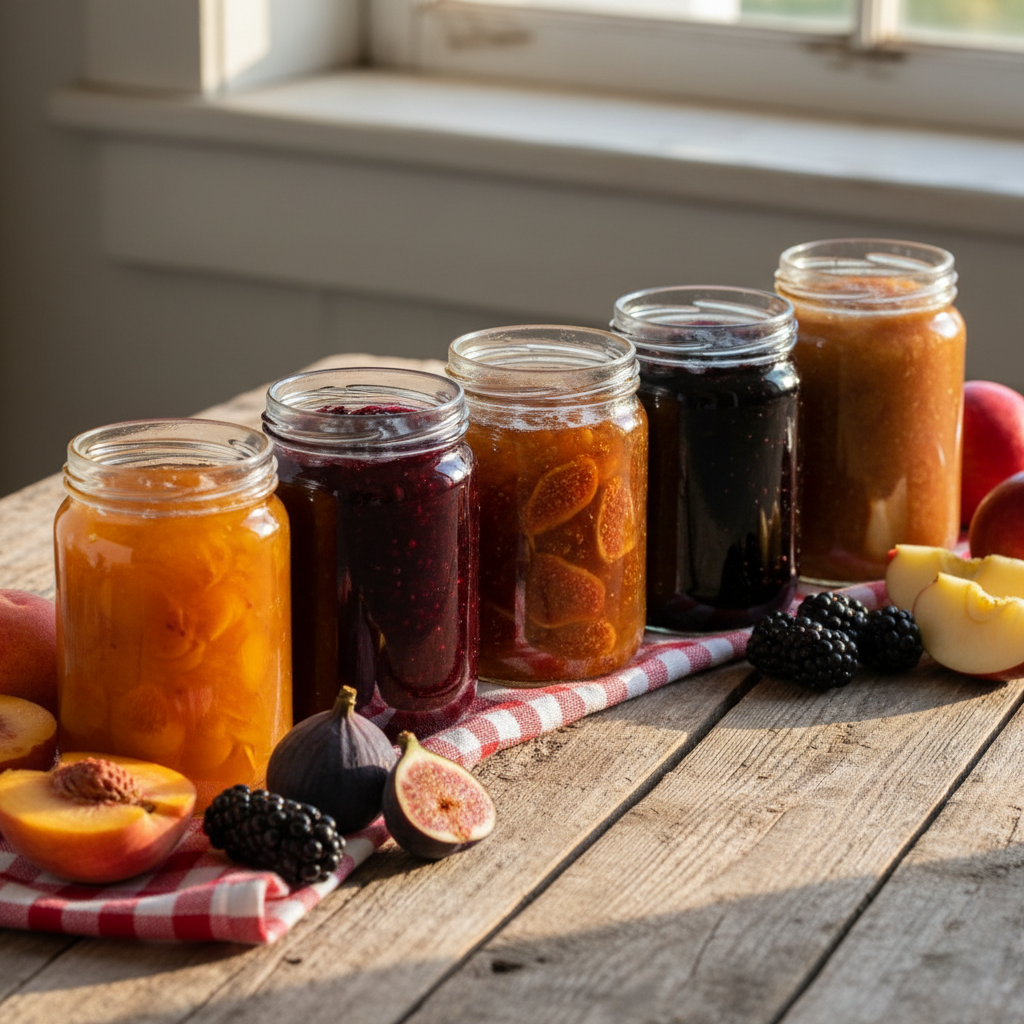
There’s a moment every fall when I step back and look at the jam shelf — all those jewel-toned jars lined up, each one representing a different season, a different harvest, a different afternoon spent in the kitchen. Peach bourbon from July, blackberry lavender from August, apple butter from October. It’s like a edible timeline of the year, and it never fails to make me smile.
Frequently Asked Questions
My jam didn’t set. Can I fix it?
Yes. You can reprocess unset jam by returning it to the pot, adding more pectin (follow the re-cook instructions on the pectin package), bringing it to a full boil, and reprocessing in clean jars with new lids. Alternatively, embrace it as a syrup — unset jam is wonderful drizzled over pancakes, ice cream, or yogurt. Sometimes the best “mistakes” become family favorites.
Can I reduce the sugar in these recipes?
Not if you’re using regular powdered pectin — the sugar is essential for the gel to set. If you want lower-sugar jam, switch to a low-sugar pectin like Pomona’s Universal Pectin, which uses calcium water instead of sugar to activate the gel. You’ll need to adjust the recipe proportions according to the pectin package instructions, but the results can be excellent.
Do I have to use commercial pectin?
No. You can make jam without added pectin by cooking the fruit and sugar longer until the natural pectin and evaporation create a set. This old-fashioned method works best with high-pectin fruits like apples, quince, and underripe berries. It produces a softer, more fruit-forward jam but requires more time and practice to get the consistency right.
How long does home-canned jam last?
Properly canned and sealed jam is safe essentially indefinitely, but for best quality, use it within 12-18 months. Over time, the color may darken and the flavor may dull, but it remains safe as long as the seal is intact. Once opened, store jam in the refrigerator and use within a month. If you see mold, off colors, or strange odors, discard the jar.
Can I use frozen fruit to make jam?
Absolutely. Frozen fruit works beautifully for jam and is a great way to preserve fruit at peak ripeness for jam making when you have more time. Measure the fruit while it’s still frozen, then thaw it in a bowl (saving all the juices) before cooking. The texture of the finished jam will be identical to jam made with fresh fruit. This is especially handy for berries, peaches, and cherries.