Off-Grid Solar for Beginners: An Honest Guide to Powering Your Homestead
- A basic off-grid solar starter system costs $500–$1,500 and can power lights, phone charging, a small fridge, and basic tools
- The core components: solar panels + charge controller + battery bank + inverter
- A single 400W panel with a 100Ah lithium battery handles most small homestead electrical needs
- Start small: you can expand your system modularly as your needs and budget grow
- Solar works best as a supplement to grid power for most homesteaders, not a full replacement
Off-grid solar involves DC and AC circuits that can cause fire, severe burns, and arc-flash injury if wired incorrectly. A shorted lithium battery bank can deliver thousands of amps in milliseconds. Before you build anything:
- Follow NEC 2023 Article 690 (PV Systems) and Article 706 (Energy Storage Systems). These govern grounding, overcurrent protection, disconnects, conductor sizing, and labeling for permanent installations. Mobile/RV/boat installs should follow ABYC E-11.
- Permits and inspection are required in most US jurisdictions for any system attached to a dwelling, even off-grid. Check with your local building department before you start.
- Hire a licensed electrician for anything that ties into your home’s main panel, transfer switches, or sub-panels. DIY is reasonable for small standalone systems (sheds, coops, cabins, RVs); it is not reasonable for whole-house wiring.
- Notify your home insurance carrier before installing a battery bank or permanent PV array. An undisclosed install can void coverage in a fire claim.
- This guide is educational, not a substitute for a qualified installer. If any step feels beyond your skill level, stop and get help.
Off-grid solar has a reputation for being expensive and complicated. And it can be: if you’re trying to run central air, an electric dryer, and a hot tub. But for a homestead? A modest solar setup that powers your essentials is surprisingly affordable and genuinely straightforward.
This guide is the honest, non-affiliate-driven introduction to solar that most homesteaders need. No upselling, no $20,000 whole-house systems, just practical information about sizing a system for real homestead use.
How Solar Power Works (The Simple Version)
- Solar panels convert sunlight into DC (direct current) electricity
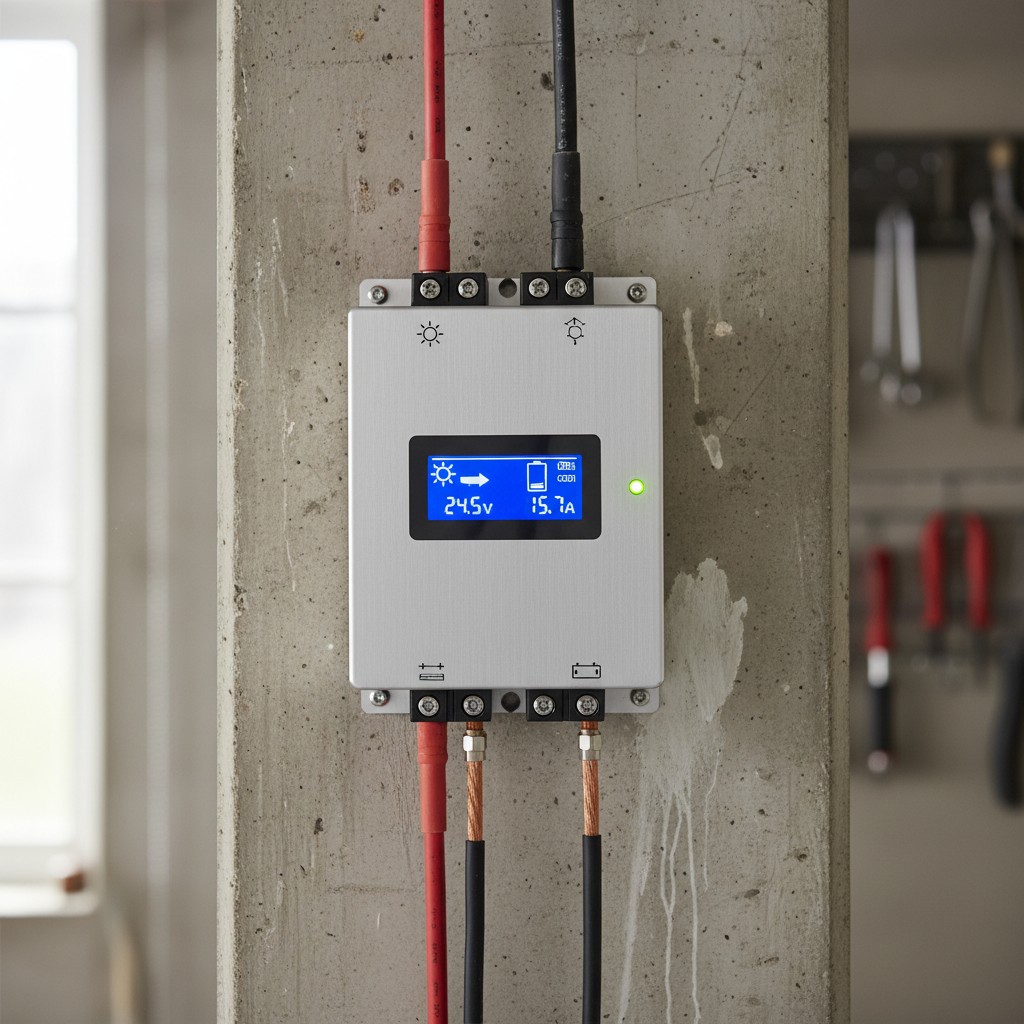
- A charge controller regulates the power flowing from panels to batteries (prevents overcharging)
- Batteries store the electricity for use when the sun isn’t shining
- An inverter converts DC battery power to AC (alternating current), the same type your house outlets use
That’s it. Four components. Everything else is cables, fuses, and mounting hardware.
How to Size Your System
Before buying anything, calculate what you actually need to power. Here’s what common homestead items draw:
| Device | Watts | Hours/Day | Watt-Hours/Day |
|---|---|---|---|
| LED lights (5 bulbs) | 50W | 5 | 250 |
| Phone/laptop charging | 30W | 3 | 90 |
| Small chest freezer | 50W | 8 | 400 |
| Water pump | 150W | 1 | 150 |
| Chicken coop heater (winter) | 100W | 8 | 800 |
| Fan | 30W | 6 | 180 |
| Basic homestead total | ~1,000–1,900 Wh |
Rule of thumb: Most homesteads need 1,000–2,000 watt-hours per day for basic electrical needs. That’s a very manageable solar system.
Get site-specific sun hours from NREL PVWatts. Peak sun hours vary dramatically by location and month. Seattle in December is a different planet from Phoenix in June. Plug your address into the free NREL PVWatts calculator to get accurate monthly production estimates for your specific location, array tilt, and azimuth. Size your system for your worst month, not your annual average, or you’ll be running a generator all winter. Also derate nameplate output by 15–25% for real-world losses (temperature, wiring, inverter efficiency, dust), a 400W panel realistically delivers 1,200–1,700 Wh/day in 4–5 peak sun hours, not the full nameplate 1,600–2,000.
Three System Tiers: From Starter to Full Power
| Tier | Panels | Battery | Powers | Cost |
|---|---|---|---|---|
| Starter | 1× 200W | 1× 100Ah lithium | Lights, charging, radio | $500–$800 |
| Essential | 2× 400W | 2× 100Ah lithium | + fridge, pump, fans | $1,500–$2,500 |
| Full homestead | 4× 400W+ | 4× 100Ah+ lithium | + power tools, washer, workshop | $4,000–$8,000 |
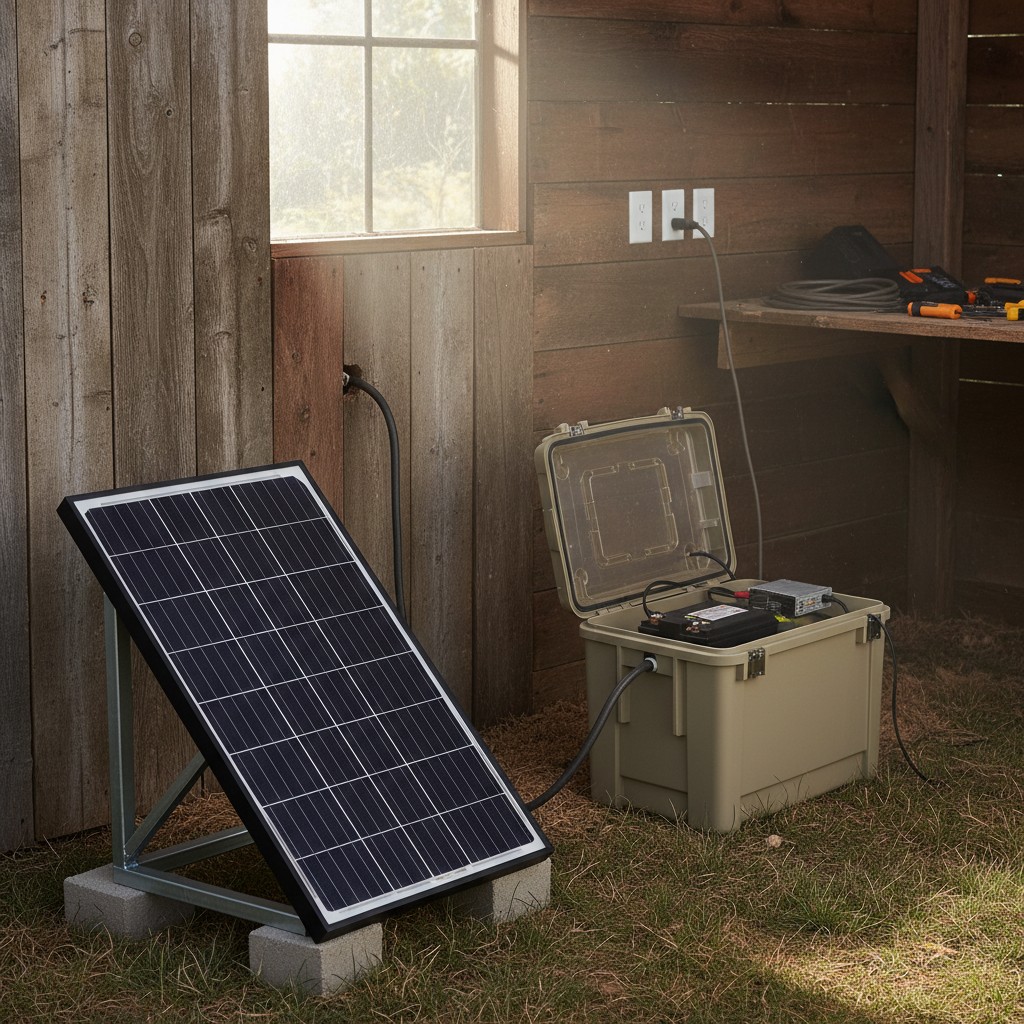
From our homestead: I started with a $600 portable power station and a single 200W panel to run the chicken coop lights and charge tools in the barn. It’s not glamorous, but it works perfectly and saves us from running extension cords 200 feet from the house. You don’t need to go all-in on day one.
Component Guide: What to Buy
Solar Panels
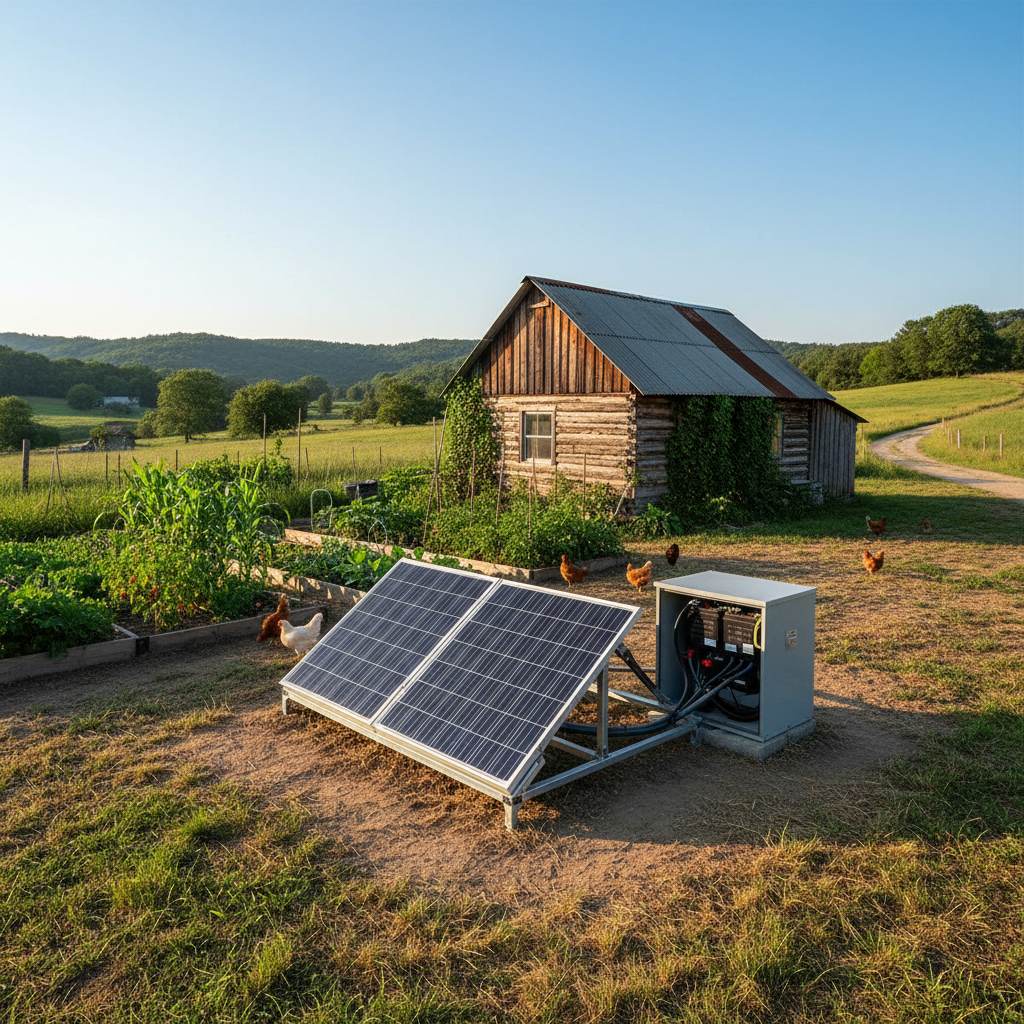
Modern panels are efficient and affordable. A 400W monocrystalline panel costs $150–$250 and produces about 1,600–2,000 Wh per day in good sun (4–5 peak sun hours). Mount on a ground rack, roof, or pole mount facing south at your latitude angle.
Charge Controller
Get an MPPT (Maximum Power Point Tracking) controller, not PWM. MPPT is 10–30% more efficient depending on temperature and array voltage, and worth the extra $50–$100.
How to size a charge controller (the math most guides skip): controller amps = panel watts ÷ battery voltage, plus a 25% safety margin for cold-weather voltage spikes (NEC 690.8 requirement).
- 400W panel on a 12V battery: 400 ÷ 12 ≈ 33A × 1.25 ≈ 41A → use a 40A MPPT minimum (not 20A or 30A, that will be permanently clipped and can overheat).
- 400W panel on a 24V battery: 400 ÷ 24 ≈ 17A × 1.25 ≈ 21A → a 30A MPPT is fine. This is why many builders jump to 24V once they pass ~400W of panels.
- 800W of panels on 12V: 800 ÷ 12 ≈ 67A × 1.25 ≈ 84A → you need a 80–100A MPPT, or split into two controllers, or move to 24V/48V.
Reputable MPPT brands: Victron, EPEver Tracer, Renogy Rover, Midnite Solar. Victron publishes a free Wiring Unlimited guide that walks through sizing in detail.
Batteries
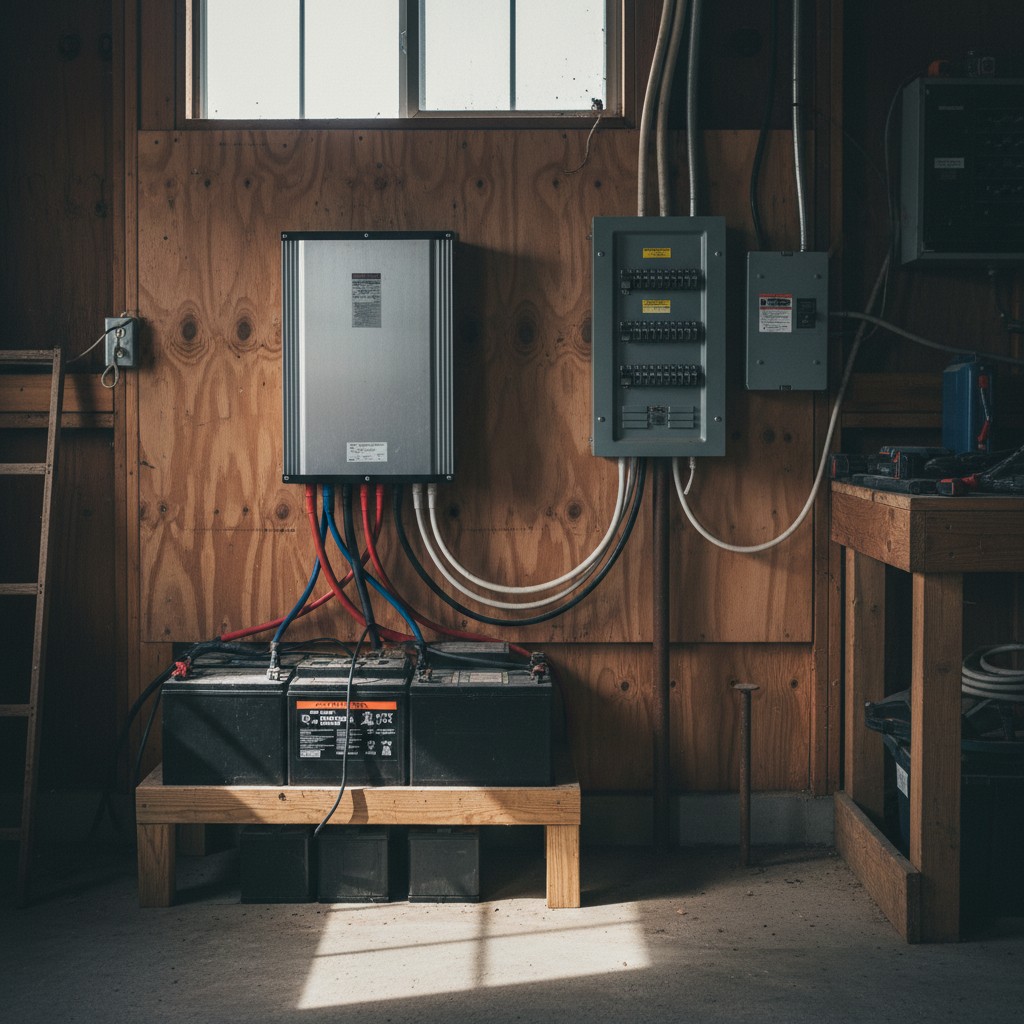
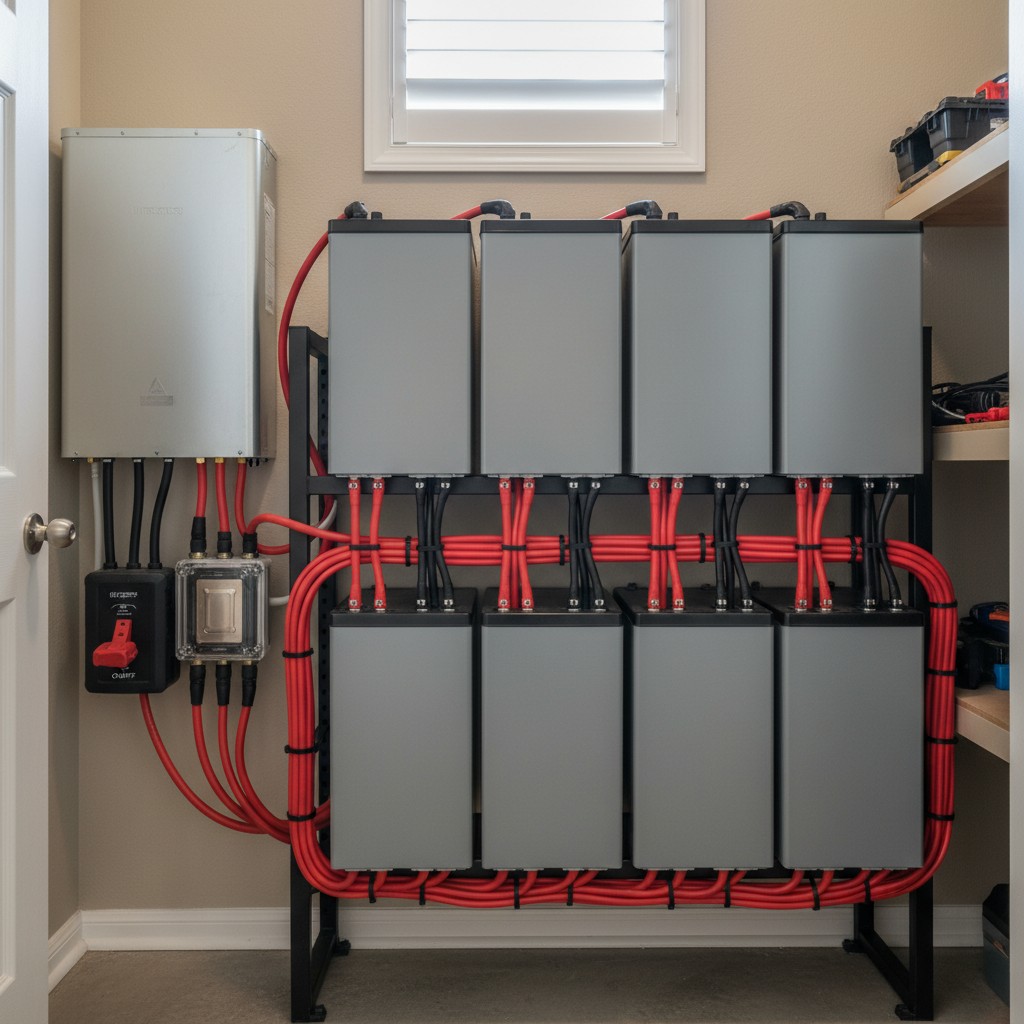
Lithium iron phosphate (LiFePO4) is the way to go for homestead solar. Quality cells last 10+ years (vs. 3–5 for flooded/AGM lead-acid), deliver 80–90% usable depth of discharge (lead-acid only ~50% if you want it to last), and weigh about half as much. A 100Ah LiFePO4 battery is nominally 12.8V, storing 12.8V × 100Ah ≈ 1,280 Wh, and costs $300–$500 from reputable brands (Battle Born, Victron, SOK, Renogy).
- Built-in BMS (battery management system). Every cell in a LiFePO4 pack must be monitored for over-voltage, under-voltage, over-current, over-temperature, and cell balancing. Buy batteries with a reputable internal BMS or build an external one, never run raw cells. Cheap no-name batteries often have undersized BMSes that fail under load.
- Class-T fuse between the battery bank and the inverter. A shorted LiFePO4 bank can deliver 2,000–10,000+ amps before a standard MRBF or ANL fuse blows. Only a Class-T fuse has the DC interrupt rating (typically 20,000A at 125VDC) to safely clear that fault. Mount it within 7 inches of the battery positive terminal per ABYC E-11. Battle Born, Victron, and every credible installer treat this as mandatory, not optional.
- Class-T fuse sizing rule of thumb: continuous inverter DC amps × 1.25. A 2,000W inverter at 12V draws ~167A continuous → use a 200A Class-T fuse. A 3,000W inverter at 24V draws ~125A → use a 150A Class-T. Match the wire gauge to the fuse, not the other way around.
- DC breakers / fuses on every circuit: between panels and charge controller, charge controller and battery, and battery and any DC loads. NEC 690.9 and 706 require overcurrent protection on both ends of any ungrounded conductor.
- Lead-acid alternative: if you go flooded lead-acid instead, ventilate the battery enclosure, charging off-gasses hydrogen, which is explosive. Wear eye protection and gloves when topping up electrolyte.
Inverter
A pure sine wave inverter is essential, modified sine wave units damage sensitive electronics, make motors hum, and will not run variable-speed power tools or many medical devices. Anything advertised as a 2,000W pure sine wave inverter for $150 is almost certainly modified sine, underrated, or both. Real pricing for quality 2,000W pure sine wave units:
- Budget tier ($250–$450): Renogy, AIMS, Go Power, Giandel. Acceptable for intermittent homestead loads. Read reviews: surge ratings and idle draw vary widely.
- Mid tier ($500–$900): Victron Phoenix, Samlex EVO, MultiPlus (inverter/charger combos). Higher efficiency, lower idle draw, better surge handling.
- Premium tier ($1,000+): Victron MultiPlus-II, Magnum Energy MS-series, Schneider XW Pro. Whole-home grade with integrated transfer switches, grid assist, and generator pass-through.
Size for surge, not just continuous watts. Motors and compressors (fridges, freezers, well pumps, power tools) draw 3–7× their running wattage at startup (locked-rotor amps, or LRA). A chest freezer rated at 80W running can spike to 500–800W for a fraction of a second. A 1,000W inverter with a weak surge rating may fail to start it at all. Check the inverter’s surge rating (usually listed as “peak” or “2-second surge”) and make sure it covers the largest startup load you plan to run.
Realistic Starter System Shopping List (with required safety gear)
| Component | Spec | Cost |
|---|---|---|
| Solar panel | 200W monocrystalline | $100–$150 |
| Charge controller | 20A MPPT (sized for 200W @ 12V) | $60–$120 |
| Battery | 100Ah 12V LiFePO4 w/ internal BMS | $300–$500 |
| Inverter | 1,000W pure sine wave (quality brand) | $180–$350 |
| Class-T fuse + holder | 125A, mounted at battery + | $40–$80 |
| DC breakers / inline fuses | PV, controller, load circuits | $30–$60 |
| Cables, lugs, connectors | 10 AWG PV, 2–4 AWG battery-to-inverter, MC4 | $40–$80 |
| Realistic total | $750–$1,250 |
Common Mistakes to Avoid
- Undersizing batteries. Panels are cheap; batteries are expensive. But skimping on storage means your system dies at sunset. Size your battery bank for at least 1.5 days of usage.
- Using PWM instead of MPPT. The $50 savings costs you 20–30% of your solar production. Always go MPPT.
- Ignoring wire gauge. Undersized wires cause voltage drop and fire risk. Use proper gauge for your current (10 AWG for most 12V homestead systems under 30A).
- Trying to run everything on solar. Electric heating, dryers, AC, and electric stoves draw enormous power. Use propane, wood, or grid power for high-draw appliances.
- Shade. Even partial shade on one panel dramatically reduces output. Place panels in full, unobstructed sun all day.
Frequently Asked Questions
How much does a basic off-grid solar system cost?
A starter system that powers lights, phone charging, and small devices costs $500–$800. An essential system that adds a fridge, water pump, and fans runs $1,500–$2,500. A full homestead system capable of powering a workshop and major appliances costs $4,000–$8,000. You can start small and expand modularly.

Can I install solar panels myself?
It depends on scope and jurisdiction. Small standalone systems (RV, shed, cabin, chicken coop) that are not attached to a permanent dwelling and not connected to your main panel are usually DIY-friendly and often don’t trigger permit requirements, similar to wiring a 12V RV system. Anything attached to a permanent residence is a different story: most US jurisdictions require permits, inspection, and NEC 2023 Article 690/706 compliance even for off-grid installs, and many require a licensed electrician for the connection to the dwelling’s panel. Grid-tied systems that feed power back to the utility always require permits and usually a licensed installer. Call your local building department before you start, and notify your home insurance carrier once the system is installed.
How many solar panels do I need for a homestead?
It depends on your power usage. Most small homesteads need 1,000–2,000 Wh per day, which requires 1–2 panels (400W each) in an area with 4–5 hours of peak sun. Calculate your daily watt-hour usage first, then size panels to produce 1.25x that amount to account for cloudy days and system losses.
Lithium or lead-acid batteries?
Lithium (LiFePO4) is worth the higher upfront cost for almost everyone. They last 3–4x longer (10+ years vs. 3–5), can be discharged deeper (80–90% usable DoD vs. ~50% for lead-acid), weigh half as much, and require zero maintenance. Over their lifespan, lithium batteries actually cost less per cycle than lead-acid.
Does solar work in cloudy climates?
Yes, but output is reduced. Panels still produce 10–25% of their rated output on overcast days. In consistently cloudy areas (Pacific Northwest, Northeast winters), you’ll need more panels and more battery storage to compensate. Check your area’s average peak sun hours, 3–4 hours is workable, 5+ is ideal.