Pressure Canning for Beginners: Safely Preserve Low-Acid Foods
Pressure Canning for Beginners: Safely Preserve Low-Acid Foods
- Pressure canning is the ONLY safe method for preserving low-acid foods like meats, beans, stocks, and most vegetables at home
- Water bath canning cannot reach the 240°F temperature needed to destroy Clostridium botulinum spores in low-acid foods
- Always follow USDA-tested recipes — pressure canning is not the place for creative experimentation
- Modern pressure canners are safe and straightforward to use once you understand the basics
- Pressure canning opens up a world of shelf-stable convenience foods that drastically reduce your dependence on the grocery store
When I first started canning, I stuck to the safe and familiar: jams, pickles, tomato sauce. High-acid foods that only required a water bath canner. But I kept looking at my shelves of bone broth in the freezer and bags of dried beans in the pantry and thinking: there has to be a better way.
There is. It’s called pressure canning, and it completely transformed our food preservation game.
I’ll be honest — pressure canning intimidated me for years. Old stories about exploding canners, the unfamiliar equipment, the stakes of botulism. But modern pressure canners are engineered with multiple safety features, and once I actually did my first batch, I wondered why I’d waited so long. The process is methodical, yes. But difficult? Not at all.
Why Pressure Canning? Understanding the Science
The reason pressure canning exists comes down to one organism: Clostridium botulinum. This bacterium produces spores that can survive boiling water (212°F) and thrive in the oxygen-free environment inside a sealed jar. If those spores survive the canning process, they can produce botulinum toxin — one of the most potent natural toxins known.
The good news: C. botulinum spores are destroyed at 240°F when held at that temperature for the specified time. The bad news: you can’t reach 240°F with water at normal atmospheric pressure — water boils at 212°F and that’s its ceiling.
A pressure canner solves this by sealing the vessel and building steam pressure, which raises the boiling point of water. At 10 pounds of pressure (at sea level), water boils at 240°F. That’s the temperature needed to safely process low-acid foods.
Low-Acid vs. High-Acid: Know the Difference
| Pressure Canner Required (Low-Acid, pH above 4.6) | Water Bath OK (High-Acid, pH below 4.6) |
|---|---|
| Meat and poultry | Fruits and fruit juices |
| Fish and seafood | Jams and jellies |
| Bone broth and stock | Pickles (vinegar-brined) |
| Beans and legumes | Tomatoes (with added acid) |
| Corn, peas, green beans | Salsas (tested recipes) |
| Potatoes, carrots, beets | Chutneys and relishes |
| Soups, stews, chili | Pie fillings (tested recipes) |
The first thing I pressure canned was chicken broth, and the satisfaction of seeing those jars seal and knowing I had shelf-stable broth ready anytime — no freezer space required, no defrosting needed — was honestly life-changing for our kitchen. That single batch freed up an entire freezer shelf.
Choosing a Pressure Canner
First, an important distinction: a pressure canner is NOT the same as a pressure cooker or Instant Pot. Pressure canners are specifically designed for safe home canning — they’re larger, have more precise pressure regulation, and meet USDA requirements. Do not use an electric pressure cooker for pressure canning unless it has been specifically validated for that purpose by USDA.
Two Types of Pressure Canners
| Feature | Dial Gauge Canner | Weighted Gauge Canner |
|---|---|---|
| How it works | Dial shows exact pressure on a gauge | Weighted regulator jiggles at correct pressure |
| Monitoring | Watch the dial constantly | Listen for the jiggle pattern |
| Maintenance | Must be tested annually for accuracy | No calibration needed |
| Precision | Shows exact PSI | Fixed settings (5, 10, 15 PSI) |
| Popular brands | Presto (some models) | Presto, All American |
| Beginner-friendly | Moderate | Yes — once you learn the jiggle |
For beginners, I recommend a weighted gauge canner. The Presto 23-quart is an excellent, affordable starting point that holds 7 quart jars or 20 pint jars. If budget allows, the All American is a tank that will last generations — it uses a metal-to-metal seal instead of a gasket.
Essential Equipment Checklist
- Pressure canner (not a pressure cooker)
- Mason jars (Ball or Kerr) — quarts and/or pints
- New lids (rings can be reused; lids should be new each time)
- Jar lifter — essential for safely handling hot jars
- Canning funnel — keeps jar rims clean
- Bubble remover/headspace tool — removes air pockets
- Clean cloths for wiping jar rims
- Timer — accurate timing is non-negotiable
- USDA-tested recipe source (Ball Complete Book of Home Preserving, NCHFP website, or tested extension recipes)
Step-by-Step: Pressure Canning Process
This general process applies to most pressure canning recipes. Always defer to your specific tested recipe for product preparation, jar size, headspace, and processing times.
Step 1: Prepare Your Food and Jars
Prepare your food according to the tested recipe. Wash your jars in hot, soapy water and keep them hot (in a pot of simmering water or your dishwasher’s heated dry cycle). Warm the lids in a bowl of warm water. Jars don’t need to be sterilized for pressure canning since the high temperatures handle sterilization.
Step 2: Fill the Jars
Using a canning funnel, fill the hot jars with the prepared food, leaving the headspace specified in your recipe (typically 1 inch for most pressure-canned items). Remove air bubbles by running a bubble remover or butter knife around the inside edges. Wipe the jar rims perfectly clean with a damp cloth — any food residue can prevent a proper seal.
Place the lids on and screw on the rings to “fingertip tight” — snug but not cranked down hard. The ring holds the lid in place; overtightening can prevent air from escaping during processing.
Step 3: Prepare the Canner
Place the canning rack in the bottom of your pressure canner. Add 2-3 inches of hot water (check your canner’s manual for the exact amount). For raw-packed foods, use hot water. For hot-packed foods, use very hot or simmering water.
Step 4: Load the Jars
Using the jar lifter, lower the filled jars onto the rack in the canner. Jars shouldn’t touch each other or the sides of the canner. If stacking a second layer (for pint jars), place a second rack between layers.
Step 5: Lock the Lid and Vent
Secure the canner lid according to your model’s instructions. Leave the vent open (weighted gauge off or petcock open). Turn the heat to high and wait for a steady stream of steam to jet from the vent. Let this steam vent for 10 minutes — this step is critical as it exhausts all the air from the canner. Air pockets prevent the canner from reaching accurate temperatures.
Step 6: Build Pressure
After 10 minutes of venting, place the weighted gauge on the vent or close the petcock. Pressure will begin to build. Watch the gauge or listen for the weighted regulator to begin rocking.
Step 7: Process at Pressure
Once the correct pressure is reached, START YOUR TIMER. Maintain steady pressure throughout the processing time. Adjust the heat as needed — you want consistent pressure without dramatic fluctuations.
For weighted gauge canners: the weight should rock or jiggle 1-4 times per minute at the correct pressure. If it’s jiggling rapidly, reduce heat slightly.
For dial gauge canners: keep the gauge at or slightly above the required pressure. Small fluctuations are normal.
Critical rule: If at any point the pressure drops below the required level, you must bring it back up to pressure and RESTART your timing from zero. This is why staying near the canner during processing is important.
Step 8: Cool Down Naturally
When the processing time is complete, turn off the heat. Do NOT remove the weight, open the vent, or try to speed up cooling. Let the canner depressurize naturally — this typically takes 30-60 minutes. The gauge should read zero and no steam should escape when you test the vent before opening.
Rushing this step can cause liquid loss from jars, seal failure, or jar breakage.
Step 9: Remove and Rest
Open the canner lid carefully, tilting it away from you to avoid the rush of hot steam. Using the jar lifter, remove jars and place them on a towel on the counter. Leave at least 1 inch of space between jars. Don’t tighten the rings or check the seals yet.
Let jars cool undisturbed for 12-24 hours. You’ll hear the satisfying “ping” of lids sealing as they cool — one of the most rewarding sounds in the homestead kitchen.
Step 10: Check Seals and Store
After 24 hours, check each seal by pressing the center of the lid. It should not flex up and down. Remove the rings for storage (they can trap moisture and cause rust). Label each jar with the contents and date. Store in a cool, dark place.
Any jars that didn’t seal should be refrigerated and used within a few days, or reprocessed with a new lid within 24 hours.
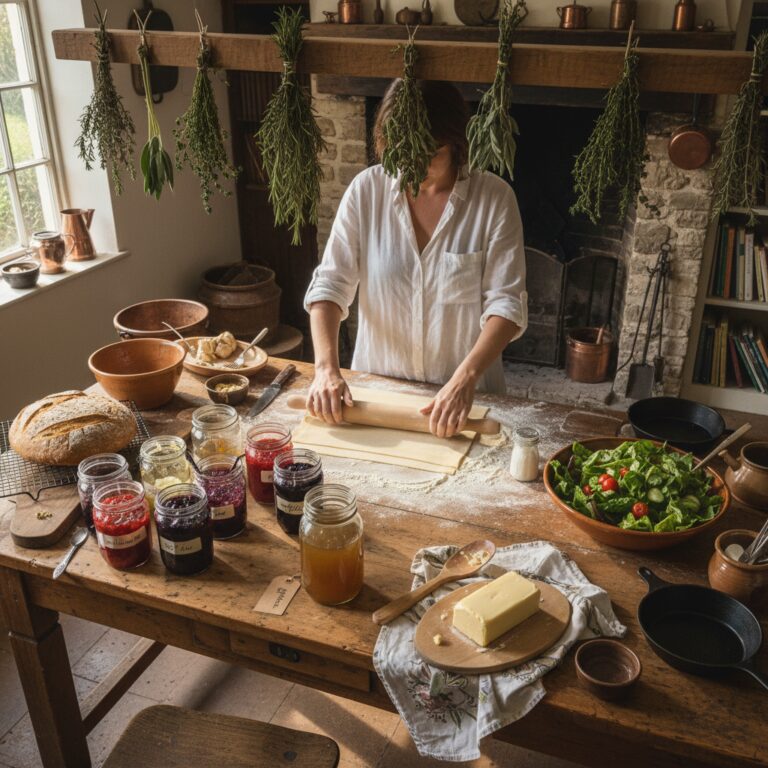
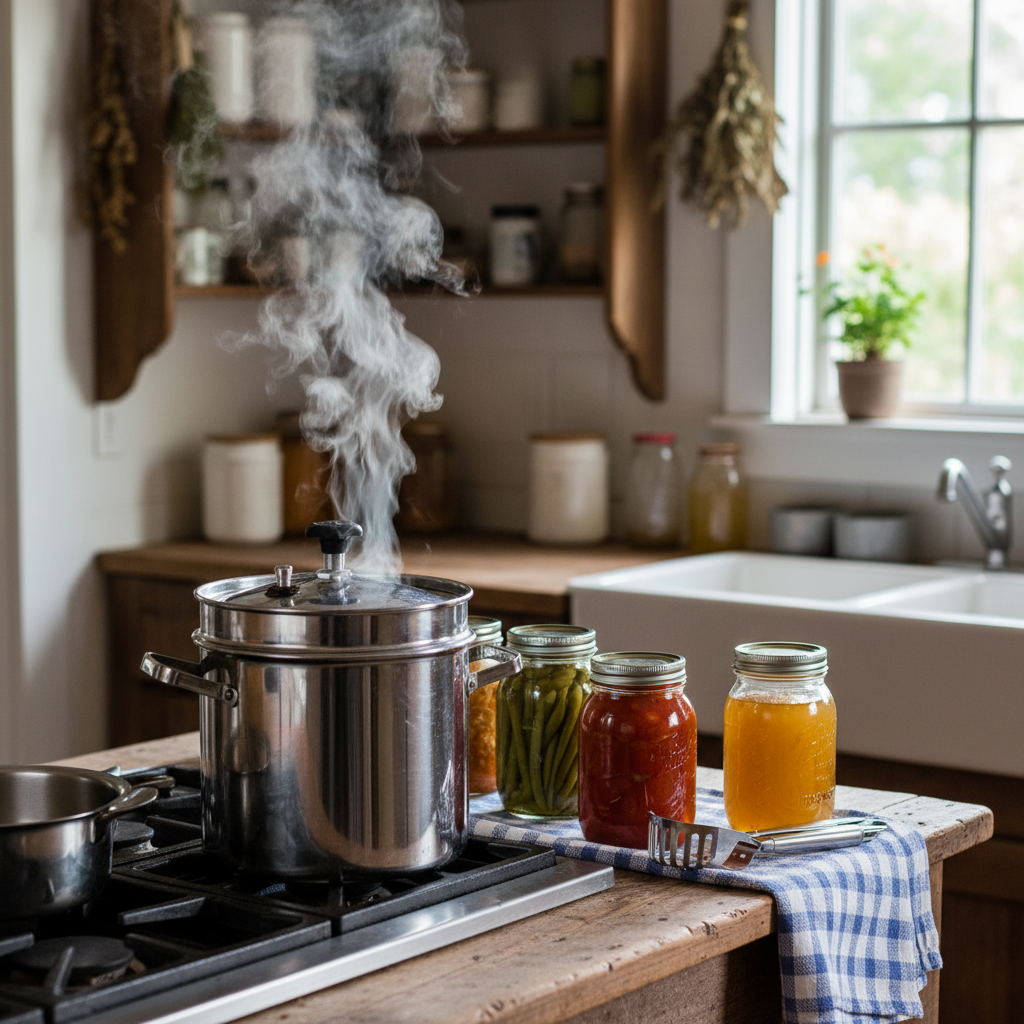
My pantry shelf of pressure-canned goods is the backbone of our from-scratch kitchen. Quarts of chicken broth, pints of dried beans, jars of venison stew meat, and green beans from the garden. On a busy weeknight, I can pull a jar of broth and a jar of beans and have soup on the table in 20 minutes — all from our own homestead, shelf-stable, no freezer required.
Altitude Adjustments
Pressure canning times and pressures are based on sea level. If you live above 1,000 feet elevation, you MUST adjust your pressure to ensure food safety.
| Altitude | Weighted Gauge | Dial Gauge |
|---|---|---|
| 0-1,000 ft | 10 lbs | 11 lbs |
| 1,001-2,000 ft | 15 lbs | 11 lbs |
| 2,001-4,000 ft | 15 lbs | 12 lbs |
| 4,001-6,000 ft | 15 lbs | 13 lbs |
| 6,001-8,000 ft | 15 lbs | 14 lbs |
Best Foods to Start Pressure Canning
If you’re new to pressure canning, start with these beginner-friendly projects that provide the most value for your effort:
Bone broth: Perhaps the single most useful thing you can pressure can. Make a large batch of bone broth and can it in quart jars. You’ll use it for soups, sauces, rice, and more throughout the year.
Dried beans: Can pints and quarts of beans — black, pinto, navy, chickpeas. Having shelf-stable cooked beans ready to use makes cooking from scratch so much faster.
Chicken or beef: Raw-pack meat is one of the easiest pressure canning projects. Simply cube the meat, pack it in jars with salt, and process. The result is tender, ready-to-use meat for quick meals.
Green beans: If you grow green beans in your preserver’s garden, pressure canning is the best way to put up large quantities. They hold their texture better than frozen in many applications.
Potatoes: Canned potatoes are incredibly convenient — already peeled, cubed, and cooked. Add them to soups, fry them up, or make quick potato salad.
Safety Rules: Non-Negotiable
- Only use USDA-tested recipes. Do not adapt water bath recipes, internet recipes without sources, or grandmother’s untested recipes for pressure canning
- Never add thickeners like flour, cornstarch, or cream before canning. These change the density and heat penetration. Thicken after opening
- Never can dairy, butter, or eggs. There are no tested safe recipes for these products
- Never can in an oven, dishwasher, or slow cooker. Only a pressure canner provides the controlled environment needed
- Have dial gauges tested annually. Your local extension office usually does this for free
- Inspect gaskets and vents before each use. A clear vent and intact gasket are essential for safe operation
- When in doubt, throw it out. If a jar looks, smells, or seems off in any way, dispose of the contents safely
The best companion to pressure canning is a well-planned root cellar or cool pantry for storing your finished jars. Together, they form the foundation of year-round food self-sufficiency.
Frequently Asked Questions
Is pressure canning dangerous?
Modern pressure canners are engineered with multiple safety features including locking lids, overpressure plugs, and backup vents. As long as you follow the manufacturer’s instructions and don’t modify the canner, it is very safe. The stories about exploding pressure canners come from older models without modern safety features, or from improper use. Treat your canner with respect, follow the manual, and you’ll be fine.
Can I use my Instant Pot for pressure canning?
Generally, no. Most electric pressure cookers, including the standard Instant Pot, have not been validated for pressure canning by USDA. Some newer Instant Pot models (like the Instant Pot Max) claim canning capability for specific recipes, but the USDA has not broadly endorsed electric pressure cookers for canning. A stovetop pressure canner is the safest choice.
Why did liquid come out of my jars during processing?
This is called siphoning and is usually caused by: rapid pressure changes (fluctuating heat), not leaving enough headspace, removing jars too quickly, or overpacking the jars. The jars are still safe as long as they sealed properly and food is still covered by at least some liquid. To prevent it, maintain steady pressure and let the canner depressurize fully and naturally.
How long do pressure-canned foods last?
The USDA recommends using home-canned foods within one year for best quality, though properly sealed jars stored in cool, dark conditions can remain safe much longer. The food doesn’t “expire” — rather, it gradually loses color, texture, and nutritional value over time. Always inspect jars before opening: check the seal, look for signs of spoilage, and smell the contents before tasting.
Do I need to sterilize jars before pressure canning?
No. Since pressure canning processes foods at temperatures well above boiling (240°F), the jars are sterilized during processing. You do need to wash jars in hot, soapy water and keep them hot before filling to prevent thermal shock, but pre-sterilizing (boiling for 10 minutes) is only required for water bath recipes processed less than 10 minutes.