21 Garden Corner Ideas to Turn an Empty Space Into Something Beautiful
[tldr]A bare garden corner doesn’t have to stay bare. From a simple corner bench to a full rain garden, these 21 ideas transform unused angles into purposeful, beautiful spaces, whether you want seating, food, wildlife habitat, or pure visual delight.[/tldr]
Every garden has at least one awkward corner, the spot where the fence meets the shed, the shady triangle behind the garage, or the dry strip between two walls that nothing seems to want to grow in. Most gardeners walk past it, vaguely planning to “do something about it someday.”
That corner is actually among the most valuable pieces of real estate in your yard. Enclosed on two or three sides, it creates natural structure, shelter from wind, and a sense of enclosure that open garden beds simply can’t replicate. The right treatment turns it into a destination rather than a dead zone.
Below are 21 concrete ideas organized into themed groups, seating nooks, vertical gardens, container displays, wildlife corners, and edible corners, so you can find exactly the right fit for your space, light levels, and goals.
Seating Nooks
Corners are natural candidates for seating because two solid sides provide instant shelter and a sense of privacy you’d otherwise have to build from scratch. Even a small corner can hold a surprisingly comfortable sitting area.
1. What Makes a Corner Bench the Perfect Starting Point?
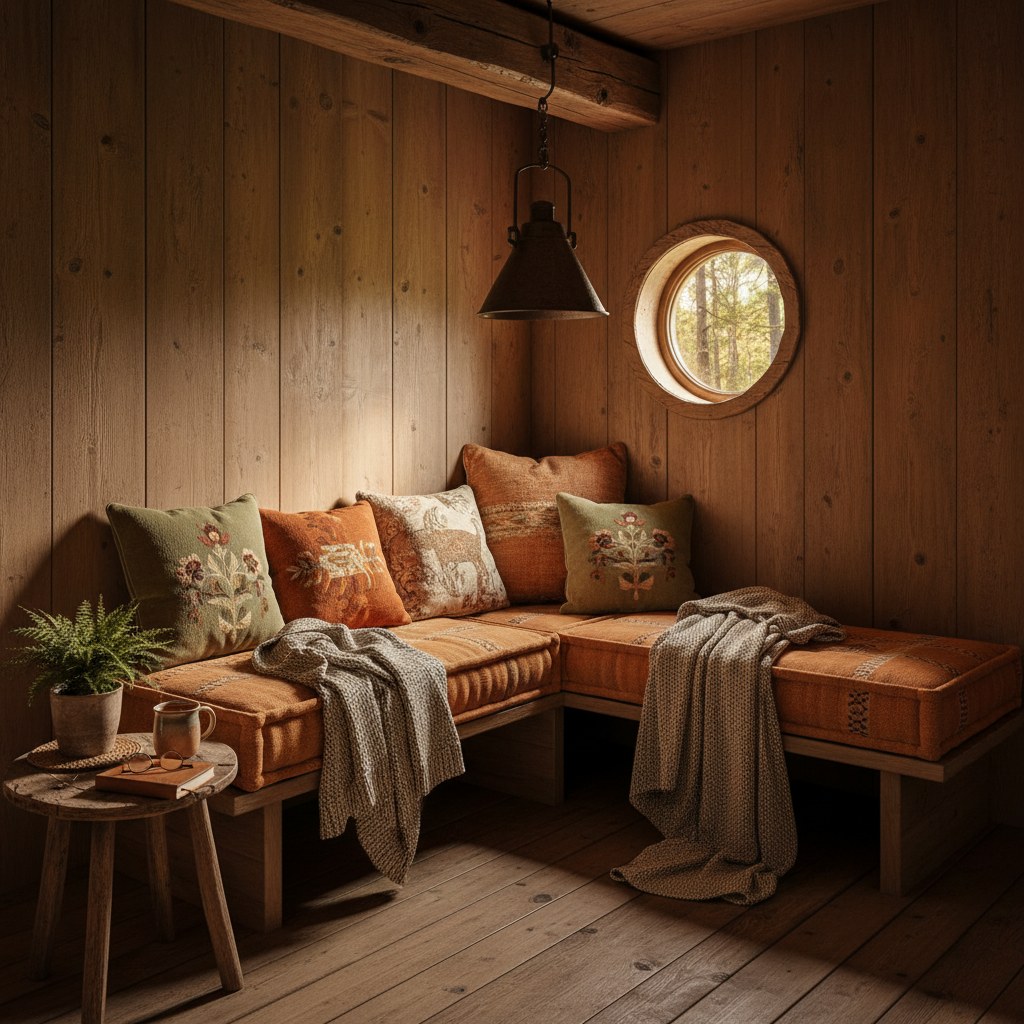
A built-in L-shaped corner bench solves the corner problem elegantly: it fills dead space, provides seating for several people, and, if you build it with a hinged seat, doubles as waterproof outdoor storage for cushions, tools, and pots. Pressure-treated lumber or cedar are the standard materials for longevity, though reclaimed wood adds character if you seal it well. Seat height should be 17–18 inches for comfortable sitting, and a depth of 16–18 inches accommodates most adults without feeling cramped.
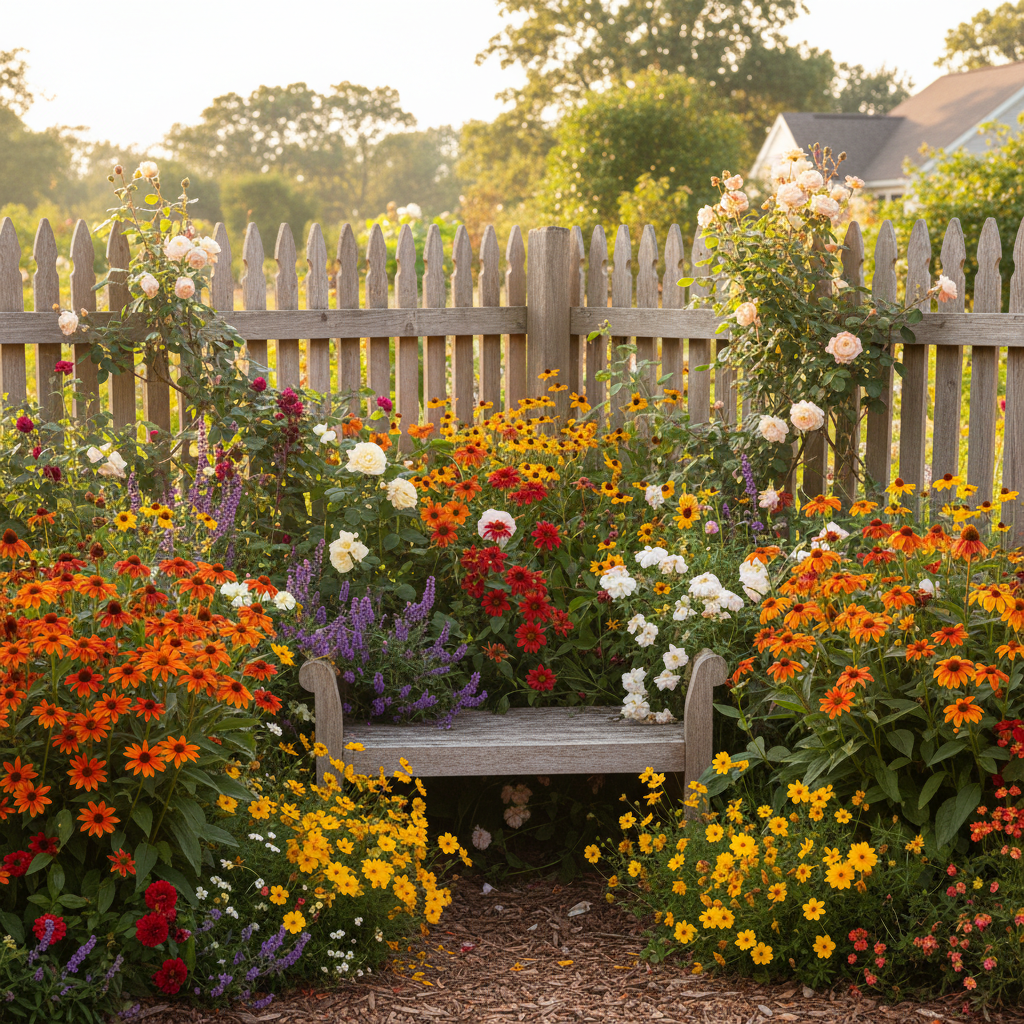
Frame the bench with climbing plants on the two walls behind it, a trellis for jasmine or climbing hydrangea transforms a utilitarian structure into an enclosed garden room. Add a small side table (even a stump or upturned terracotta pot works), and the corner becomes a destination rather than overflow seating. According to the American Horticultural Society, enclosed seating areas increase the perceived usability of garden space by encouraging longer dwell time outdoors.
Citation: American Horticultural Society, The American Horticultural Society Encyclopedia of Gardening (DK Publishing, updated ed.).
2. How Do You Design a Reading Nook That Actually Gets Used?
The difference between a reading nook that gets used daily and one that turns into a plant stand is light and comfort. For a corner reading nook, you need morning sun (east- or southeast-facing is ideal) or dappled shade rather than harsh afternoon exposure, a surface comfortable enough for an hour of sitting, and enough visual privacy that you feel genuinely tucked away.
Start with a wide bench or a pair of Adirondack chairs angled toward each other. Add a pergola or arbor overhead, even a simple 4-post structure draped with shade cloth or a fast-growing annual vine like scarlet runner bean creates the canopy effect that makes outdoor reading comfortable. Underplant with soft, fragrant groundcovers like creeping thyme or sweet woodruff so the whole space smells good when you brush past. A small solar lantern on a post handles evening reading without running wiring. The RHS (Royal Horticultural Society) recommends fragrant planting near seating areas specifically because scent extends the perceived pleasure of a space.
Citation: RHS: RHS Encyclopedia of Plants and Flowers, 2019 ed.
3. Is a Hammock Corner Realistic in a Small Garden?
A hammock corner is entirely realistic as long as your two anchor points, posts, trees, or walls, are at least 10–15 feet apart and structurally sound. If your corner doesn’t have trees, two 4×4 cedar posts set 24 inches deep in concrete provide permanent anchors. Between posts or trees, a Brazilian- or Nicaraguan-style hammock with spreader bars takes up minimal visual space when hung and folds down to nothing when stored.
Plant around the base of each post with a skirt of low ornamentals, lavender, catmint, or ornamental grasses, to anchor the posts visually and prevent the setup from looking like bare poles in a garden. Drape the overhead section with a lightweight fabric canopy or grow a fast-maturing vine (like clematis) up a simple rope guide between the posts for seasonal shade. A hammock corner signals a garden that prioritizes rest, which is among the most underrated design intentions in home landscapes.
Citation: Sunset Magazine, Sunset Western Garden Book, 9th ed. (Sunset Publishing, 2012).
4. What Goes Into a Fire Pit Corner That’s Safe and Beautiful?
A fire pit corner extends the garden season well into autumn and creates the most socially magnetic spot in any yard. Safety is the first constraint, and it is a bigger one than most corner designs allow for: the International Fire Code requires an open recreational fire to sit 25 feet from any structure or combustible material (IFC 307.4.2), fences and overhanging branches included. That rules out a genuine corner for a wood fire in most yards. Two honest ways around it: put the wood fire out in the open where it can have its 25 feet and use the corner for seating that faces back toward it, or choose a listed portable fire pit or chiminea, which is a separate class of appliance with its own much shorter manufacturer-listed clearances and is what actually belongs in a tight corner.
Use the corner walls or fence sections to hang heat-resistant string lights (Edison bulbs on heavy-gauge wire) that define the “room” without cluttering the space. Surround the fire pit with a gravel or paver apron at least 3 feet wide for ember safety and easy foot traffic. Low, heat-tolerant perennials like agastache, rudbeckia, or ornamental grasses planted just beyond the apron add color without overgrowing into the fire zone. According to the National Fire Protection Association, backyard fire pits should sit on non-combustible surfaces, stone, brick, or compacted gravel, and be at least 25 feet from structures.
Citation: National Fire Protection Association. NFPA 1, Fire Code (2021 edition).
Vertical Gardens
Corners are inherently vertical, two walls or fence sections meeting at 90 degrees give you more vertical surface area than any other part of the garden. These ideas exploit that geometry to grow up rather than out, which matters enormously in small yards.
5. How Does a Trellis Arch Transform a Garden Corner?
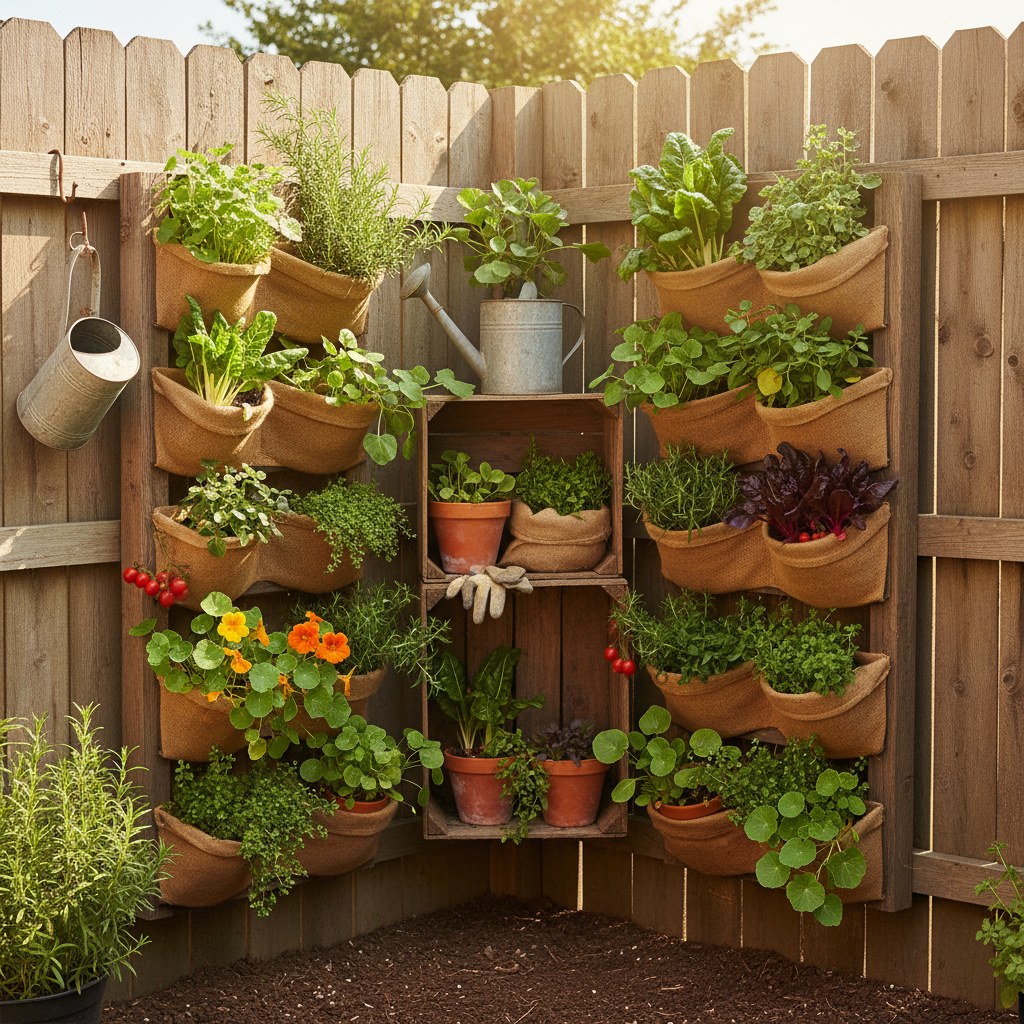
A trellis arch mounted in a corner does double duty: it fills vertical space with flowering or fruiting vines, and it frames a view into or out of the corner, giving the entire garden a sense of depth. For most home gardens, a simple 6-foot wooden or metal arch, the kind sold in flat pack at garden centers, can be mounted directly to a corner fence with two 2×4 brackets, creating a stable structure without digging post holes.
Plant choice matters significantly here. Climbing roses (like ‘New Dawn’ or ‘Zephirine Drouhin’) give you fragrance and bloom all summer. Clematis layers well with roses, extending the flowering season into early fall. For edible options, try kiwi vine (extremely vigorous, needs robust support), passion fruit in USDA zones 7+, or a small espaliered apple trained on horizontal wires. The University of Missouri Extension notes that vertical gardening on trellises and arches increases growing area by up to 300% compared to flat beds of the same footprint.
Citation: University of Missouri Extension, “Vertical Gardening,” publication G6971.
6. Can a Vertical Pallet Garden Actually Thrive?
Yes, with two caveats. First, use only heat-treated (HT-stamped) pallets, never methyl bromide-treated (MB) ones, which are toxic. Second, line the back and sides with landscaping fabric before filling with a lightweight potting mix, because a pallet full of standard garden soil weighs several hundred pounds and will pull away from its wall mount. With those conditions met, a vertical pallet garden mounted on a corner fence section is among the most cost-effective ways to grow herbs, strawberries, or shallow-rooted annuals.
Mount the pallet at a slight forward lean (5–10 degrees) so roots settle toward the back board rather than tumbling out. Water with a slow drip line along the top, gravity does the rest. Strawberries, lettuce, spinach, and herbs like basil, thyme, and chives all perform well in the shallow pockets. For best results, pair with a container gardening approach, same principles of lightweight mix, regular fertilizing, and moisture management apply whether the container is round or slatted.
Citation: Oregon State University Extension, “Pallet Gardening,” EM 9136.
7. What Makes Climbing Roses the Classic Corner Choice?
Climbing roses have anchored garden corners for centuries because they solve the corner’s biggest aesthetic challenge: how to soften a hard right angle without losing structural definition. A climbing rose trained on wires or a trellis panel maintains the geometry while blurring it with color, fragrance, and seasonal change (bloom, hip, bare cane, repeat). They are not truly self-clinging like ivy, they need tying in at least twice a year, but that’s also what makes them controllable.
For disease resistance and lower maintenance, choose modern climbing roses bred with that in mind: ‘Aloha,’ ‘Darlow’s Enigma,’ ‘Compassion,’ or any David Austin climber. Plant at least 18 inches from the wall or fence to allow air circulation (the number-one preventative for black spot). Feed in spring with a slow-release rose fertilizer and deadhead regularly to extend bloom. The Royal National Rose Society recommends training new canes horizontally as they develop, this stimulates more lateral flowering shoots and a fuller display than vertical training alone.
Citation: Royal National Rose Society, Growing Roses, advisory publication (RNRS, 2020).
8. How Do Hanging Baskets Work as a Corner Feature?
A cluster of hanging baskets at different heights in a corner creates a lush, layered effect that’s impossible to achieve with ground-level planting alone. The trick is treating the grouping as one composition rather than identical individual baskets: vary the basket sizes (12-inch, 16-inch, and 20-inch), the heights (staggered by 8–12 inches), and the plant textures (trailing vs. Mounding vs. Upright). Use a unifying color palette, all soft pinks and purples, or all hot oranges and yellows, to prevent the arrangement from looking cluttered.
For watering, a simple drip-irrigation ring (sold for hanging baskets) fed from a single line dramatically reduces the labor of daily hand watering, which is the main reason hanging baskets get neglected. Line baskets with coir rather than plastic-backed liners, coir breathes, which helps roots stay healthier in summer heat. The Penn State Extension recommends a slow-release granular fertilizer incorporated into the potting mix at planting, supplemented with weekly liquid feeding once the plants are in active growth.
Citation: Penn State Extension, “Hanging Baskets,” Horticulture fact sheet.
9. What Is a Succulent Wall and How Do You Build One?
A succulent wall is a mounted planting frame, typically a shallow shadow-box style structure filled with cactus mix and planted densely with succulents, sedums, and echeverias, fixed flat against a fence or wall. Because succulents store water in their leaves and require minimal soil depth, these structures stay surprisingly lightweight and last for years with almost no irrigation once established.
Build the frame from 1×4 cedar with a hardware cloth back stapled on, fill with a 50/50 blend of coarse sand and perlite, and lay flat for four weeks after planting so cuttings root before the frame is mounted vertically. Succulents to consider: hens-and-chicks (Sempervivum), stonecrop (Sedum), ghost plant (Graptopetalum), and aloe for a statement plant. This works best in USDA zones 5–11 depending on species; in colder zones, mount the frame in a detachable bracket so it can overwinter indoors. Succulents are ideal for hot, dry corners that face south or west where other plants struggle.
Citation: University of California ANR, “Succulents for California Gardens,” publication 8448.
Container Displays
Containers free you from soil quality, drainage problems, and permanent commitment, the perfect corner solution when you want flexibility or are renting. These ideas range from simple pot groupings to elaborate multi-level displays.
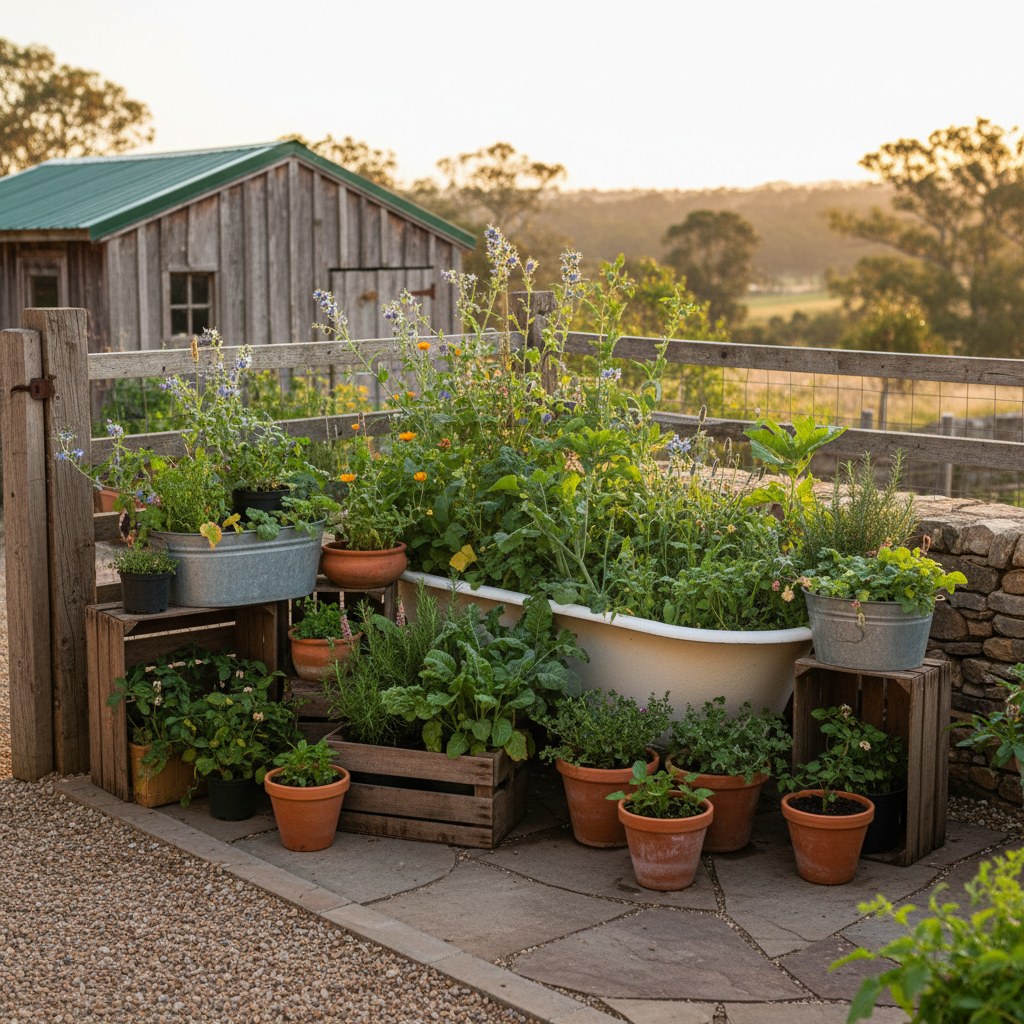
10. How Should You Arrange a Tiered Planter Display?
A tiered planter, whether a purpose-built pyramid stand, a DIY stacked-crate structure, or simply pots on a stepladder, uses height variation to make a corner feel lush even with a modest number of plants. The visual rule is to work in odd numbers (3, 5, or 7 containers), place the tallest element at the back of the corner, and cascade downward toward the front so every plant gets adequate light and visibility.
For a cottage garden corner, plant the upper tiers with upright salvias or geraniums, the middle tier with cascading calibrachoa or bacopa, and the lowest pots with a creeping thyme or low sedum that spills over the edges toward the ground. For a more structured, formal look, repeat the same plant (standard topiary ball, clipped boxwood sphere, or architectural agave) at three heights in matching containers. Both container gardening principles apply throughout: use high-quality potting mix, ensure drainage holes in every container, and water based on individual plant needs rather than on a fixed schedule.
Citation: Clemson Cooperative Extension, “Container Gardening,” HGIC 1654.
11. What Makes a Fairy Garden a Corner Worth Stopping At?
A fairy garden works in a corner because the enclosed space naturally suggests a hidden world, two sides forming walls gives it an architectural quality without any additional structure. What makes a fairy garden that doesn’t look like a cluttered novelty display is restraint and scale consistency: every element (miniature furniture, tiny paths, diminutive plants) should be in proportion, and the plant palette should be limited to two or three species that genuinely stay small.
Best plants for miniature gardens: baby’s tears (Soleirolia), miniature sedums, dwarf mondo grass, corsican mint (also fragrant when crushed), and moss collected locally or purchased as sheet moss. Build the “ground” from a fine gravel mulch in a warm tone, decomposed granite or fine pea gravel, for a naturalistic look. A small mirror shard set into the gravel reads as a pond. This type of corner works beautifully as a children’s garden space and tends to evolve seasonally as small decorative items rotate in and out.
Citation: NC State Extension, “Creating Miniature Gardens,” consumer fact sheet.
12. How Do You Create a Potting Station Corner That’s Functional and Attractive?
A potting station corner solves the practical problem of where to pot up seedlings, repot houseplants, and store soil without making a mess. A purpose-built potting bench, or a repurposed utility shelf, mounted in the corner keeps all supplies organized and creates a genuinely useful garden workspace. The station should include a work surface at a comfortable height (about 36 inches for standing work), storage below for bags of compost and pots, and hooks or pegboard above for hand tools.
To make it visually attractive rather than purely utilitarian, paint the bench in a deep garden color (slate blue, hunter green, or terracotta), hang a few trailing plants in small pots from overhead hooks, and store tools in weathered terracotta crocks rather than plastic bins. Line the surrounding ground area with fine gravel so spilled soil sweeps up easily without creating mud. A potting station corner near the vegetable garden is particularly efficient, it cuts down on carrying distance for seedlings and supplies.
Citation: Michigan State University Extension, “Creating a Potting Bench,” Master Gardener advisory.
13. What’s a Japanese Zen Corner and How Do You Build One on a Budget?
A Japanese zen corner applies the principles of karesansui (dry landscape) design to a garden corner: raked gravel or decomposed granite, a few carefully chosen rocks, minimal planting, and absolute intentionality about every element. The goal is to create stillness in the garden, a visual pause that feels different in character from surrounding planting.
On a budget, the core materials are inexpensive: a bag of pea gravel or decomposed granite ($8–15), three or five stones chosen for interesting form (free from fields, roadsides, or landscape suppliers), and one or two plant specimens, a slow-growing Japanese maple, a clump of black mondo grass, or a single architectural ornamental grass like ‘Rotstrahlbusch’ hakonechloa. Rake the gravel in parallel lines or concentric arcs around the stones. The simplicity is the point: the fewer the elements, the more each one matters. This type of corner works particularly well in partial shade and pairs beautifully with a bamboo fence section or a simple stone lantern as a focal point.
Citation: Ohashi, H., Japanese Gardens (Graphic-sha, 2009).
Wildlife Corners
A garden corner dedicated to wildlife serves ecological function, requires relatively low maintenance once established, and provides the quiet pleasure of watching birds, bees, and butterflies visit daily. These ideas build habitat incrementally, you can start with one element and add more over time.
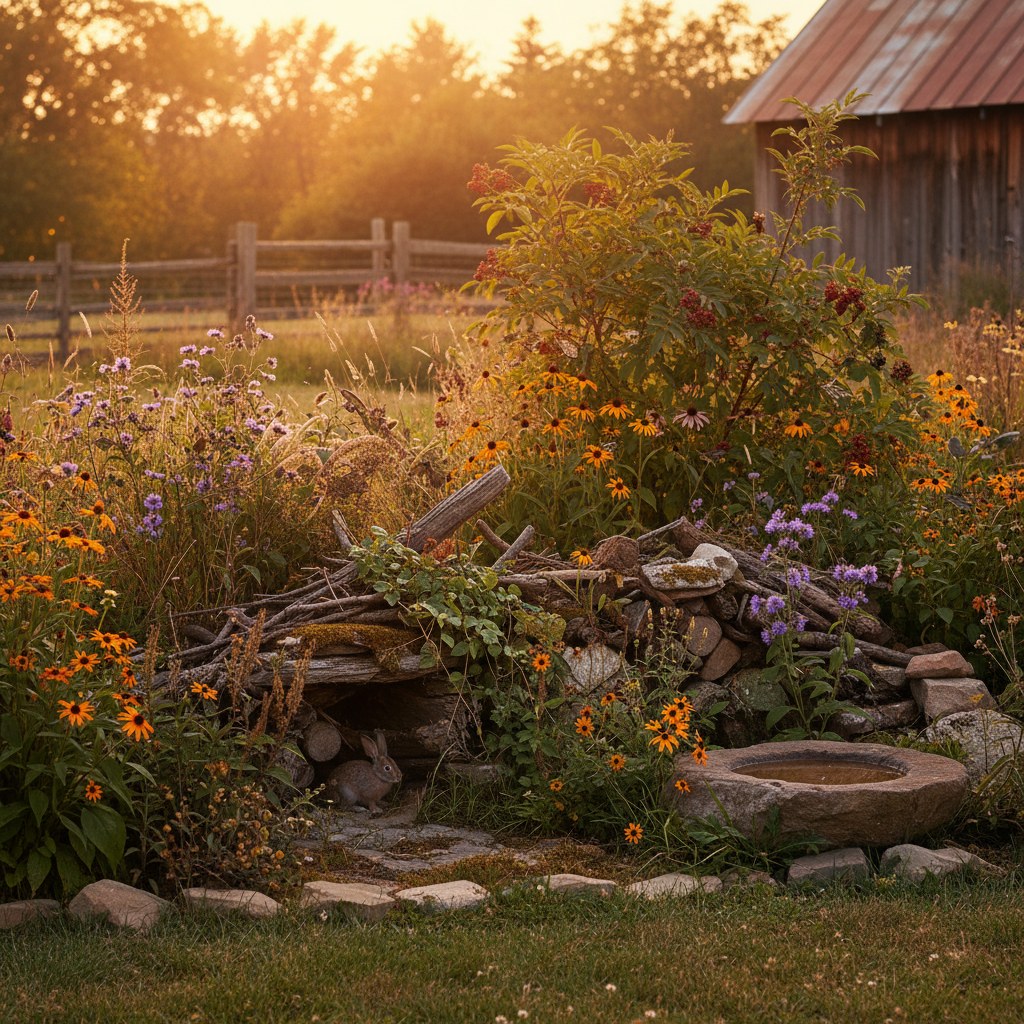
14. Where Should You Place a Bird Bath in a Corner?
Bird bath placement in a corner follows a specific logic: birds need to see predators approaching, so position the bath at least 10 feet from dense shrubs where cats can hide, but within 10–12 feet of trees or tall shrubs where birds can perch and survey before dropping down to drink. A corner location is ideal because two fence or wall sides provide some shelter from wind (which helps keep the water calmer) while the open front gives birds clear sightlines.
The bath itself should have sloping sides, a maximum depth of 2 inches in the center, and a slightly rough surface (unglazed ceramic or stone) for traction. Refresh the water every 2–3 days in summer to prevent mosquito larvae, or add a small solar-powered dripper or wiggler that keeps the water moving. Surround with native berry-producing shrubs like serviceberry, elderberry, or native viburnums to make the corner a complete feeding and bathing station. The Cornell Lab of Ornithology notes that moving water is twice as effective at attracting birds as still water.
Citation: Cornell Lab of Ornithology, “Attracting Birds with Water,” All About Birds resource, allaboutbirds.org.
15. How Do You Build a Butterfly Garden Corner That Actually Attracts Butterflies?
A butterfly garden corner needs two things that most gardeners overlook: host plants (for caterpillars to eat) and a sun trap (butterflies are cold-blooded and need warmth to fly). A sheltered corner facing south or southwest functions as a natural solar collector, the walls absorb and reflect heat, raising the microclimate temperature by several degrees. That’s exactly what butterflies seek out.
For host plants, match species to the butterflies in your region: milkweed for monarchs, parsley and dill for black swallowtails, native violets for fritillaries. For nectar plants to attract adults, prioritize flat-topped flowers in purple, pink, and orange: coneflowers, Joe Pye weed, asters, zinnias, lantana, and butterfly bush (Buddleja), though note that butterfly bush is invasive in some regions, so check your local listings. Add a flat stone in the sunniest part of the corner for basking. For a deeper dive on building a complete pollinator habitat, see our guide on pollinator gardens.
Citation: North American Butterfly Association, “Creating a Butterfly Garden,” naba.org resource library.
16. What Belongs in a Bee Hotel Corner?
A bee hotel corner supports solitary native bees, mason bees, leafcutter bees, mining bees, that don’t live in hives and have suffered significant habitat loss as natural nesting sites (hollow stems, bare soil, dead wood) have disappeared from tidy modern gardens. A properly built bee hotel gives these beneficial pollinators the cavities they need to lay eggs and complete their lifecycle.
The hotel itself should have tubes of varying diameter (3–10mm) to serve different species: hollow bamboo sections, paper tubes, and drilled wood blocks all work. Mount it on a south-facing surface at 1–2 meters height, sheltered from rain but receiving full morning sun to warm the nesting chambers. Surround the hotel with an uninterrupted patch of pollen-rich early spring bloomers: hellebores, pulmonarias, catmint, and single-flowered dahlias give bees continuous forage from March through October. Avoid pesticides in the entire corner area, even pyrethrin-based “organic” sprays harm solitary bee larvae. The Xerces Society provides free regional planting guides for native bee habitat that are the best reference for specific plant selections by climate zone.
Citation: Xerces Society, Attracting Native Pollinators (Storey Publishing, 2011).
17. How Does a Water Feature Corner Work Without a Huge Budget?
A water feature adds sound, movement, and wildlife draw to a garden corner at almost any budget level. At the simplest end, a 20-gallon stock tank or a half-barrel fitted with a small solar pump becomes a self-contained water garden for under $100. At the mid-range, a pre-formed resin pond shell sunk into the ground corner creates a more naturalistic look. Both approaches support frogs, beneficial insects, and birds without the scale or cost of a full in-ground pond.
Plant the water feature with a mix of oxygenating underwater plants (hornwort, anacharis) to keep the water clear, emergent plants at the edges (dwarf cattail, water iris, pickerelweed), and floating plants (water hyacinth, water lettuce) for shade that reduces algae. In a container setup, avoid introducing fish unless the container is at least 150 gallons, in smaller volumes, fish produce more waste than the ecosystem can cycle. No pump is needed if you keep the water-to-plant ratio right: approximately one bunch of oxygenator per 2 square feet of surface area. The Wildlife Trusts (UK) report that a garden pond, regardless of size, is the single highest-impact feature for increasing garden biodiversity.
Citation: The Wildlife Trusts, “Garden Ponds,” wildlifetrusts.org advisory page.
Edible Corners
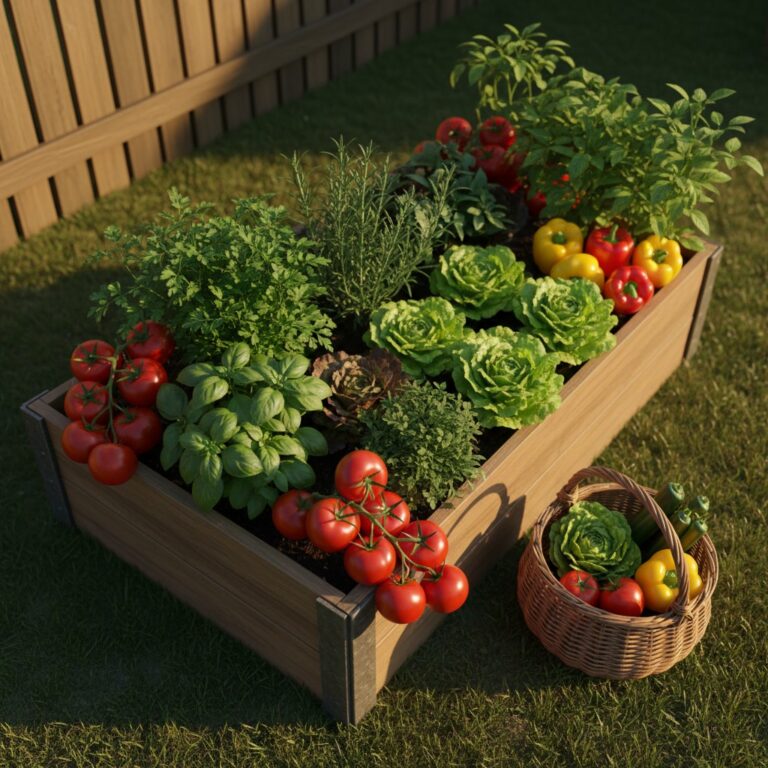
Growing food in a garden corner combines aesthetics with productivity, and corners often have the slightly sheltered, slightly warmer microclimate that edible plants appreciate. These ideas work at scales from a small herb spiral to a full composting system.
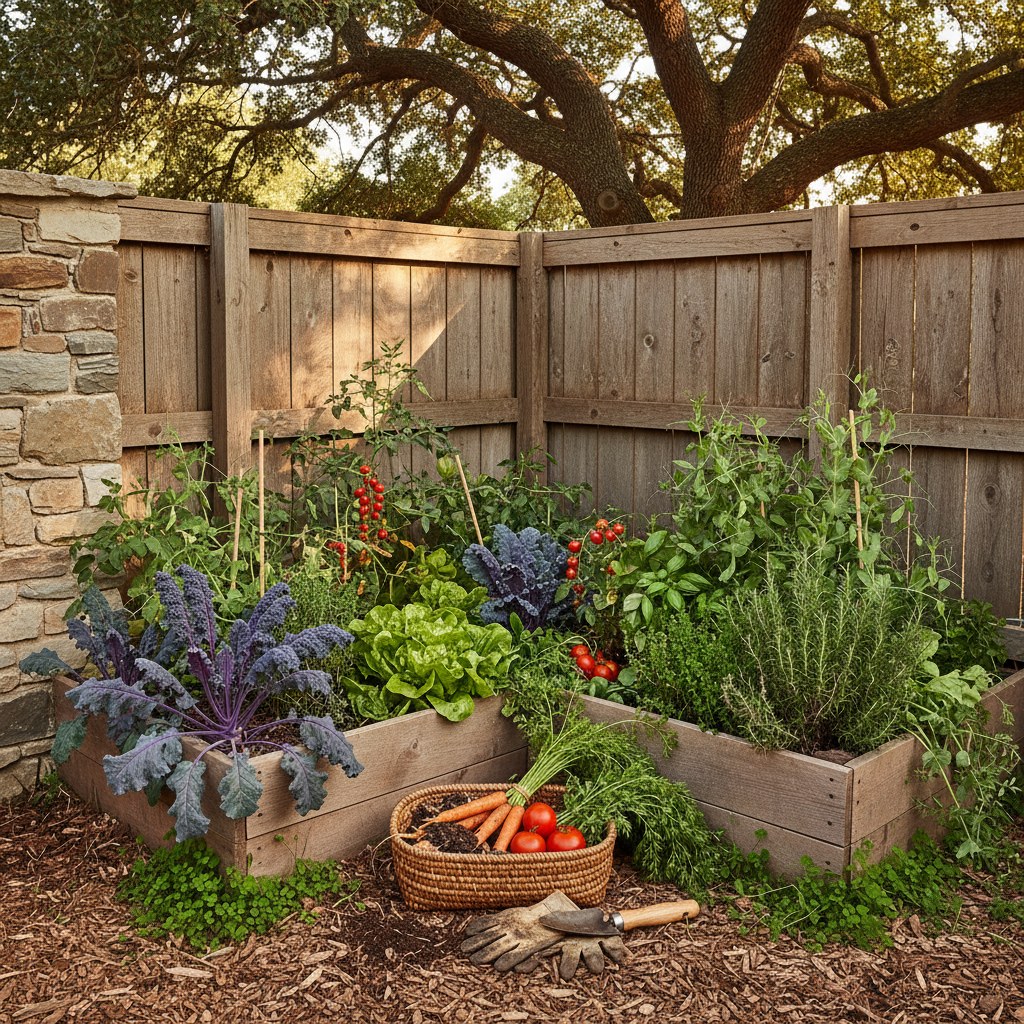
18. Why Is an Herb Spiral the Smartest Way to Use a Small Corner?
An herb spiral is a raised planting structure that spirals upward from a wide base (typically 6 feet in diameter) to a peak about 3 feet high. The vertical variation creates multiple microclimates within a single 6-foot footprint: hot and dry at the top (ideal for Mediterranean herbs like rosemary, thyme, and oregano), cooler and more moisture-retentive at the bottom (perfect for mint, chives, and parsley). A corner location is ideal because the two walls behind the spiral reflect heat and make the structure more visually prominent.
Build the spiral from stacked stone, reclaimed brick, or gabion wire filled with rock, all materials that absorb daytime heat and release it slowly through the evening, extending the growing season. Fill with a lean, free-draining mix at the top (50% compost, 50% grit) grading to a richer, moisture-retaining mix at the base. A well-planted herb spiral provides enough fresh herbs to supply a household of four throughout the growing season. Bill Mollison, who formalized the herb spiral concept in permaculture design, noted that it creates more edge habitat, the most biologically productive zone in any ecosystem, per square foot than any other garden structure.
Citation: Mollison, B., Permaculture: A Designers’ Manual (Tagari Publications, 1988).
19. What Are Ornamental Grasses Doing in an Edible Corner?
Ornamental grasses in an edible corner serve a structural role that vegetables and herbs can’t: they provide year-round form, movement in wind, and autumn and winter interest when the edibles have died back. Several species are genuinely dual-purpose, lemon grass (Cymbopogon citratus) is an ornamental clump grass that also goes into Thai cooking; Miscanthus stems make excellent plant supports and mulch material; and feather reed grass (Calamagrostis) provides excellent beneficial insect habitat at the base of its clumps.
In a corner edible garden, use one or two large ornamental grass clumps as anchors at the back of the planting, then build edible layers in front: medium-height vegetables and herbs in the middle ground, trailing or low edibles at the front edge. The grasses create a windbreak that benefits the more tender edibles and provide the visual backbone that keeps the planting looking intentional even in midsummer when vegetables look scraggly. Cut ornamental grasses back in late winter (leaving 4–6 inches of growth) to allow fresh growth to emerge cleanly in spring.
Citation: Darke, R., The Encyclopedia of Grasses for Livable Landscapes (Timber Press, 2007).
20. How Do You Set Up a Compost Corner That Doesn’t Look (or Smell) Like a Compost Corner?
A well-managed compost corner produces rich compost in 2–6 months, has virtually no odor, and can be made visually attractive enough that visitors don’t realize what it is. The odor problem that most people associate with compost is caused by anaerobic decomposition, too much nitrogen-rich “green” material (food scraps, fresh grass) without enough carbon-rich “brown” material (dry leaves, cardboard, wood chip). Maintain a roughly 3:1 brown-to-green ratio by volume and turn the pile weekly, and a properly managed compost bin is odorless.
For the corner itself, use a slatted wooden bin painted to match the fence, a decorative hori-hori-accessible tumbler mounted on a frame, or a traditional three-bin system made from reclaimed pallets. Screen it visually with a tall ornamental grass like Miscanthus sinensis ‘Gracillimus’ planted just in front, it screens the bin in summer when you’re composting most actively, and it’s cut back in winter when the bin is less in use. A compost corner combined with a potting station nearby creates a complete garden service zone that keeps all the utilitarian work in one area. The EPA estimates that composting food scraps and yard waste diverts 30% of household waste from landfills.
Citation: U.S. Environmental Protection Agency, “Composting At Home,” epa.gov/recycle/composting-home.
21. What Is a Rain Garden Corner and Why Should More People Build One?
A rain garden is a shallow, bowl-shaped depression planted with deep-rooted native plants that captures stormwater runoff, filters pollutants, and allows water to percolate slowly into the soil rather than flowing directly into storm drains. A garden corner is one of the best locations for a rain garden because corners often accumulate runoff naturally, they’re frequently the low point where two fence lines or slope gradients converge.
A properly designed rain garden is typically 30% of the size of the impervious surface draining into it (roof, driveway, patio). For a 300-square-foot roof section, you’d need about 90 square feet of rain garden, a 9×10 foot corner depression is perfect. Excavate 4–8 inches deep, amend the bottom with compost and sand to improve infiltration, and plant with deep-rooted native perennials that tolerate both temporary flooding and drought: swamp milkweed, blue flag iris, wild bergamot, switchgrass, and native sedges. The University of Wisconsin Extension reports that a correctly sized and planted rain garden can absorb 30% more water than an equivalent area of conventional lawn, while simultaneously supporting far more biodiversity.
Citation: University of Wisconsin Extension, “Rain Gardens: A How-To Manual for Homeowners,” publication GWQ037.
Frequently Asked Questions
What is the easiest garden corner idea for a complete beginner?
A corner bench with a few large containers is the most beginner-friendly option because it requires no planting knowledge, no soil preparation, and no commitment to permanent landscaping. Buy or build a simple L-bench, place 3–5 large containers at varying heights, and fill them with one reliable annual each (petunias, geraniums, or marigolds). You can refine the planting over subsequent seasons as you learn what works in your specific corner conditions.
How do you make a shady corner look good?
Shady corners benefit most from high-contrast foliage rather than flowers. Hostas, ferns, astilbe, hellebores, and variegated Solomon’s seal all thrive in shade and provide months of interest. Add a pale-painted bench or furniture to reflect light back into the space, and use light-colored gravel mulch rather than dark bark, both tricks amplify available light significantly. A mirror mounted on the shaded fence (framed to look like a window) doubles the apparent depth and brightness of the space.
How do you deal with a very small garden corner, less than 4 feet wide?
Tight corners call for vertical solutions almost exclusively. A trellis panel with a single climbing plant, a stack of 3–5 wall-mounted pocket planters, or a narrow tiered planter (some are only 12 inches deep) can fill a 4-foot corner handsomely. Avoid placing furniture in very small corners, it makes them feel stuffed rather than designed. Instead, use the corner as a vertical focal point viewed from elsewhere in the garden.
Which garden corner ideas require the least maintenance?
The lowest-maintenance corner options are: a Japanese zen corner (gravel + a few rocks + one slow-growing specimen plant, requires only occasional raking and the odd stone adjustment), ornamental grasses (cut back once a year, otherwise self-sufficient), and a rain garden (once established with deep-rooted natives, requires no watering and minimal weeding after the first year). A succulent wall is also extremely low-maintenance once established in the right climate zone.
Can you combine multiple ideas in one corner?
Yes: layering two or three compatible ideas is usually better than a single concept. Strong combinations: corner bench + trellis arch overhead + hanging baskets on the fence behind (seating + vertical + containers); herb spiral + bee hotel + butterfly host plants (edible + wildlife); bird bath + water feature + native berry shrubs (two wildlife elements reinforcing each other). The trick is not to overcrowd, leave at least 30% of the corner as negative space so the eye has somewhere to rest.