How to Dry and Store Herbs: 5 Methods for Year-Round Flavor
nn
Key Takeaways
n
- n
- Harvest herbs in the morning after dew dries but before midday heat, ideally just before the plant flowers for peak essential oil concentration.
- The five main drying methods — air drying, oven drying, dehydrator, microwave, and freeze drying — each suit different herbs and situations.
- Air drying is best for sturdy, low-moisture herbs like rosemary, thyme, oregano, and sage.
- Store dried herbs in airtight glass jars away from heat, light, and moisture. Most retain good flavor for 1-3 years.
- Some herbs (basil, chives, parsley, cilantro) lose significant flavor when dried and are better preserved by freezing.
n
n
n
n
n
n
nn
There’s a moment every summer when the herb garden hits peak abundance. The basil is chest-high, the oregano is threatening to take over the walkway, and you have more rosemary than you could use in a decade of Sunday roasts. You can only give away so many bundles to the neighbors before they start avoiding eye contact. The smart move is to preserve that bounty so you’re cooking with homegrown herbs all winter long.
nn
Dried herbs from the grocery store are fine in a pinch, but they’re often months (or years) old by the time they reach your spice rack. Herbs you dry yourself, from plants you grew, harvested at the right time and stored properly, are in a completely different league. The flavor is brighter, the aroma is stronger, and the satisfaction of reaching for a jar of your own oregano in January is hard to beat.
nn
When to Harvest Herbs for Drying
nn
Timing your harvest is arguably more important than the drying method you choose. The essential oils that give herbs their flavor and aroma fluctuate throughout the day and the plant’s life cycle.
nn
Time of Day
n
Harvest in the morning, after the dew has evaporated but before the sun gets intense — typically between 9 and 11 AM. The essential oils are most concentrated at this time. By afternoon, heat causes many of these volatile compounds to dissipate into the air. That incredible smell you get walking past your herb garden at midday? Those are the oils you want to capture, leaving the plant.
nn
Growth Stage
n
For most herbs, the ideal harvest window is just before the plant flowers. This is when essential oil concentration peaks. Once a plant begins flowering, it redirects energy from leaf production to reproduction, and the flavor of the foliage often becomes weaker or more bitter. If your herbs have already started flowering, harvest immediately — they’re still perfectly usable, just slightly past their prime.
nn
How Much to Take
n
A good rule is to never remove more than one-third of the plant at once. This allows it to recover and produce another flush of growth. For herbs you’re cutting back hard at the end of the season (before frost), you can take more. Perennial herbs like rosemary and thyme will appreciate a good harvest as a form of pruning.
nn
Method 1: Air Drying
nn
This is the oldest and simplest method, and it’s still one of the best for sturdy, low-moisture herbs.
nn
Best for: Rosemary, thyme, oregano, sage, marjoram, lavender, dill (seed heads), bay leaves
nn
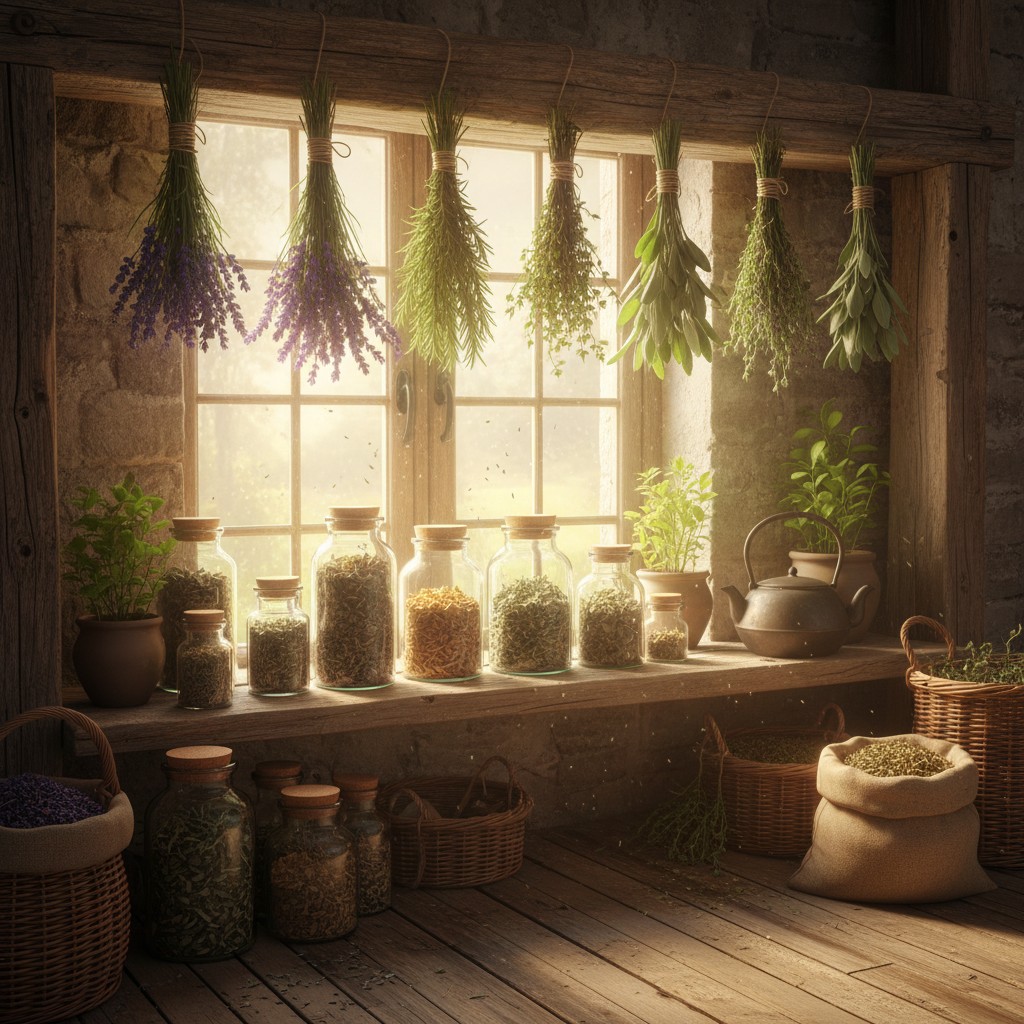
How to do it: Gather small bundles of 4-6 stems and secure them with a rubber band (stems shrink as they dry, so string often loosens and drops your bundle on the floor). Hang the bundles upside down in a warm, dry, well-ventilated area away from direct sunlight. A kitchen, covered porch, attic, or closet all work. Some people hang them from a clothesline or a simple rack made from a wooden hanger.
nn
For herbs with small leaves or seeds (thyme, oregano, dill), place the bundles inside a paper bag with small holes punched in it. The bag catches any leaves or seeds that fall during drying and prevents dust from settling on the herbs.
nn
Time: 1-3 weeks depending on humidity and herb thickness.
nn
Pros: No equipment needed. Preserves flavor and color well. Herbs look beautiful hanging in the kitchen.
nn
Cons: Slow. Doesn’t work well in humid climates (above 60% humidity, herbs may mold before they dry). Not suitable for high-moisture herbs like basil.
nn
Method 2: Oven Drying
nn
Faster than air drying and requires no special equipment beyond your kitchen oven.
nn
Best for: Any herb, but particularly useful for high-moisture herbs that don’t air-dry well: basil, mint, lemon balm, parsley
nn
How to do it: Strip leaves from stems and spread them in a single layer on a parchment-lined baking sheet. Set your oven to the lowest possible temperature — ideally 170°F or lower. If your oven doesn’t go below 200°F, prop the door open slightly with a wooden spoon to reduce the effective temperature. Higher heat will cook the herbs rather than dry them, destroying the essential oils you’re trying to preserve.
nn
Check every 30 minutes, stirring the leaves gently. Most herbs will be dry within 1-4 hours. They’re done when they crumble easily between your fingers but haven’t turned brown.
nn
Pros: Much faster than air drying. Works in any climate. Equipment-free.
nn
Cons: Easy to over-dry or scorch. Oven temperature can be hard to control at low settings. Ties up your oven for hours. Energy-intensive for small batches.
nn
Method 3: Food Dehydrator
nn
If you dry herbs (or anything else) regularly, a food dehydrator is a worthwhile investment. It provides consistent low heat with good airflow — exactly what herbs need.
nn
Best for: All herbs, especially large batches and high-moisture varieties
nn
How to do it: Strip leaves from stems (or leave small-leafed herbs like thyme on the stem). Arrange in a single layer on dehydrator trays. Set the temperature to 95-115°F. Higher temperatures work but sacrifice some flavor and color. According to the National Center for Home Food Preservation, 95°F is the ideal temperature for drying herbs, as it’s warm enough to remove moisture but cool enough to preserve volatile oils.
nn
Drying time varies by herb. Thin-leaved herbs like dill and parsley may be done in 1-3 hours. Thick-leaved herbs like sage and basil can take 4-8 hours. Check periodically.
nn
Pros: Consistent results. Set it and forget it (mostly). Works for all herbs. Energy-efficient compared to oven drying. Can dry large quantities at once.
nn
Cons: Requires purchasing equipment ($40-$80 for a basic model). Takes up counter or storage space.
nn
Method 4: Microwave Drying
nn
Here’s what most guides won’t tell you: the microwave is actually a legitimate herb-drying tool when you need small quantities dried fast. It’s not ideal for large batches, but for a handful of basil or a few sprigs of parsley, it works surprisingly well.
nn
Best for: Small quantities of any herb, especially when you need dried herbs right now
nn
How to do it: Place a single layer of clean, dry herb leaves between two paper towels on a microwave-safe plate. Microwave on high for 1 minute. Check. Continue microwaving in 20-second intervals until the leaves are dry and crumbly. Total time is usually 2-3 minutes depending on the herb and your microwave’s power.
nn
Pros: Extremely fast. No special equipment. Good color retention due to short drying time.
nn
Cons: Only practical for small amounts. Easy to overdo — one 20-second interval can take herbs from perfectly dry to scorched. Doesn’t produce quite the same depth of flavor as slower methods.
nn
Method 5: Freeze Drying
nn
Freeze drying produces the highest-quality dried herbs by a significant margin. The process removes moisture through sublimation (ice turning directly to vapor without passing through a liquid phase), which preserves the cell structure, color, and essential oils far better than heat-based methods.
nn
Best for: All herbs, but especially delicate herbs that lose flavor with other methods: basil, chives, cilantro, parsley, tarragon
nn
How to do it: Spread prepared herbs on freeze dryer trays in a single layer and run a standard cycle (typically 18-24 hours). If you don’t own a freeze dryer, some communities have shared units through local food preservation groups, or you can use a DIY approach: spread herbs on a tray in a single layer and place in a deep freezer (0°F or colder) for 2-3 weeks. This isn’t true freeze drying, but the extremely low humidity inside a frost-free freezer will slowly sublimate the moisture. The results aren’t as good as a dedicated freeze dryer but are better than you might expect.
nn
Pros: Superior flavor, color, and nutrient retention. Herbs rehydrate to near-fresh quality.
nn
Cons: Home freeze dryers are expensive ($2,000-$4,000). Energy-intensive. Overkill for hardy herbs that air-dry perfectly well.
nn
Which Herbs Dry Best — And Which You Should Freeze Instead
nn
Not all herbs respond well to drying. As a general rule, herbs with lower moisture content and stronger essential oils dry beautifully, while tender, high-moisture herbs lose significant flavor.
nn
Herbs That Dry Exceptionally Well
n
- n
- Oregano: Arguably better dried than fresh. The flavor concentrates and deepens. Shelf life of 2-3 years.
- Thyme: Retains its flavor extremely well. Dries quickly due to small leaf size.
- Rosemary: Nearly indestructible. Dried rosemary can maintain good potency for 3+ years stored properly.
- Sage: Dries well and develops a slightly more mellow, complex flavor.
- Bay leaves: Actually improve with drying — fresh bay can be somewhat bitter and one-dimensional.
- Marjoram: Sweet, delicate flavor holds up well through drying.
n
n
n
n
n
n
nn
Herbs Better Preserved by Freezing
n
- n
- Basil: Loses much of its brightness when dried. Freeze whole leaves in a single layer, then transfer to a freezer bag. Or blend with olive oil and freeze in ice cube trays.
- Chives: Turn papery and lose most flavor when dried. Chop and freeze flat in a zip-top bag.
- Cilantro: Barely worth drying — the flavor is almost entirely lost. Freeze in ice cube trays with a splash of water or oil.
- Parsley: Dried parsley is functional but bland compared to frozen. Flat-leaf (Italian) parsley freezes particularly well.
- Tarragon: The anise flavor is volatile and dissipates quickly with heat-based drying. Freeze in oil or vinegar.
n
n
n
n
n
nn
Proper Storage for Maximum Shelf Life
nn
All that careful harvesting and drying is wasted if you store your herbs improperly. The enemies of dried herbs are light, heat, air, and moisture.
nn
- n
- Containers: Glass jars with tight-fitting lids are ideal. Mason jars work perfectly. Avoid plastic bags and containers, which can absorb oils and aren’t fully airtight. Metal tins work in a pinch but can impart a slight flavor over time.
- Location: Store in a cool, dark place. A pantry or cabinet away from the stove is perfect. Never store herbs on a spice rack near the stovetop — the heat and light accelerate degradation dramatically. That cute open shelf with matching glass jars next to the range looks great on Instagram, but your herbs will taste like cardboard within a few months.
- Preparation: Store leaves whole whenever possible and crush or crumble them just before use. Whole leaves retain their essential oils much longer than pre-crushed herbs. A dried whole oregano leaf will stay potent for years; the same leaf crushed into flakes starts losing flavor within months.
- Labeling: Always label with the herb name and the date dried. It sounds obvious, but dried sage, oregano, and thyme can look remarkably similar after a few months in matching jars.
n
n
n
n
nn
Shelf Life by Herb
n
- n
- Rosemary, thyme, oregano, sage: 2-3 years with proper storage
- Bay leaves: 2-3 years
- Mint, marjoram, dill weed: 1-2 years
- Basil, parsley (dried): 6-12 months (another reason to freeze these instead)
- Lavender (for cooking): 2-3 years
n
n
n
n
n
nn
The simplest freshness test: crush a small amount between your fingers and smell. If the aroma is strong and immediate, the herb is still good. If you have to hold it to your nose and really search for the scent, it’s time to replace it.
nn
Frequently Asked Questions
nn
How do I convert fresh herb quantities to dried in recipes?
n
The standard ratio is 3:1 — three parts fresh equals one part dried. So if a recipe calls for one tablespoon of fresh thyme, use one teaspoon of dried. This works for most herbs, though some (like rosemary) are so potent when dried that you might want to start with even less and adjust to taste.
nn
Can I dry herbs that have already started flowering?
n
Yes. The flavor may be slightly weaker or more bitter than pre-flower herbs, but they’re still perfectly usable. In some cases, the flowers themselves are edible and flavorful — lavender flowers, chive blossoms, and oregano flowers are all worth drying and using.
nn
Why did my dried basil turn black?
n
Basil is uniquely prone to oxidation during drying. The leaves turn dark when exposed to slow heat or prolonged air exposure. To minimize this, dry basil quickly — a dehydrator at 95°F or the microwave method gives the best color. Even then, some darkening is normal. The flavor is usually still fine even when the color isn’t Instagram-perfect. For the best color and flavor retention, freeze basil instead of drying it.
nn
Is it safe to dry herbs outdoors in the sun?
n
Sun drying is traditional in Mediterranean climates, but it’s generally not recommended for herbs. UV radiation breaks down the essential oils and chlorophyll, resulting in faded color and diminished flavor. The exception is herbs being dried primarily for tea (like chamomile), where a slight mellowing of flavor is acceptable. For culinary herbs, dry in the shade with good airflow or use one of the indoor methods described above.
nn