Wellness Mama Elderberry Syrup Recipe: The Classic Version, Made Safely
Wellness Mama Elderberry Syrup Recipe: The Classic Version, Made Safely
A single batch of the Wellness Mama elderberry syrup uses about 1 cup of dried berries, 3 cups of water, warming spices, and 1 cup of raw honey, yielding roughly 2 cups of finished syrup. That recipe, published by Katie Wells at wellnessmama.com, is one of the most searched homemade remedies on the internet. It is also the recipe most homesteaders remember making the first time they tried to build a winter medicine shelf.
This guide walks through the exact ratios, why the boil-and-reduce step is not optional, how long the finished syrup really keeps according to the University of Maine Cooperative Extension (spoiler: not the two months you often see quoted), what the peer-reviewed clinical evidence actually shows, and how to adapt the recipe for children, long storage, and honey-free households. After four winters of running elderberry syrup out of our zone 6b kitchen, I have tried the honey-only, brandy-preserved, and vinegar oxymel versions of this recipe; the notes below cover which one holds up.
Two safety points up front. Raw elderberries and every green part of the plant contain cyanogenic glycosides; cooking is what makes the syrup safe. And raw honey is unsafe for babies under 12 months regardless of how long the syrup was simmered, because botulinum spores survive normal cooking heat, per the Centers for Disease Control and Prevention.
What Is the Wellness Mama Elderberry Syrup Recipe?
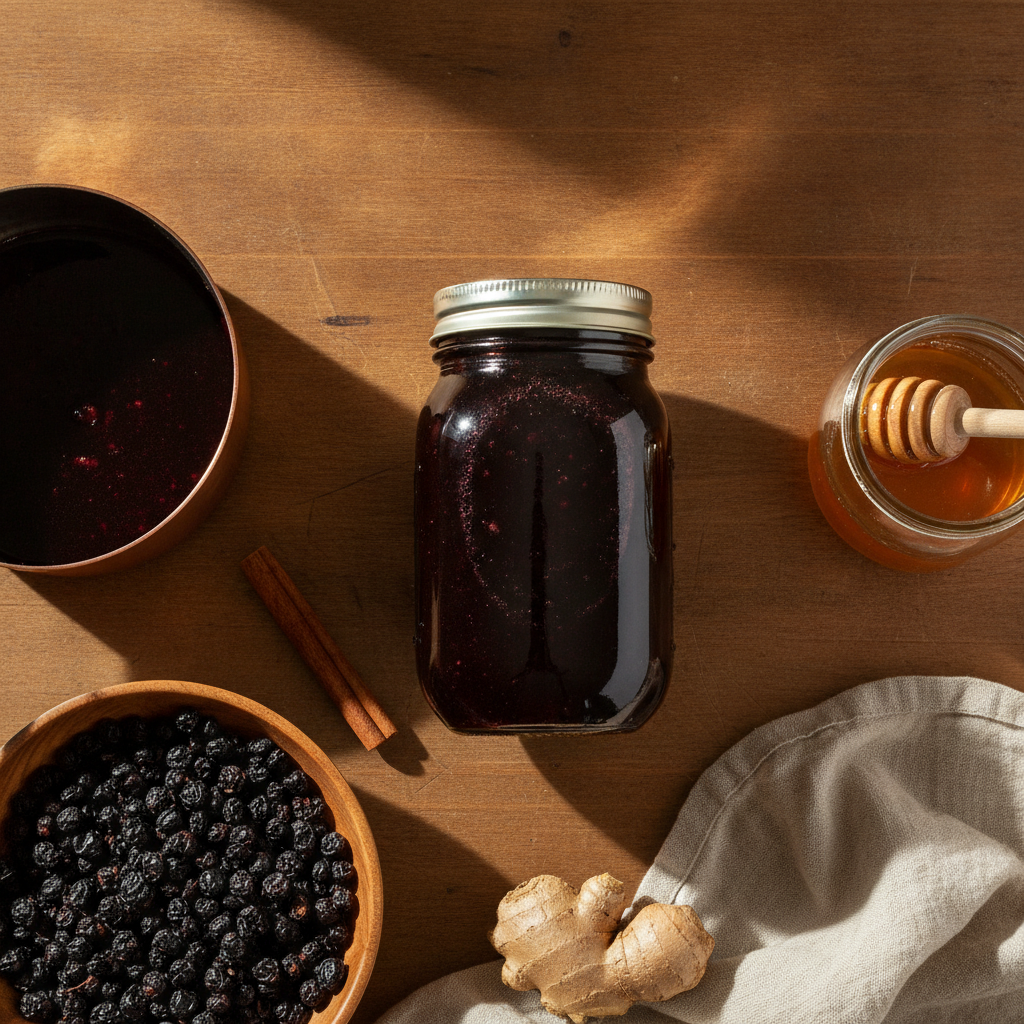
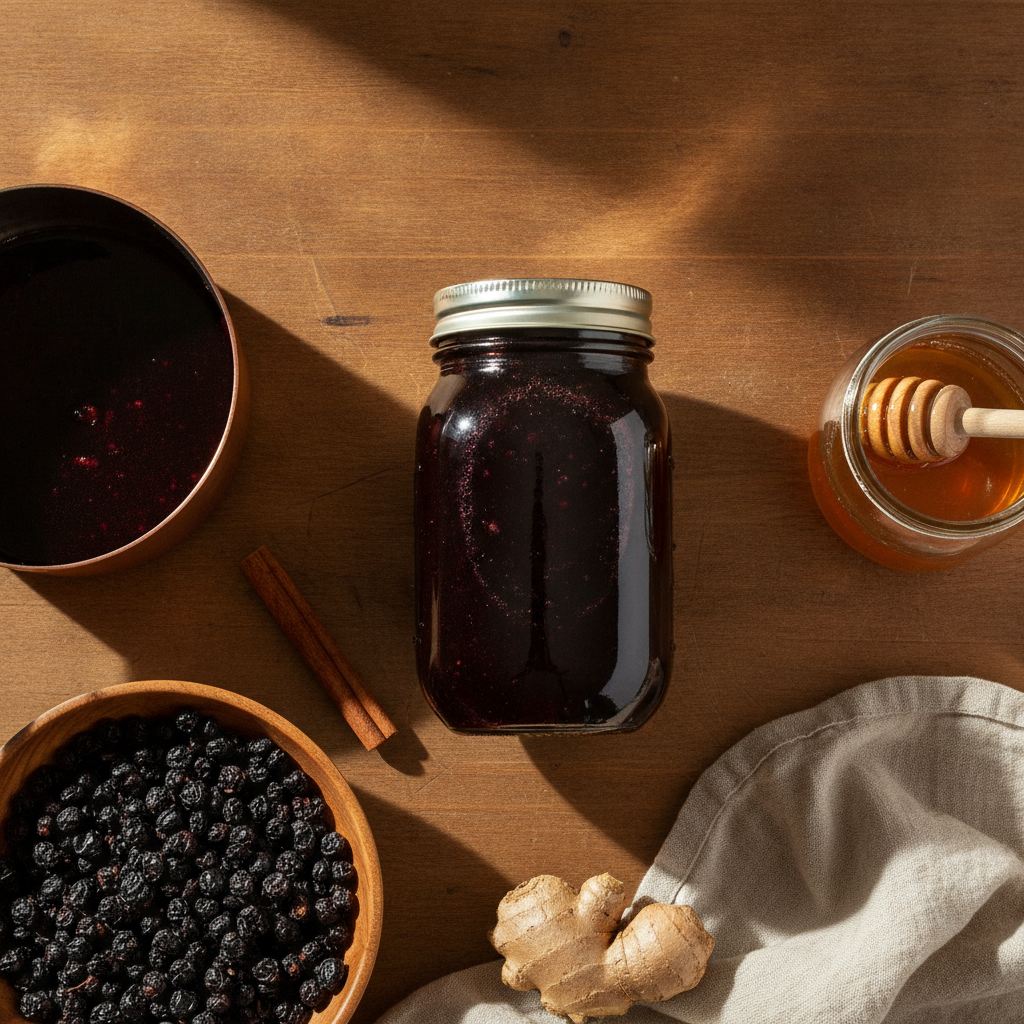
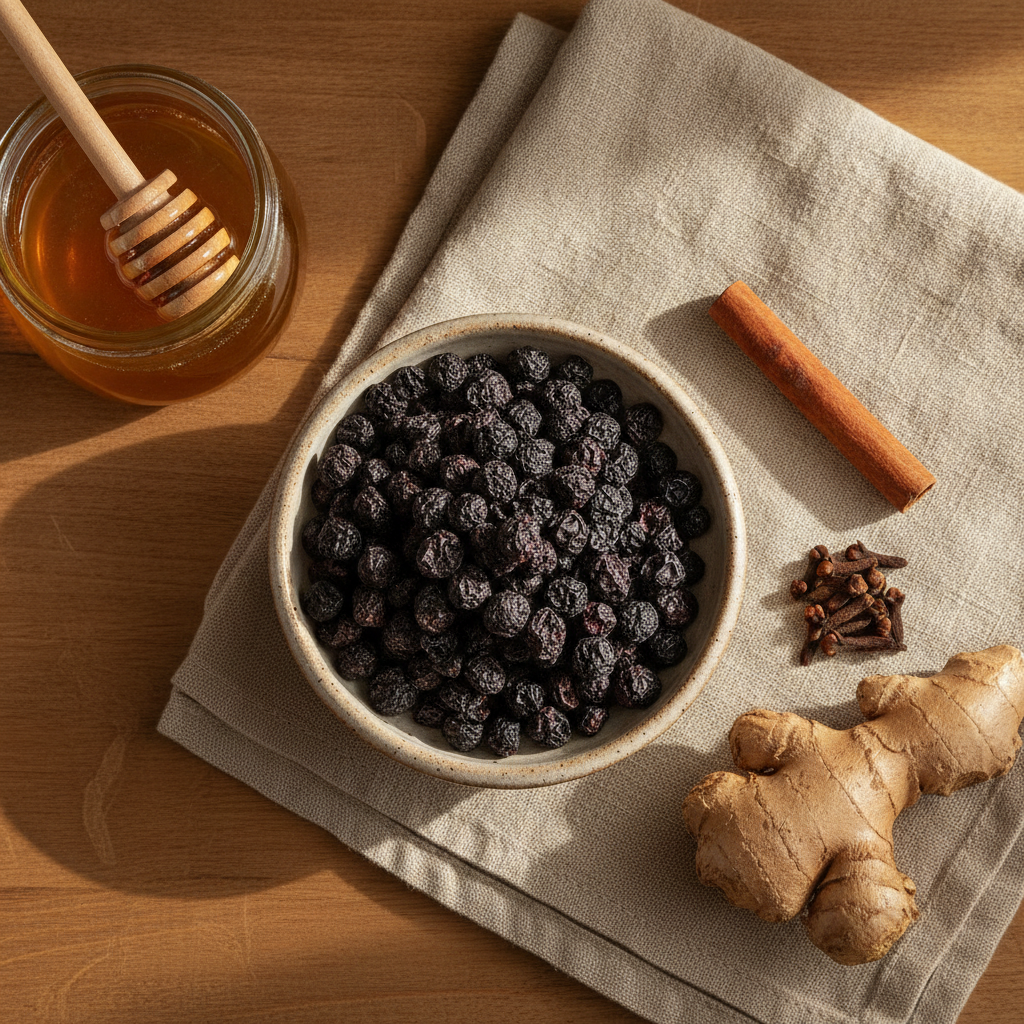
The Wellness Mama elderberry syrup recipe is a honey-based decoction of dried Sambucus berries simmered with warming spices, strained, and preserved in raw honey at a roughly 1:1 juice-to-honey ratio. According to the recipe as published by Katie Wells on wellnessmama.com, the core ingredient list is 1 cup of organic dried elderberries, 3 to 4 cups of water, 2 tablespoons of fresh or dried ginger root, 1 teaspoon of cinnamon powder (or 1 to 2 cinnamon sticks), a half teaspoon of cloves (or 5 to 10 whole cloves), and 1 cup of raw honey. The method: bring everything except the honey to a boil, drop to a simmer for roughly 30 minutes or until the liquid has reduced by half, cool to lukewarm, strain, then stir in the honey.
The recipe yields about 2 cups of finished syrup. Wellness Mama recommends 1 tablespoon per day for adults and 1 teaspoon for children (over age 1) as a daily maintenance dose, doubled to every 2 to 3 hours at the first sign of illness. The blend is straightforward, and that simplicity is why the recipe traveled so far online. What most republishers of the recipe leave out is the tighter refrigerator shelf life that university extension services now recommend, and the exact reason cooking is not optional. Both are covered below.
Why Must Every Elderberry Recipe Cook the Berries First?
Every elderberry syrup recipe worth following boils and simmers the berries because raw elderberries and all green plant parts contain cyanogenic glycosides that release cyanide during digestion. According to Oregon State University Extension bulletin EM-9446, “eating raw elderberries or drinking raw elderberry juice can cause nausea, and in some instances has led to serious illness and hospitalization. Cyanogenic glycosides are naturally occurring plant molecules… During digestion, these compounds release cyanide, which goes into the bloodstream and prevents proper oxygen utilization.” The compound of concern is sambunigrin, and Oregon State Extension confirms it is concentrated in the seeds, leaves, and stems, but that “cooking the berries destroys the toxins in the seeds.”
The most cited real-world case is the 1983 Monterey County, California outbreak documented in the CDC’s Morbidity and Mortality Weekly Report. According to that report, staff at a religious retreat had “gathered local, wild elderberries 2 days before the outbreak and prepared juice from them the next day by crushing bunches of berries with their leaves and branches in a stainless-steel press.” Eleven people vomited within 15 minutes; eight were airlifted to a hospital, and severity tracked with the volume consumed. Two lessons apply to any home syrup batch: strip berries from stems before cooking, and never taste the raw slurry.
How much of the toxin is actually in ripe fruit?
A 2021 peer-reviewed analysis of American elderberry cultivars (Appenteng et al., Molecules, PMC7961730) reported that “levels of CNGs found in various fruit tissues of American elderberry cultivars studied ranged from between 0.12 and 6.38 µg/g,” with seeds carrying the highest load. Ripe, fully colored berries fall at the low end. Green or unripe berries and any pieces of leaf or stem push the number toward the top of that range, which is why hand-stripping the clusters and then boiling for the full simmer time matters more than any specific brand of berry.
How Do You Make the Recipe Step by Step?
Follow a boil-simmer-strain-honey sequence, working with cool honey after the decoction has dropped below 115 degrees Fahrenheit so live enzymes and flavor survive. The University of Maine Cooperative Extension summarizes the base method: “combine fresh, frozen, or dried berries with water and the flavoring ingredients, then bring the mixture to a boil and simmer to reduce it into a syrup.” The Wellness Mama version sits inside that safe framework. What follows is the recipe as she publishes it, with the small adjustments that university extension guidance recommends layered in.
- Combine berries, water, and spices. In a 2-quart saucepan, add 1 cup dried elderberries, 3 to 4 cups filtered water, 2 tablespoons fresh grated ginger (or 1 tablespoon dried), 1 teaspoon ground cinnamon or 1 to 2 sticks, and a half teaspoon ground cloves or 5 to 10 whole. Stir once.
- Boil, then simmer 30 to 45 minutes. Bring to a rolling boil, cover partially, and reduce to a gentle simmer. UMaine Extension advises simmering “until the liquid is reduced by about half.” Crush the softened berries against the pan with a wooden spoon halfway through to release the juice.
- Cool, then strain. Turn off the heat and let the pot cool for 20 minutes. Pour through a fine-mesh sieve or nut milk bag set over a heatproof bowl, pressing the pulp firmly to extract every drop. You should recover about 2 cups of dark juice.
- Cool to lukewarm before adding honey. Wait until the juice reads below 115 degrees Fahrenheit on an instant-read thermometer, then whisk in 1 cup of raw honey until smooth.
- Bottle and refrigerate. Sterilize a pint jar (boil submerged for 10 minutes), pour the syrup in warm, cap, label with the date, and refrigerate immediately.
Should you use dried, fresh, or frozen berries?
All three work; the swap is a matter of moisture. Dried berries are the most common because they store easily and travel well through the mail. Fresh or frozen berries are the preferred substitute if you grow your own or forage American elderberry (Sambucus canadensis), which West Virginia University Extension notes grows across USDA zones 3 through 9. Fresh berries carry more water, so use less added water and simmer slightly longer. The table below shows the swap ratios for the same 2-cup yield.
| Berry form | Amount | Water | Simmer time | Notes |
|---|---|---|---|---|
| Dried | 1 cup | 3 to 4 cups | 30 to 45 min | Wellness Mama default |
| Fresh | 2 cups | 2 to 3 cups | 30 min | Strip stems first; stems boost sambunigrin |
| Frozen | 2 cups | 2 to 3 cups | 30 to 40 min | No need to thaw first |
How Long Does Homemade Elderberry Syrup Actually Last?
The honest answer is 2 weeks refrigerated by university extension standards, not the 2 months the original Wellness Mama post cites; freezing extends that to 6 to 8 months. According to the University of Maine Cooperative Extension, “recent research shows that elderberries are not acidic enough to preserve by canning like other berries,” and the extension recommends “making small batches of syrup or juice that can be kept in the refrigerator and used within two weeks or frozen and used within 6 to 8 months.” That guidance is stricter than the shelf life you see repeated on remedy blogs, and it exists because raw honey, though naturally antimicrobial, does not lower the pH of the juice enough to guarantee shelf stability against yeasts and molds over months in the fridge.
Penn State Extension puts numbers on the acidity problem. Its research team found “the average pH of elderberry fruit was 4.92 across all varieties and samples, with a range of 4.73 to 5.19,” while “the maximum pH for safe canning of fruits and fruit products is 4.60.” That is why boiling-water canning of elderberry syrup is unsafe: the pH sits above the botulinum cutoff. Penn State’s recommendation is blunt: “elderberries are low in acid and cannot be safely made into syrup or the berries canned using Extension-recommended recipes… freezing the product is recommended instead.” For beginners on the general preservation questions this raises, our water bath canning beginner guide and homemade salsa canning recipe show the pH-testing habits that keep pantry jars safe.
The safest freezer strategy for a family batch
Pour cooled syrup into a silicone ice-cube tray in tablespoon portions and freeze until solid, then transfer the cubes to a labeled freezer bag. Each cube is one adult dose. Pull one per morning during cold and flu season and let it thaw in a small dish of warm water or a mug of tea. This trick sidesteps the two-week refrigerator window entirely and matches UMaine Extension’s 6- to 8-month freezer allowance. On our place, one September batch of 4 cups produces about 60 dose cubes, enough to run our family from November through April.
Does the Science Actually Support the Immune Claims?
Two randomized, double-blind, placebo-controlled trials suggest standardized elderberry syrup shortens influenza symptoms by roughly 3 to 4 days, though the study populations are small and results have not been replicated in a large emergency-department trial. The landmark study is Zakay-Rones et al. 2004, published in the Journal of International Medical Research (SAGE, doi 10.1177/147323000403200205). In that trial, “patients received 15 ml of elderberry or placebo syrup four times a day for 5 days” and “symptoms were relieved on average 4 days earlier and use of rescue medication was significantly less in those receiving elderberry extract compared with placebo.” A 2016 randomized trial in air travelers (Tiralongo et al., PMC4848651) also reported reduced cold duration and severity with elderberry supplementation.
The proposed mechanism is direct viral blockade at the cell surface. Peer-reviewed work indexed in PubMed (Torabian et al. 2019, S1756464619300313; Kinoshita et al. 2012 on hemagglutinin binding) describes elderberry anthocyanins binding to the influenza virus’s hemagglutinin spike protein, the exact protein flu uses to attach to the sialic acid receptors on your airway cells. Block the spike, and the virus cannot enter. The evidence is strong enough that most homestead herbalists treat elderberry as a symptom-shortener rather than a preventive, and weak enough that no responsible source calls it a substitute for vaccination or medical care.
What elderberry does not do
Elderberry syrup is not an antibiotic; it does nothing for bacterial infections such as strep throat or bacterial pneumonia. It is not a substitute for the flu vaccine, which the CDC still recommends for people over 6 months old. And it does not prevent COVID-19; the 2020 wave of viral posts claiming an elderberry-cytokine-storm risk was based on hypothetical extrapolation and never demonstrated in clinical data, but the corresponding immune-boost claims were also unsupported. Treat this syrup as one tool in a broader home-remedy kit alongside rest, fluids, and steam, not a cure-all.
Who Should Not Take Elderberry Syrup?
Infants under 12 months, people on immunosuppressive drugs, and anyone with a known Sambucus allergy should skip this recipe or ask a clinician first. The infant restriction is the strictest, and it has nothing to do with the elderberries themselves. According to the Centers for Disease Control and Prevention, “honey given to children younger than 12 months may cause a severe food poisoning called botulism. Do not give your child honey until they are at least 12 months old.” The CDC further notes that “botulinum spores are heat-resistant, meaning they can survive elevated temperatures, including those used in baking or cooking.” Simmering the syrup does not neutralize the risk, because the honey is added off the heat, and even if it were boiled, the spores would survive.
Pregnancy and lactation guidance is less settled. Most conservative herbalists recommend cooked elderberry syrup is acceptable in small culinary doses during pregnancy, but that a clinician should sign off before using it in medicinal doses. People taking immunosuppressive drugs, including anti-rejection drugs after organ transplant or corticosteroids for autoimmune disease, should not use elderberry, since its immune-stimulating action can theoretically antagonize those medications. A rare Sambucus allergy also exists; if the first tablespoon triggers a rash or throat tightness, stop.
The honey-free swap for babies over 6 months
For a household with an infant, replace the honey with pure maple syrup (grade B or dark amber for the deepest flavor), which is safe from 6 months onward. The swap is 1:1 by volume, and the shelf life is comparable at 2 weeks refrigerated. Freeze the extra in tablespoon cubes just like the honey version. Note that a maple-sweetened batch is thinner and less viscous, so shake before dosing.
How Do You Adapt the Recipe for Kids, Adults, and Long Storage?
Adjust the dose by age and swap the preservation base for shelf life, keeping the same cooked-berry decoction as the starting point. A common family setup uses one jar of honey syrup in the fridge for daily use and one bottle of alcohol-preserved tincture on the pantry shelf as backup. The Wellness Mama dose scheme (1 tablespoon adult, 1 teaspoon child) works as a maintenance approach, and doubles during acute illness. Adults can safely take up to 4 tablespoons per day during an active cold based on the 2004 Zakay-Rones dosing schedule of 15 ml four times daily. Children under 12 should not exceed 4 teaspoons daily, and infants under 12 months should not take the honey version at all.
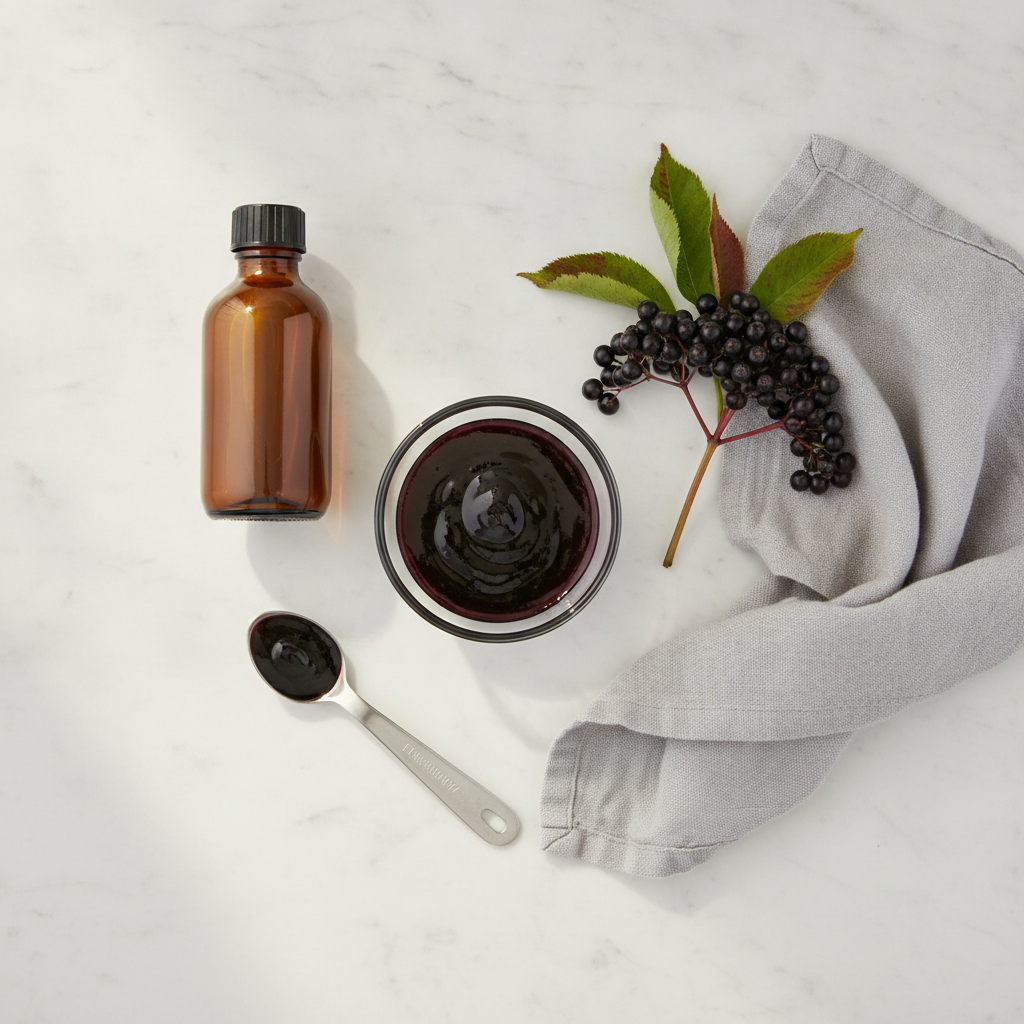
The preservation swap is where the recipe branches. Honey syrup keeps 2 weeks in the fridge according to UMaine Extension, or 6 to 8 months frozen. A brandy-added version (a quarter cup of 80-proof spirit stirred into 1 cup of finished syrup) stretches refrigerator life to about 6 months by dropping the water activity. A vinegar oxymel (equal parts elderberry juice, apple cider vinegar, and honey) tastes sharper but keeps up to 12 months refrigerated. A straight alcohol tincture (1 part dried berries to 2 parts 80-proof vodka, cold-infused for 4 to 6 weeks) is not a syrup at all, but it is the shelf-stable insurance policy for a homestead medicine cabinet. The comparison table below shows which is which.
| Preparation | Ratio | Refrigerated shelf life | Room temp shelf life | Best for |
|---|---|---|---|---|
| Honey syrup (Wellness Mama) | 1:1 juice to honey | 2 weeks (UMaine) or 2 months (WM) | Not recommended | Daily family use, over age 1 |
| Honey syrup with brandy | 1:1 juice:honey + 25% brandy | 6 months | Not recommended | Adult use, longer storage |
| Frozen syrup cubes | Standard 1:1 recipe, portioned | Thawed portion: 3 days | 6 to 8 months frozen | Whole-winter family supply |
| Apple cider vinegar oxymel | 1 juice : 1 vinegar : 1 honey | 12 months | 3 to 6 months | Sour palates, long-term pantry |
| Alcohol tincture | 1 berry : 2 parts 80-proof spirit | Not needed | 3 to 5 years | Adult emergency shelf, travel |
Sourcing tips: dried, fresh, or grow your own
Buy dried Sambucus nigra berries from a reputable herb supplier (Mountain Rose Herbs, Frontier Co-op, or Starwest Botanicals are common choices) and check the packing date. Dried elderberries lose potency after about 2 years even when stored well. If you grow your own, University of Missouri Extension notes American elderberry (Sambucus canadensis) has “far lower concentrations of cyanogenic glycosides” than European types, which is a plus for beginner producers. Pair two cultivars for cross-pollination, harvest whole clusters, and freeze the berries off the stem to make winter syrup runs a 20-minute job.
How Does This Recipe Fit Into a Broader Homestead Medicine Kit?
Elderberry syrup sits alongside a small set of shelf staples that cover most household coughs, cold sores, and minor first aid: a jar of raw honey, a bottle of apple cider vinegar, a tincture of echinacea root, and a jar of infused garlic-and-thyme oil. Adding elderberry syrup gives that kit a targeted antiviral for the cold-and-flu window, and the same simmer-strain-preserve technique transfers directly to a dozen other homestead skills. The 2004 Zakay-Rones trial is what pulled elderberry into mainstream conversation, and it has stayed there because the decoction method is easy, the ingredients are cheap, and the results, though modest, are measurable.
The technique overlap with other preservation skills is what makes elderberry syrup a natural gateway project. The reduce-and-preserve method is the same one behind homemade herb butter and infused oils, and the ferment-adjacent oxymel version borrows from fermentation for beginners. Even the sourdough-schedule mindset from the 7-day sourdough starter guide applies: batch, label, rotate, use. Once the pattern clicks, the pantry starts to look less like a grocery bill and more like a working kitchen.
FAQ
Is the Wellness Mama elderberry syrup recipe FDA-approved?
No home remedy is “FDA-approved” in the drug-approval sense, and the Wellness Mama elderberry syrup recipe is a dietary preparation, not a licensed medication. The FDA does not evaluate individual home recipes. What is evaluated by peer review is the clinical evidence behind standardized elderberry extracts; the 2004 Zakay-Rones trial (SAGE, doi 10.1177/147323000403200205) and the 2016 Tiralongo air-traveler trial (PMC4848651) are the two most-cited randomized studies. Treat the home syrup as a food-grade supportive remedy, and follow the university extension safety guidance covered above for preparation and storage.
Can I use elderberry syrup as a daily preventive?
Most herbalists and the Wellness Mama guidance suggest 1 tablespoon per day for adults and 1 teaspoon for children over age 1 as a routine dose during cold and flu season. Clinical trials, though, tested the 15 ml (1 tablespoon) four-times-daily dose during active illness, not for prevention. There is no strong trial evidence that daily preventive dosing shortens the season for people who are otherwise healthy. If you take it daily, budget for one 2-cup batch every 2 weeks (fridge) or plan on freezing dose cubes for a whole-season supply.
Why does my elderberry syrup taste bitter?
Bitterness usually traces to overcooking, stem residue, or old dried berries. Simmering past the 45-minute mark concentrates tannins from the seeds and stems into the juice; stop the reduction the moment the liquid reaches half its starting volume. Strain through the finest sieve you own to catch stem fragments. And check the dried berry supply: berries older than about 2 years develop a musty, cardboard-adjacent flavor that no amount of honey masks. Fresh raw honey (raw, unheated) contributes floral top notes that balance the earthy elderberry base.
Can I can elderberry syrup in a water bath?
No. Penn State Extension is direct on this point: “elderberries are low in acid and cannot be safely made into syrup or the berries canned using Extension-recommended recipes.” The average pH of elderberry fruit is 4.92, above the 4.60 cutoff required for safe boiling-water canning of high-acid foods. The only extension-tested canning recipe for elderberry is a specific jelly formula that adds lemon juice to bring the pH down. For any syrup or juice product, the University of Maine Cooperative Extension recommends refrigeration for 2 weeks or freezing for 6 to 8 months.
What is the difference between Sambucus nigra and Sambucus canadensis for syrup making?
Both work for syrup, but they behave slightly differently. Sambucus nigra is the European black elder used in most commercial extracts and clinical trials, including the Zakay-Rones 2004 study. Sambucus canadensis is the American elderberry, native across USDA zones 3 through 9, and University of Missouri Extension notes it carries “far lower concentrations of cyanogenic glycosides” than European types. The berries are smaller and slightly less sweet, so most home cooks add a touch more honey. For a store-bought dried berry, S. nigra is what you almost certainly have.
How long does the syrup take from start to finish?
Active time is about 15 minutes; total time including simmer and cool-down is about 90 minutes. Plan on 5 minutes to measure and combine, 30 to 45 minutes of simmer, 20 minutes to cool to safe honey-adding temperature, 5 minutes to strain and stir in honey, and 5 minutes to bottle and label. A single batch yields 2 cups, enough for one adult daily dose for about 30 days or one family (two adults, two kids) for about 10 days.
Can I make this recipe with maple syrup instead of honey?
Yes, and this is the recommended swap for households with a baby under 12 months old. The CDC’s warning against honey applies until age 1 regardless of the honey’s source or how the syrup was cooked, since botulinum spores survive normal cooking heat. Substitute pure maple syrup 1:1 for the raw honey, add it after the decoction has cooled below 115 degrees Fahrenheit, and refrigerate. The maple version is thinner and slightly sweeter; shake the jar before dosing. Shelf life mirrors the honey version at about 2 weeks refrigerated.