Greenland Gardener 42 in x 42 in Raised Bed Garden: A Complete Setup, Soil, and Planting Guide
Greenland Gardener 42 in x 42 in Raised Bed Garden: A Complete Setup, Soil, and Planting Guide
A 42 by 42 inch bed gives you exactly 12.25 square feet of growing space, which sounds small until you realize a single square of that grid can hold sixteen carrots or nine bush beans. The Greenland Gardener kit is one of the most common entry-level raised beds sold at Home Depot and Lowe’s, and its recycled composite boards are food-safe, rot-proof, and light enough to move by hand. What most buyers get wrong is treating the stock 8-inch depth as final. It works for greens; it stalls tomatoes.
This guide covers exactly what the kit contains, whether the recycled plastic is safe to grow food in, where to site it, how deep the soil really needs to be, what mix to fill it with, what to plant in a square this size, and how to water and maintain it through a full season. It also flags the common mistakes people make with this specific kit, most of which show up in Home Depot Q&A threads. After two seasons running a stacked 42×42 composite bed on our homestead in zone 6b, I’ll share which crops earned their square inches and which never will.
What Is the Greenland Gardener 42 in x 42 in Raised Bed Kit?
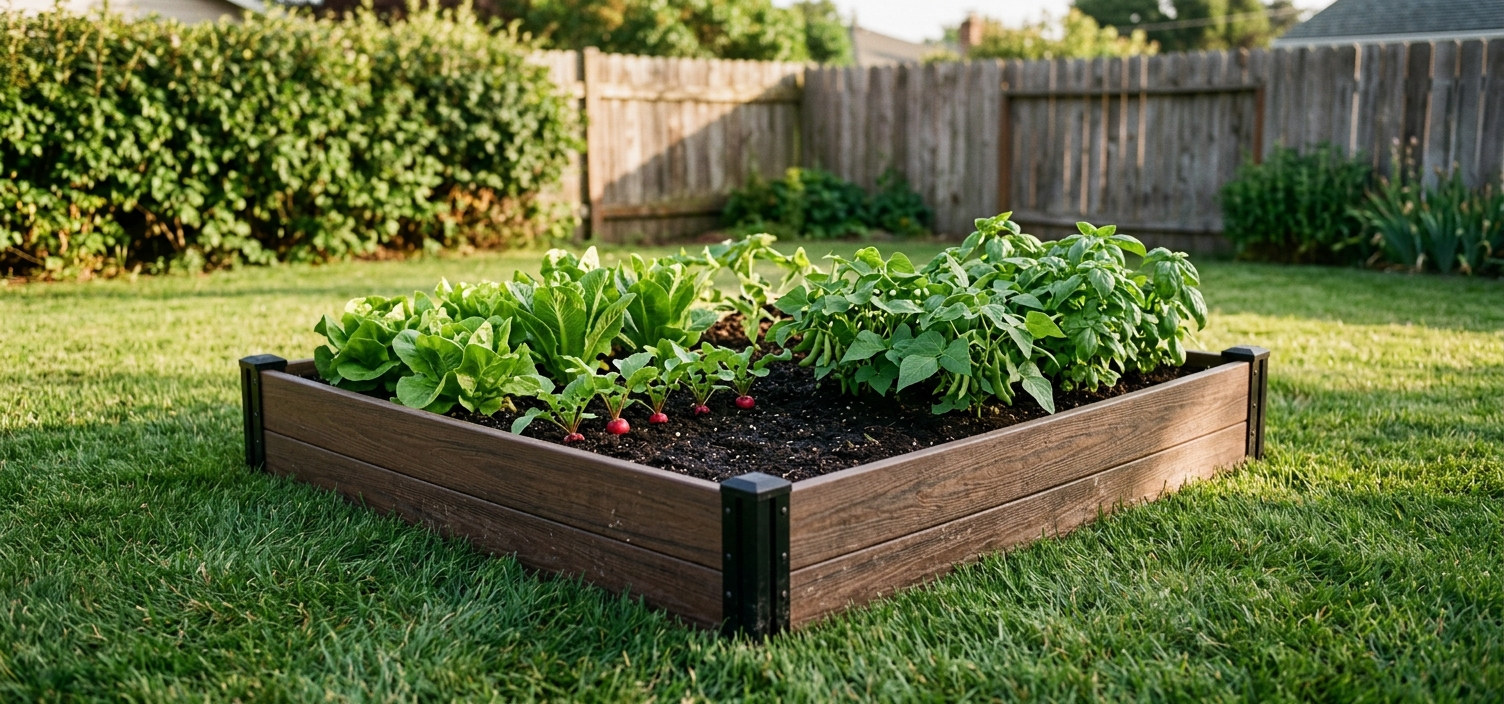
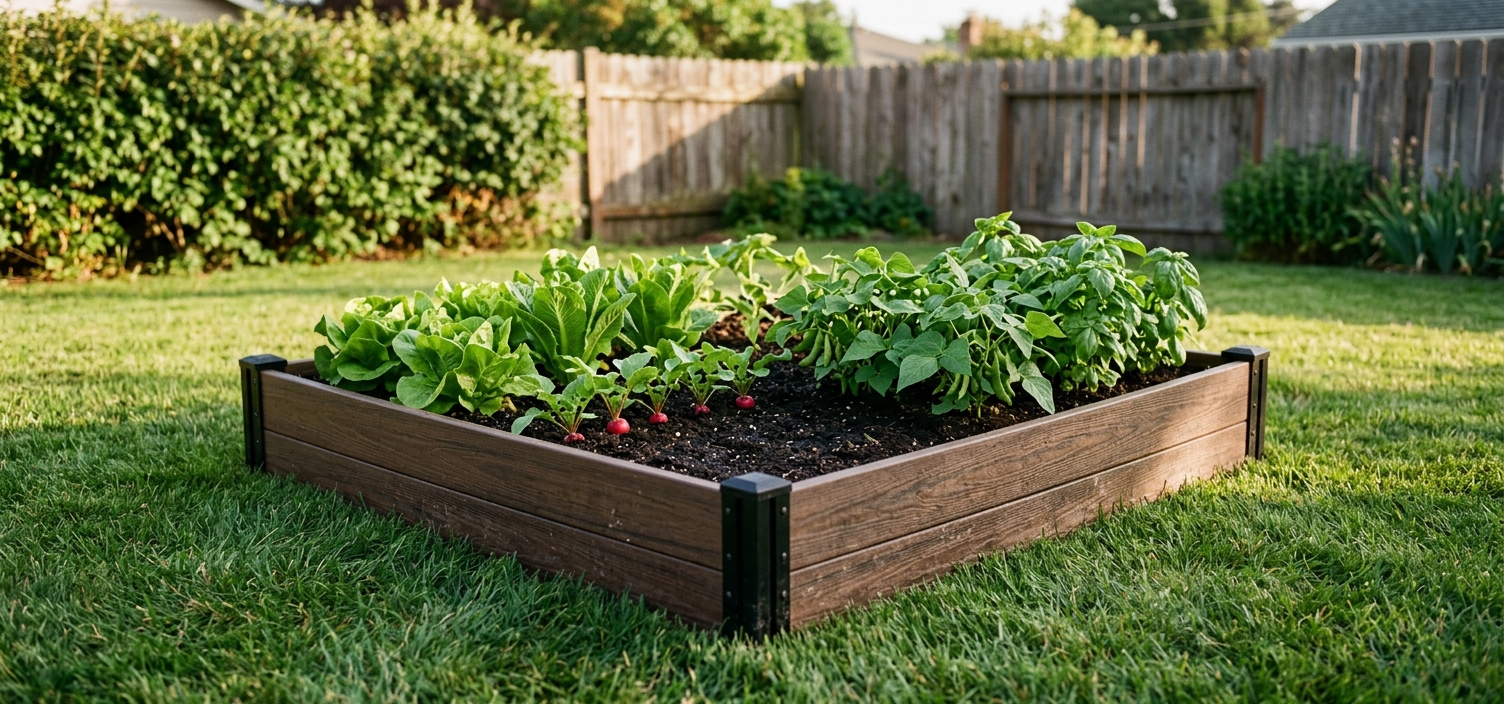
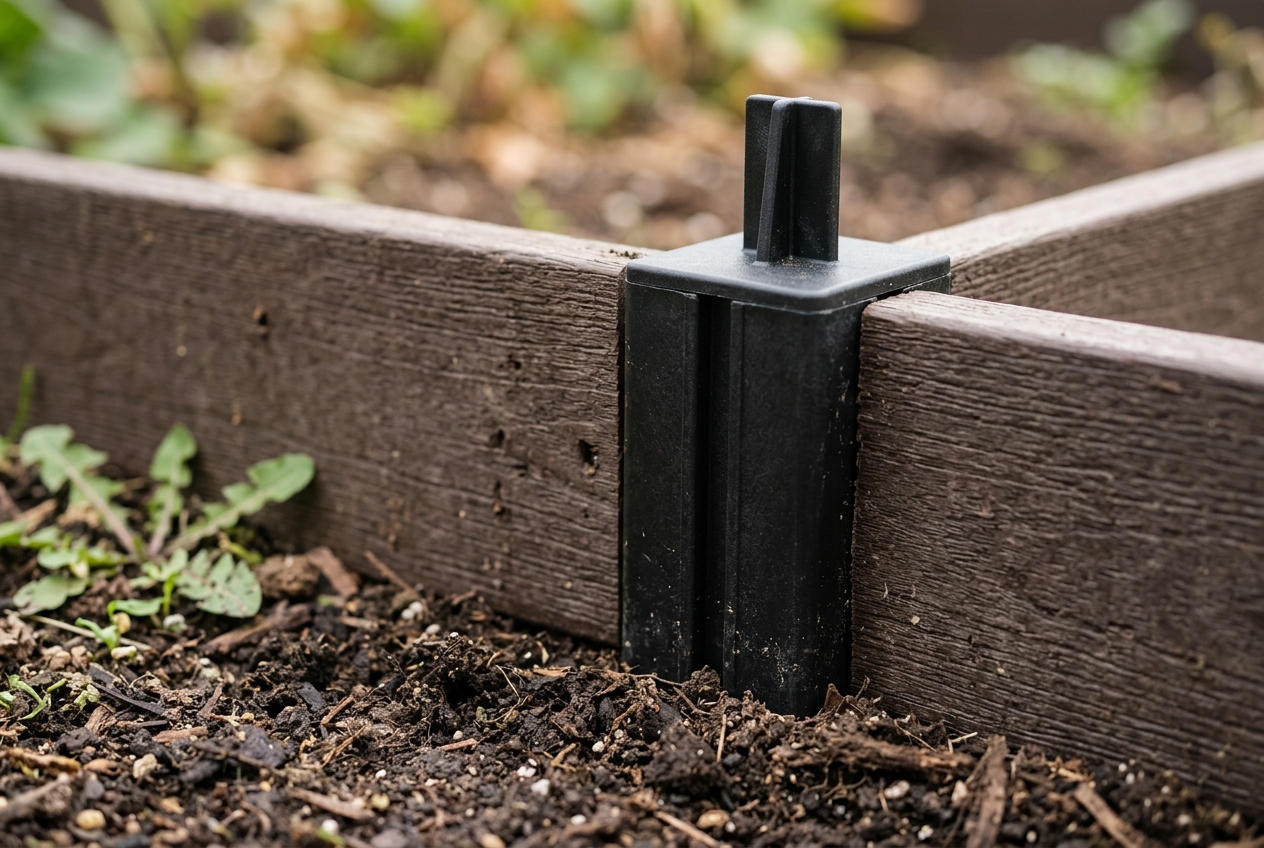
The kit is a tool-free modular raised bed made from recycled composite boards. According to product specs from Northern Tool, the standard box contains four composite boards, four corner connectors, and four vertical stacking clips, with a finished footprint of 42 inches square and a wall height of 8 inches. The boards slot into the corner pieces by hand, and the whole assembly takes most people under 15 minutes on a flat surface.
The material is the interesting part. Greenland Gardener manufactures the boards from recycled plastic waste, and the company states that each kit diverts roughly 22 pounds of plastic from landfills. The composite is engineered to resist rot, warping, splitting, and cracking, which are the failure modes that kill untreated cedar or pine raised beds in three to five seasons. Filled to 8 inches, the bed holds about 7 cubic feet of garden soil, or roughly nine to ten standard 0.75 cubic foot bags of bagged mix.
Where the kit stops making sense is depth. Eight inches of soil is fine for lettuce, spinach, radishes, garlic, and shallow herbs, but it undersells crops with deeper root systems. The vertical stacking clips are the manufacturer’s answer: buy a second kit, stack the boards to 16 inches, and the bed becomes a real vegetable garden.
Is the Recycled Composite Safe for Growing Food?
Yes, when the plastic is food-grade HDPE, which is what reputable recycled composite raised beds are made from. According to a University Extension Ask a Master Gardener answer, high-density polyethylene (HDPE) is the best recommendation for garden bed use because it is durable, used in food containers, and certified as food safe and BPA free. HDPE is the same plastic used for milk jugs and cutting boards; it does not leach measurable chemicals into moist soil under normal outdoor conditions.
Two cautions still matter. First, generic composite decking sold for outdoor patios is not the same product as garden-grade recycled boards. Some deck composites include colorants, UV stabilizers, and wood-flour binders that were never certified for food contact, and they should not be repurposed as bed sides. Second, even food-safe plastic gets brittle if it sits in direct sun for many years without any UV inhibitor, which is why manufacturers add a stabilizer to garden-grade boards.
The Greenland Gardener kit is sold as a garden product, not decking scrap, which puts it in the food-safe category alongside other recycled HDPE beds. If you want a belt-and-suspenders check, run your hand along a new board on a hot day; a garden-grade board should not have a strong plasticizer smell. For a deeper comparison of bed materials, see our raised bed gardening for beginners guide.
Where Should You Place a 42 by 42 Raised Bed?
Put it in the sunniest, most level spot within reach of a hose. Penn State Extension is direct on the sun requirement: when growing vegetables, site the bed in an area that receives at least six hours of sunlight. Six is the floor for most crops. Fruiting vegetables like tomatoes, peppers, and squash push toward eight or more, and leafy greens can get by on five or six with morning sun and light afternoon shade in hot climates.
Orientation matters less than sun hours, but it does matter. Penn State Extension recommends laying out beds either north to south or east to west rather than on a diagonal, and if you plan to run a trellis for cucumbers or pole beans, put it at the northern end and run it east to west so it does not shade the rest of the bed. A single 42 by 42 kit is small enough that shading is rarely a problem within the bed itself, but a fence, shed, or mature tree ten feet south of it can steal two critical hours of afternoon light.
One siting rule almost no first-time buyer knows: Penn State Extension warns not to install a raised bed near black walnut trees, because they produce juglone, a toxin that will inhibit the growth of vegetables, particularly tomatoes. The safe distance is at least 50 feet from the trunk. On our property we lost an entire first-year tomato crop before we learned this. Level the site to within an inch across the 42-inch span; the composite boards will bow slightly if the ground slopes, and water will pool at the low corner.
How Deep Should Your Soil Be?
Deeper than the stock 8 inches for most vegetables. Rutgers Extension states plainly that a minimum 12 inch depth of imported topsoil is recommended for proper root-zone volume and drainage. Purdue University Extension echoes the number: a minimum depth of 10 to 12 inches is recommended for most plants exposed to drying wind and sun. Both numbers assume the bed will hold enough water and nutrients to carry a crop through a hot week without daily rescue.
University of Maryland Extension breaks the depth down by crop, which is more useful for a 42 by 42 kit. Beds placed on hard surfaces are fine if they are a minimum of 8 inches deep for leafy greens, beans, and cucumbers, and 12 to 24 inches deep for pepper, tomato, and squash. On open soil, roots can dive below the boards if the ground beneath is loose, so a single-kit 8-inch bed on native soil grows a wider crop list than the same bed on a concrete patio.
The practical rule for the Greenland Gardener kit: one 8-inch layer is a salad garden, two stacked layers at 16 inches is a full vegetable garden. Utah State University Extension confirms the range, noting that the raised bed box should be at least 6 to 12 inches high to accommodate the rooting depth of most vegetables. If you plan to grow tomatoes, peppers, or full-size winter squash, buy the stacking clips and a second board set from the start.
| Bed height | Soil volume needed | Best crops for that depth |
|---|---|---|
| 8 in (one kit) | ~7 cu ft | Lettuce, spinach, radishes, garlic, basil, chives |
| 12 in (add one row of boards) | ~10.5 cu ft | Bush beans, beets, carrots, chard, peppers |
| 16 in (two kits stacked) | ~14 cu ft | Tomatoes, squash, potatoes, kale, most everything |
Filling the Bed: Soil Mix and How Much You Need
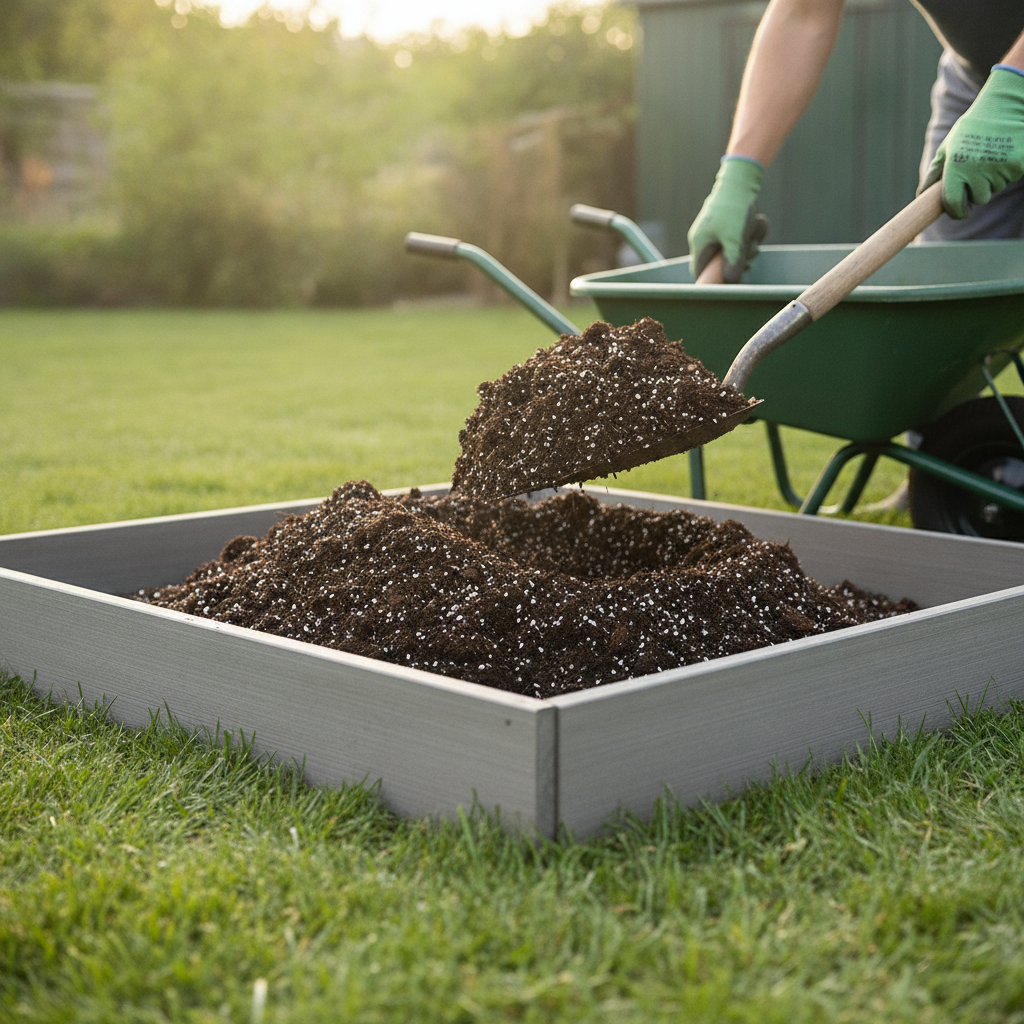
The Greenland Gardener kit needs approximately 7 cubic feet of soil at its stock 8-inch depth, which works out to nine to ten standard 0.75-cubic-foot bags of raised bed mix, or about one-quarter cubic yard of bulk mix. According to Northern Tool’s product page, to fill the raised garden requires 7 cubic feet of garden soil. Stacked to 16 inches, that jumps to about 14 cubic feet, or roughly a half cubic yard from a bulk landscape supplier.
The recipe that fits a small bed best is Mel’s Mix, developed by Mel Bartholomew for square foot gardening. The Square Foot Gardening Foundation lists the formula as one-third finished compost, one-third peat moss or coco coir, and one-third coarse vermiculite by volume. Compost feeds the crop, peat or coir holds moisture and buffers pH, and vermiculite keeps the mix airy so roots do not suffocate. For a 7-cubic-foot fill, that means about 2.3 cubic feet of each component. Blend all three on a tarp before shoveling into the bed rather than layering, which lets one component dominate a zone.
If Mel’s Mix is out of budget (vermiculite has become expensive), a serviceable substitute is 60% bagged raised bed soil, 30% finished compost, and 10% perlite. For a deeper walkthrough with cost math for common bed sizes, see our raised bed soil mix guide. Whatever mix you choose, add two inches of finished compost each spring after that; small beds burn through organic matter faster than large ones, and topping up is cheaper than a full refill. Our composting 101 guide covers how to make that annual top-up on-site.
What Should You Plant in a 42 by 42 Bed?
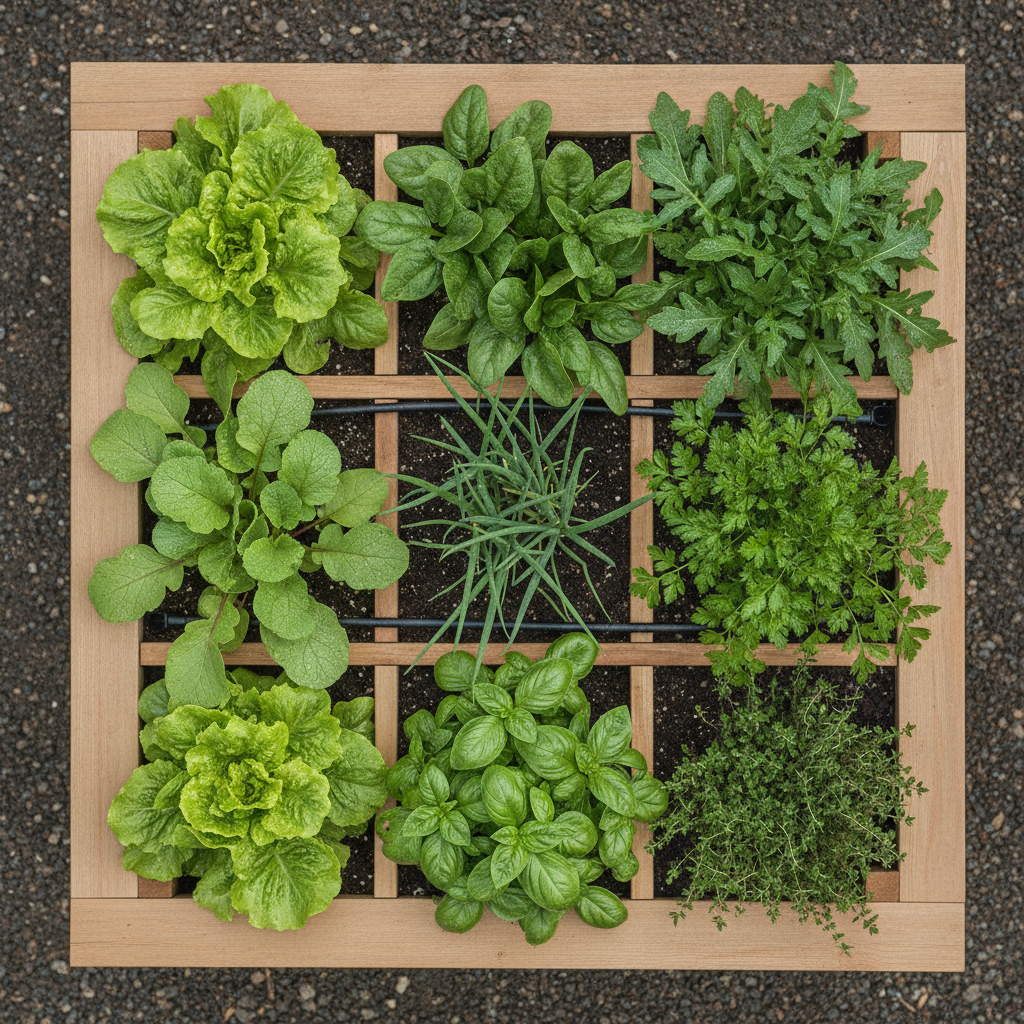
Divide the bed into a 12-square grid and plant by mature size. The square foot gardening method, developed by Mel Bartholomew and now used by thousands of home gardeners, recommends an open-bottom raised bed exactly this size divided into sixteen one-foot squares. Each square is planted with a different crop, and based on the plant’s mature size either 1, 4, 9, or 16 plants are placed per square. A 42 by 42 kit is slightly larger than a true 48 by 48 bed, so you can either draw the grid to 12 x 12 inches (9 squares total) or 14 x 14 inches (nine squares with slightly more room per plant).
The four-plants-per-square set includes lettuce, kale, chard, and basil. The nine-per-square group covers bush beans, spinach, beets, and garlic. Sixteen per square works for carrots, radishes, and green onions. A single plant per square is right for a full tomato, pepper, broccoli plant, or an indeterminate cucumber trained up a trellis. In a single-kit 8-inch bed, skip the last group and stick with the first three; those crops thrive in shallow soil.
A productive spring layout for one kit: two squares of leaf lettuce (8 heads), one square of radishes (16), one square of spinach (9), one square of arugula (9), one square of scallions (16), one square of basil (4), one square of parsley (4), one square of thyme or oregano (1). Rotate the fast crops through the season; a spring square of radishes becomes a summer square of bush beans becomes a fall square of turnips. If a kitchen herb plot is your priority, our kitchen herb garden guide covers which perennials belong here versus in pots.
Watering, Feeding, and Season-Long Care
Water more often than you think, and feed lightly through the season. According to a San Diego Master Gardener drip irrigation guide, most vegetable gardens need about 1 inch of water per week from rain or irrigation, and a raised bed may require more water per week than an in-ground bed watered at 1 to 2 inches a week. A 42 by 42 bed at 8 inches deep dries fastest of any format because it has a small soil volume relative to its surface area. In July heat on our zone 6b property, our single-kit bed needed a deep soak every other day; the stacked 16-inch bed next to it stretched to twice a week.
Water in the morning if you can. The two goals are to reach the root zone (the top four inches, minimum) and to let leaf surfaces dry before nightfall, which reduces the fungal pressure that spreads powdery mildew and early blight. A soaker hose or half-inch drip line laid on the soil surface with 12-inch emitter spacing does both without waste. Overhead sprinklers waste water to evaporation, wet the foliage, and encourage disease.
Feed with a top dressing of compost in spring, plus a mid-season side dressing of a balanced organic fertilizer (a 5-5-5 or 4-4-4 blend) at half the label rate around heavy feeders like tomatoes, peppers, and chard. Light greens and herbs need almost nothing beyond the initial mix. At season end, pull spent crops, chop the roots in place if they are disease-free, and layer 2 inches of fresh compost on top before the ground freezes. If you plan to keep the bed producing year over year, our seed saving guide covers which of these crops (beans, lettuce, tomatoes) are easy to save from.
Common Mistakes to Avoid With This Kit
The five failure modes below account for almost every one-star review of the Greenland Gardener kit online. UGA Extension’s raised bed dimensions guide is worth reading before purchase because it addresses three of them directly (accessibility, height, and reach), noting that raised beds are usually 2 to 4 feet wide, 2 to 24 inches high, and as long as desired, and that beds wider than 3.5 to 4 feet make it difficult to access the middle. The kit lands at exactly the upper accessibility limit, which is fine as long as the bed is reachable from all four sides.
The first mistake is siting on an unlevel base. The composite boards flex slightly, and a half-inch drop across the 42-inch span pools water at the low corner and rots the roots in that square. Shim with pavers or scrape the ground flat before assembly. The second is treating 8 inches as final depth for tomatoes or peppers; buy a second kit from the start if those crops are on your list, or plant shallow-rooted crops only.
The third is filling with straight bagged topsoil, which compacts within one season and drains poorly. Use a raised bed mix or blend your own per the recipe above. The fourth is skipping the stacking clips, which are what keep the second row of boards from bowing outward when wet soil pushes against them. The fifth is walking away in July; a single-kit bed dries out in 48 hours during a heat wave, and one skipped watering can end a lettuce square in a single afternoon. Set a reminder or install a drip timer.
Frequently Asked Questions
How many bags of soil do I need to fill the Greenland Gardener 42 in x 42 in bed?
At the stock 8-inch depth, you need about 7 cubic feet of soil, which is nine to ten standard 0.75-cubic-foot bags of raised bed mix. Stacked to a 16-inch double-kit height, you need about 14 cubic feet, or eighteen to twenty bags. Bulk mix from a landscape supplier ordered by the cubic yard is much cheaper per volume than bagged and worth the delivery fee at the double-kit size.
Can I put the raised bed on a patio or driveway?
Yes, but you need to compensate for the lack of soil beneath. University of Maryland Extension notes that a bed on a hard surface needs at least 8 inches of soil for leafy greens, beans, and cucumbers, and 12 to 24 inches for tomatoes, peppers, and squash. That means a single-kit setup on concrete is a lettuce-and-herb bed only. Stack two kits for full vegetable growing on a hard surface, and drill or leave drainage gaps so the boards can shed excess water.
Is the recycled composite plastic in the kit safe for growing vegetables?
Yes, provided the boards are food-grade HDPE, which is the standard material for recycled composite garden beds sold by major retailers. HDPE is the same plastic used for milk jugs and cutting boards, and Extension Ask a Master Gardener identifies it as the best recommendation for garden bed use because it is durable, used in food containers, and certified BPA free. Avoid repurposing generic composite decking, which may contain additives that were not tested for food contact.
How long will the Greenland Gardener kit last outdoors?
Manufacturers of recycled HDPE raised beds commonly cite a service life of 20 years or more, and some warranty their boards for life. The composite resists rot, warping, splitting, and cracking, which are the failure modes that limit cedar to five to seven seasons and pine to two or three. UV exposure will slightly fade the color over a decade, but structural integrity should hold provided the bed is not overloaded or driven over.
Can I stack two kits to get a taller bed?
Yes, and the vertical stacking clips included with each kit are made for this. Two kits stack to 16 inches, which puts the soil depth in the range Rutgers, Purdue, and Utah State Extension all recommend for full vegetable production. Level the base carefully before assembly, seat the clips fully into both boards, and fill the bottom third of the stacked bed with rough organic matter (branches, straw, or partly finished compost) to save on soil volume before topping with a proper raised bed mix.
What is the best soil mix to fill it with?
Mel’s Mix, developed for square foot gardening, is the classic recipe: one-third finished compost, one-third peat moss or coco coir, and one-third coarse vermiculite by volume. The mix drains well, holds moisture, and never compacts. A budget alternative is 60% bagged raised bed soil, 30% compost, and 10% perlite. Whichever you choose, top-dress with 2 inches of fresh compost every spring so the small volume of a 42 by 42 bed does not run out of organic matter mid-season.
What crops should I skip in this size bed?
Skip full-sized sprawling crops that need more than a square yard per plant: winter squash, watermelon, pumpkin, sweet corn, and indeterminate tomatoes without a strong trellis. A single 42 by 42 bed does not have the width to support their vines, and they will shade out everything else. Grow those in a larger bed or directly in-ground. This kit shines for salad greens, herbs, bush beans, root crops, garlic, and one or two determinate tomatoes or peppers when stacked to 16 inches.