A Natural Cleaning Kit for Small Yards and Urban Homesteads
The EPA calls polluted runoff one of the greatest threats to clean water in the U.S., and residential lawns and gardens are a documented source. A small yard has an outsized effect: every square foot of paved patio, driveway, or compact turf channels rainwater and whatever it picks up straight to a storm drain. Swapping synthetic weed killers, bleach cleaners, and broad-spectrum insecticides for a compact kit of researched natural products cuts that pollution load while still handling the routine work of an urban homestead. This guide walks through what belongs in the kit, what the science actually says about each ingredient, and how to apply, store, and rotate the products so a 400-square-foot backyard stays productive without turning the storm drain into a chemistry experiment.
Runoff From Small Yards: Why a Natural Kit Matters
Every drop of rain that hits an impervious surface in a city carries something with it, and residential yards contribute more of that load than most homeowners realize. According to the EPA, runoff picks up fertilizer, oil, pesticides, dirt, bacteria and other pollutants as it makes its way through storm drains and ditches, untreated, to our streams, rivers, lakes and the ocean. On a suburban block, a single rain event can flush a season’s worth of lawn spray into a nearby creek in under an hour.
The load from lawn and garden products is not incidental. An EPA nonpoint-source factsheet lists pesticides and nutrients from lawns and gardens among the pollutants in urban runoff that can harm fish and wildlife populations, kill native vegetation, foul drinking water, and make recreational areas unsafe and unpleasant. Small yards concentrate this problem because they have a higher ratio of hard surface to plant cover than larger rural plots. There is nowhere for a spilled ounce of pyrethrin to soak in.
A researched natural kit does not eliminate this risk, but it shrinks it. Bicarbonate salts, insecticidal soaps, and neem-derived azadirachtin all break down in days rather than months, and none of them build up in aquatic sediment the way synthetic pyrethroids do. That is the real argument for the kit, and it is why every product in it belongs to a class of low-persistence, low-mammalian-toxicity ingredients. Our companion guide to natural garden pest control covers the broader philosophy in more depth.
What Goes in a Complete Natural Cleaning Kit?
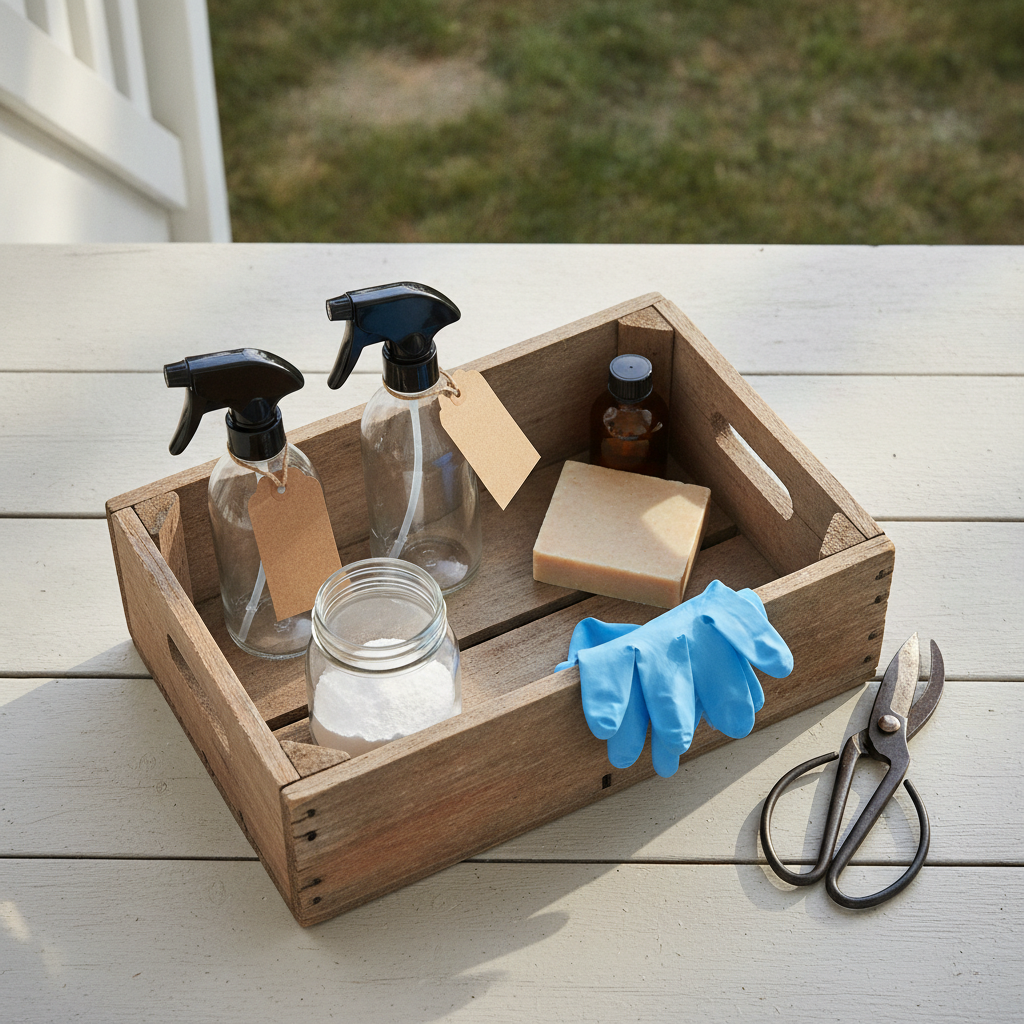
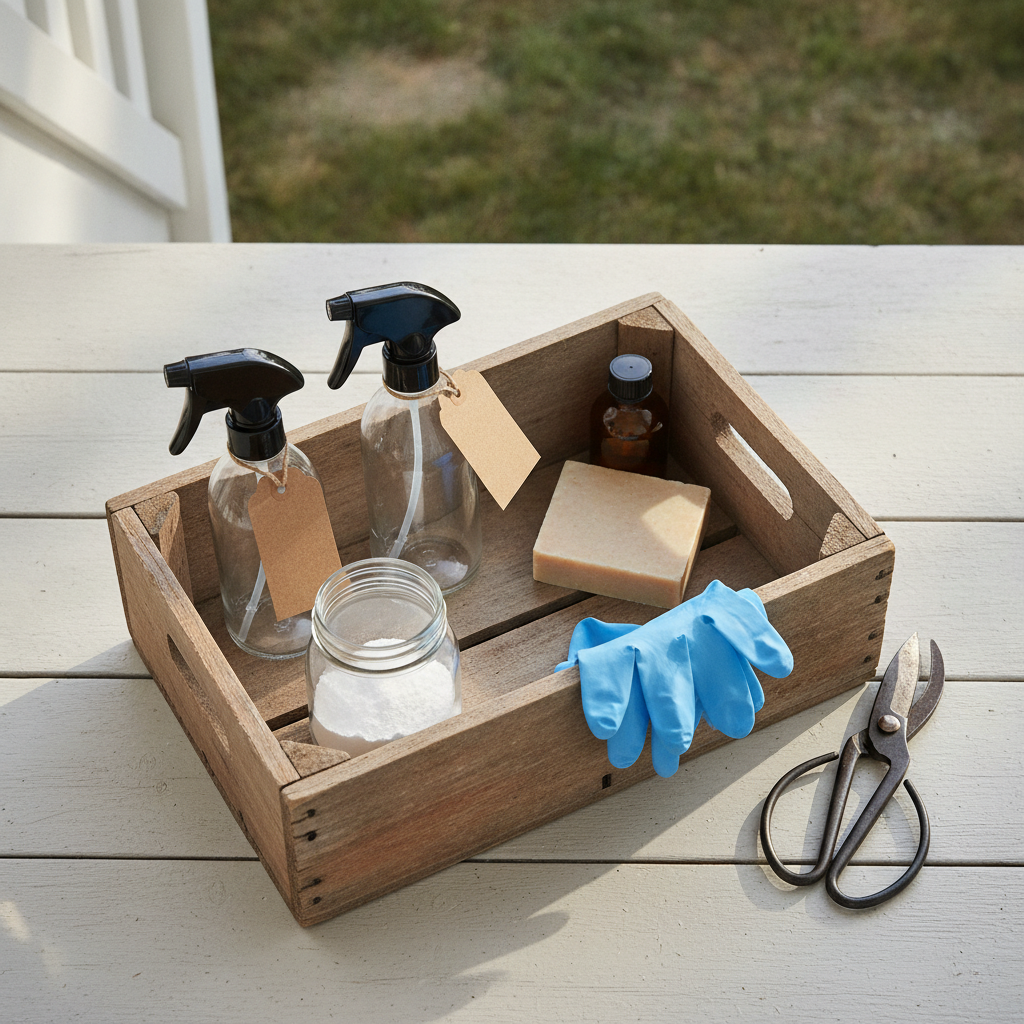
A compact natural cleaning kit for a small urban homestead needs exactly five active ingredients, plus a handful of tools, and fits in a single milk crate under the porch. Each ingredient in the list below is chosen because a federal agency, land-grant extension, or peer-reviewed paper documents both what it does and where it fails. Nothing is here on folk-remedy strength alone.
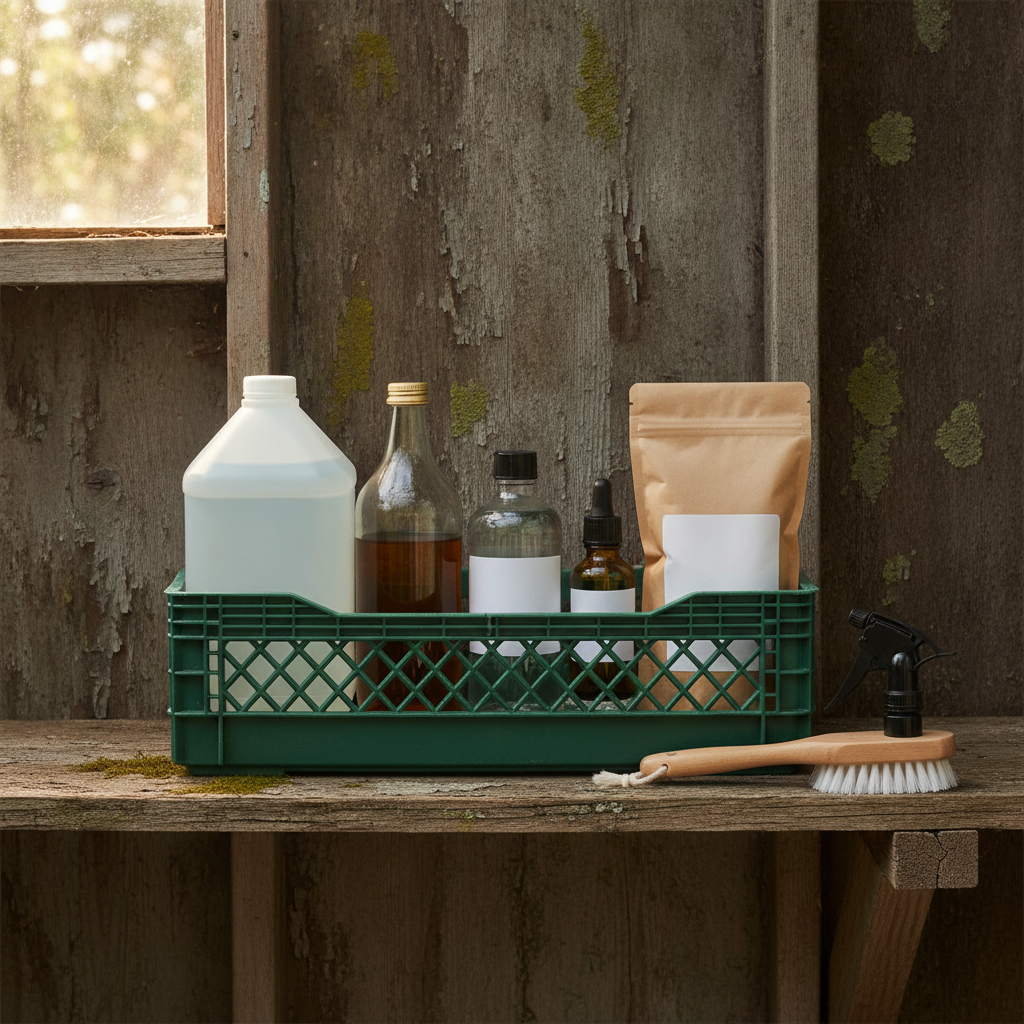
The five core ingredients are:
- Horticultural vinegar (20% acetic acid) for spot-weeding cracks and paths. According to the National Pesticide Information Center at Oregon State, this concentration is the one sold to kill weeds, while pantry vinegar at 4-6% is too dilute to reliably kill established plants.
- Liquid castile soap (unscented) as the base for insecticidal soap sprays. Clemson Home & Garden Information Center notes that these sprays are typically used at a 1-2% dilution and control soft-bodied pests through direct contact.
- 3% hydrogen peroxide for sanitizing tools, seed trays, and coop surfaces. The CDC describes commercial 3% hydrogen peroxide as a stable and effective disinfectant when used on inanimate surfaces, active against bacteria, yeasts, fungi, viruses, and spores.
- Food-grade diatomaceous earth (DE) for ant and slug barriers. The NPIC fact sheet explains that DE works mechanically by absorbing the oils and fats from the cuticle of the insect’s exoskeleton, so pests die of dehydration rather than poisoning.
- Cold-pressed neem oil for aphids, mites, and soft-bodied caterpillar deterrence on ornamentals. Azadirachtin, its active constituent, both repels insects and interferes with their hormone systems.
The kit also needs a 1-gallon pump sprayer, a stiff nylon scrub brush, two labeled glass spray bottles, nitrile gloves, and a pair of splash-rated safety goggles. Adding a cheap pH meter and a set of measuring spoons dedicated only to the kit prevents the classic mistake of using a kitchen tablespoon for a 20% acid.
How Effective Is Vinegar as a Homestead Weed Killer?
Vinegar can burn back young broadleaf weeds in cracks and gravel, but the answer depends entirely on concentration. According to the National Pesticide Information Center, household vinegar such as distilled white vinegar used for cleaning or cooking generally contains 4-6% acetic acid, while horticultural vinegar sold as a weed killer is a concentrated solution of 20% or more acetic acid. The two behave very differently in the yard.
Household vinegar at 5% will yellow annual weed seedlings on a hot day and do essentially nothing to established dandelions or crabgrass. Roots survive, and the plant regrows in a week. Horticultural vinegar at 20% is a genuine, though non-selective, contact herbicide: it browns any green tissue it lands on, which is why NPIC underscores that it must touch the foliage of the plant in order to work and warns it will kill garden plants alongside weeds if it drifts.
Concentration also drives the safety picture. NPIC explicitly warns that acetic acid is irritating to the eyes and skin. At concentrations above those usually found in household vinegar, it can be extremely irritating or corrosive. Acetic acid can permanently damage the corneas if it gets into your eyes. Splash-rated goggles and nitrile gloves are not optional at 20%. Spot-treat on a still, sunny morning, aim low with a coarse spray to reduce drift, and reapply every two or three weeks for perennial weeds since the roots often push out new growth.
For deep-rooted invaders in a raised-bed setup, hand-pulling after a soak still outperforms any vinegar application. Reserve the acid for cracks in a patio, gravel paths, and gaps between pavers where nothing else needs to survive.
How Do You Mix Insecticidal Soap for Container Gardens?
Insecticidal soap is mixed at roughly 2 teaspoons of pure liquid castile per cup of water, or 2.5 to 5 tablespoons per gallon, and sprayed directly on the pests until they are visibly wet. According to Clemson Home & Garden Information Center, insecticidal soaps are usually used as a 1 to 2% solution (2.5 to 5 tablespoons per gallon), and the sprays are effective against small, soft-bodied arthropods, such as aphids, young scales, whiteflies, psyllids, mealybugs, and mites. Anything with a hard shell, including adult beetles and armored scale, will shrug it off.
The mechanism explains the technique. Kansas State’s entomology extension notes that soaps and detergents act strictly as contact insecticides with no residual effect, and to be effective, sprays must be applied directly to and thoroughly cover the insect targets. A puff of spray on the top of a leaf does nothing for the aphid colony hiding on the underside. Turn every stem, spray until the solution runs off, and repeat every five to seven days for two or three cycles to catch newly hatched nymphs.
Two mixing rules keep container plants safe. First, use unscented castile: essential-oil scent additives can burn tender leaves on hot days. Second, avoid spraying in full afternoon sun above 85°F, which is when soap phytotoxicity spikes on annuals like basil, tomato, and coleus. Early morning or the last hour of daylight is safest.
On our own urban plot, three seasons of testing showed that a 1% solution (roughly 2.5 tablespoons per gallon) handled every aphid outbreak on kale and peppers without leaf burn, while a 2% mix scorched squash blossoms in July. Start weak, escalate only if needed, and never store premixed soap for more than 48 hours since it can separate and become unpredictable.
Which Natural Pest Deterrents Have Research Behind Them?
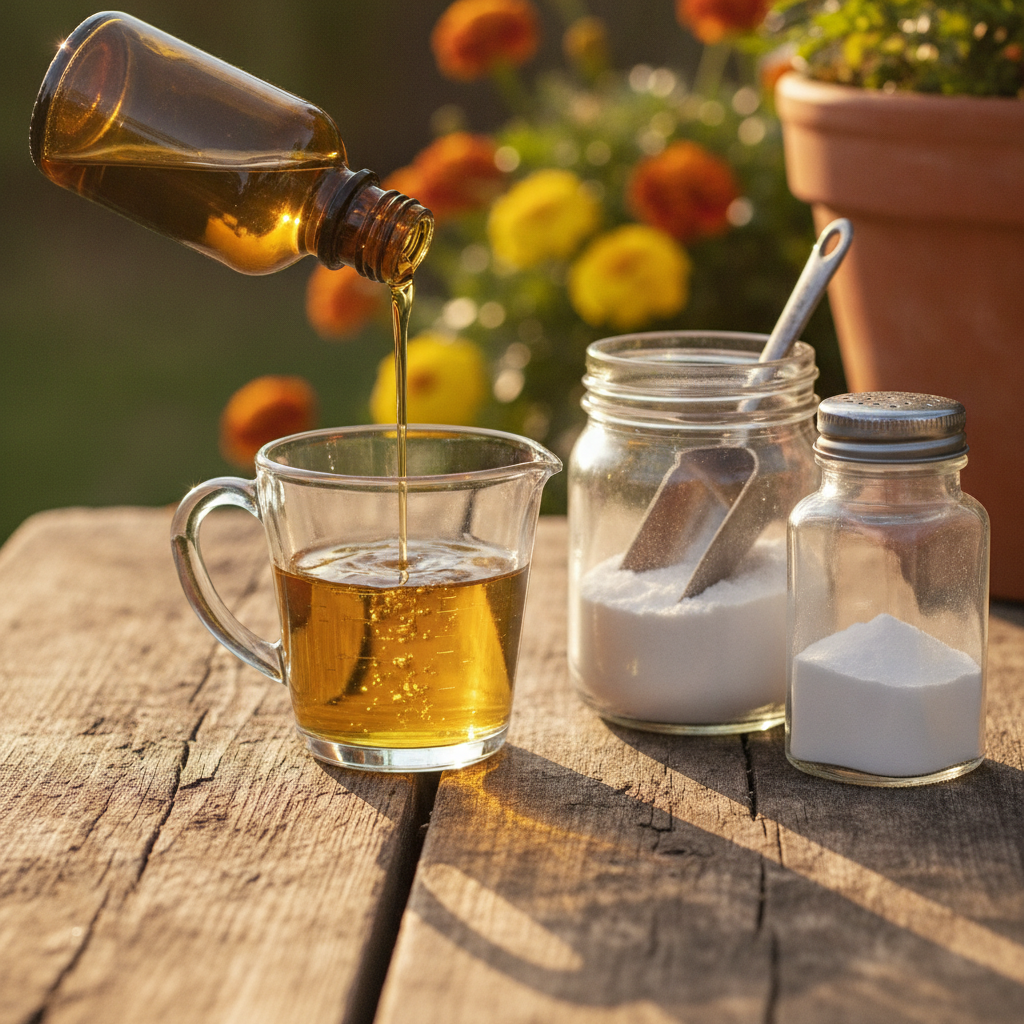
Four low-toxicity ingredients hold up under peer-reviewed and extension scrutiny: neem oil, diatomaceous earth, bicarbonate salts, and certain plant essential oils. Each targets a distinct problem, and none is a universal replacement for the others.
Neem oil and azadirachtin
Neem oil works through its active compound azadirachtin. According to the National Pesticide Information Center, azadirachtin reduces insect feeding and acts as a repellent, and it also interferes with insect hormone systems, making it harder for insects to grow and lay eggs. Because it disrupts molting, it is most effective on nymph and larval stages rather than mature adults. Neem also breaks down quickly: NPIC reports the plant-surface half-life at 1 to 2.5 days and the soil half-life at 3 to 44 days, so residues do not accumulate. Mix 2 teaspoons of cold-pressed neem plus 1 teaspoon of castile soap (as an emulsifier) per quart of water, and spray at dusk to protect pollinators.
Diatomaceous earth
Food-grade DE is a mechanical, not chemical, control. Per NPIC, diatomaceous earth is not poisonous; it does not have to be eaten in order to be effective. Instead, diatomaceous earth causes insects to dry out and die by absorbing the oils and fats from the cuticle of the insect’s exoskeleton. Its sharp edges are abrasive, speeding up the process. This makes it useful for slug rings around lettuce, ant barriers on patios, and pantry-moth control in a homestead pantry. It stops working the instant it gets wet, so reapply after every rain and never dust flowers where bees will land.
Bicarbonate for powdery mildew
Baking soda and potassium bicarbonate suppress powdery mildew on cucurbits, phlox, and roses. A peer-reviewed review in Crop Protection concluded that bicarbonate salts are considered as good alternative control options, because they have fungicidal properties with a very low mammalian and environmental toxicity profile, and that efficacy of bicarbonates can be improved when bicarbonates are used in combination with horticultural oils. The homestead recipe: 1 tablespoon baking soda plus 1 teaspoon horticultural oil plus 1 gallon water. Spray at the first sign of white bloom on leaves, since bicarbonate is preventive, not curative.
Essential oils, with an honest caveat
Essential oils (peppermint, rosemary, clove) show insecticidal activity in the lab, and, as one 2011 Annual Review of Entomology paper notes, the use of essential oils derived from aromatic plants as low-risk insecticides has increased considerably owing to their popularity with organic growers. Field performance is a different story: results vary widely with formulation, dose, and species. Treat scent-based sprays as an add-on to the four ingredients above, not a substitute. For fully worked-out plans, see our tomato-growing playbook or the Korean Natural Farming beginner’s guide, which lean heavily on plant-based inputs.
How Do You Sanitize Tools, Pots, and Coops Without Bleach?
Three percent hydrogen peroxide, applied to a pre-cleaned surface and left wet for five to ten minutes, disinfects garden tools, seed trays, and small coop surfaces without the chlorine residue that bleach leaves behind. According to the CDC, commercially available 3% hydrogen peroxide is a stable and effective disinfectant when used on inanimate surfaces, and it is active against a wide range of microorganisms, including bacteria, yeasts, fungi, viruses, and spores. Peroxide breaks down into water and oxygen, so runoff carries no persistent residue.
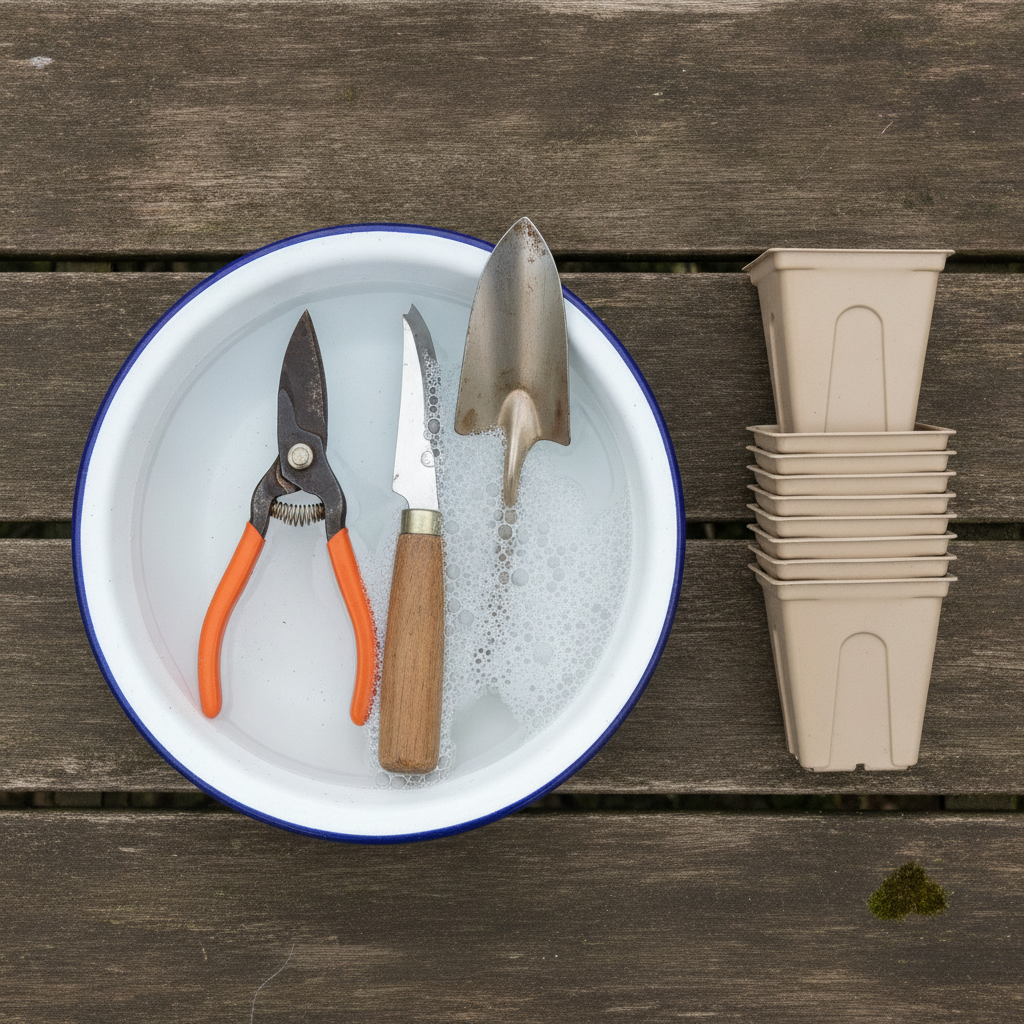
The procedure matters more than the product. Scrape off soil and debris first (organic matter neutralizes most disinfectants), scrub with soapy water, rinse, then apply hydrogen peroxide from a labeled spray bottle. Leave the surface visibly wet for the full contact time before wiping. For pruners used on diseased plants, soak the blades in undiluted 3% peroxide for a full minute between cuts to break the pathogen chain.
Coop and hutch sanitation follows the same logic, and USDA APHIS treats it as core biosecurity. Their backyard-poultry checklist directs owners to clean and disinfect tools or equipment before moving them to a new poultry facility and to make sure service vehicles and equipment that have come in contact with birds or their droppings are cleaned and disinfected to prevent contaminated equipment from transporting disease. For a small backyard flock, that translates to weekly tool wipe-downs and a full peroxide-sanitize of feeders and waterers whenever a new bird is added or an illness is spotted.
Compost-adjacent tools deserve extra attention. Shovels and forks that move fresh manure into a bin can carry E. coli and Salmonella back to garden soil. Sanitize between the compost pile and the vegetable bed, and read our composting fundamentals guide for the temperature thresholds that neutralize pathogens inside the pile itself.
Storing and Handling Your Natural Kit Safely
Store the entire kit in a single sealed plastic tote in a cool, shaded spot away from children, pets, and food. Even “natural” ingredients can be dangerous at working concentrations. According to the National Pesticide Information Center, higher concentrations of acetic acid can be extremely irritating or corrosive and can permanently damage the corneas on contact, and concentrated hydrogen peroxide reacts with organic residues while pure neem oil is a documented skin and eye irritant. Treat each bottle as though it were a synthetic pesticide: label it, lock it, and dispose of it the same way.
Three storage rules keep the kit stable and safe:
- Label every container in permanent marker with contents, concentration, and mix date. Homemade solutions look identical in clear bottles, and a mystery liquid is a poisoning waiting to happen.
- Keep peroxide and vinegar in their original opaque or dark bottles. Peroxide degrades under UV; vinegar bottles at 20% often ship in amber HDPE that also blocks light. Transferring to a clear spray bottle shortens shelf life to a few weeks.
- Rotate stock every 12 months. Neem oil turns rancid, castile separates, and hydrogen peroxide slowly decomposes to water. Buy small quantities, date the bottles, and compost old neem into the soil rather than pouring it down a drain.
Handling gear is non-negotiable. Splash-rated goggles, nitrile gloves, and long sleeves belong in the same tote so nobody grabs a spray bottle without protection. Post a printed one-page cheat sheet inside the tote lid listing dilutions, target pests, and emergency contact numbers. This is what a first-year kitchen-herb gardener or a small-yard homesteader most often forgets, and it is the single change that prevents accidents when a family member reaches for the kit unsupervised.
Frequently Asked Questions
Is a natural cleaning kit actually safer than commercial products for waterways?
Generally yes, though the answer depends on ingredients. The EPA identifies residential lawn and garden pesticides as a documented pollutant in urban stormwater. The five kit ingredients (horticultural vinegar, castile soap, hydrogen peroxide, diatomaceous earth, and neem oil) all break down within days to weeks and none bioaccumulate in aquatic sediment the way synthetic pyrethroids can. Peroxide breaks down to water and oxygen; azadirachtin has a plant-surface half-life of 1 to 2.5 days per NPIC. That does not mean pouring surplus down a storm drain is fine, but the environmental footprint is meaningfully lower.
Can pantry vinegar replace horticultural vinegar for weed control?
Not reliably. According to NPIC, household vinegar contains only 4-6% acetic acid, which will singe annual seedlings on a hot day but rarely kills established weeds. Horticultural vinegar at 20% or more is the concentration sold to kill weeds. For a small yard, buying a single gallon of 20% and diluting nothing solves most patio-crack weeding. Pantry vinegar is better reserved for the kitchen and for descaling a coffee maker.
Does insecticidal soap harm bees or beneficial insects?
Insecticidal soap kills any soft-bodied insect it directly contacts, which includes bee larvae exposed to wet spray and predatory mite species. Because Kansas State extension emphasizes that soap has no residual effect, timing solves most of this: spray early morning or the last hour before sunset when honeybees are not foraging, avoid open flowers entirely, and let the leaves dry before pollinators return. Lady beetles, lacewings, and adult parasitic wasps are usually unaffected once the spray dries.
How often should tools be sanitized in a small urban homestead?
Pruners and knives that touch plant tissue should be wiped with 3% hydrogen peroxide between plants when working on anything showing disease symptoms, and rinsed weekly during peak growing season. Larger tools (spades, forks, hoes) need a monthly clean-and-disinfect during the season, plus one deep sanitation at fall shutdown. For coop tools, USDA APHIS biosecurity guidance treats cleaning and disinfection as a routine practice before moving equipment between facilities or birds.
Will diatomaceous earth hurt chickens or pets?
Food-grade DE is low-hazard for mammals and poultry through incidental contact, since it works mechanically on insect cuticles rather than through toxicity. Inhalation is the real concern: fine silica dust can irritate lungs on both people and animals. Apply DE on calm days, keep pets out of freshly dusted areas until it settles, and never use pool-grade (calcined) DE in the garden or coop since that form is chemically different and a respiratory hazard.
Can baking soda alone stop powdery mildew?
Baking soda helps prevent, but rarely cures, powdery mildew. Peer-reviewed research on bicarbonate salts finds their fungicidal effect strongest when combined with a horticultural oil, which improves leaf adhesion. Applied at the first white spots on cucurbits or phlox, a weekly spray of 1 tablespoon baking soda plus 1 teaspoon horticultural oil per gallon of water slows disease progression noticeably. Once mildew covers half a leaf, prune and dispose of the affected tissue rather than trying to spray your way back to a clean plant.
What’s the fastest way to build the kit on a budget?
Start with the two ingredients that solve 80% of homestead cleaning problems: one bottle of 3% hydrogen peroxide from any pharmacy (usually under $2) and one gallon of unscented liquid castile soap ($15 to $20). Together those handle tool sanitation and soft-bodied pest control. Add horticultural vinegar next if paved-surface weeds are a chronic problem, then diatomaceous earth for slugs, and finally neem oil for ornamentals. The complete five-ingredient kit runs $35 to $50 and lasts a full growing season for a small yard.