Growing and Harvesting Rhubarb: A Perennial That Pays You Back for Decades
Growing and Harvesting Rhubarb: A Perennial That Pays You Back for Decades
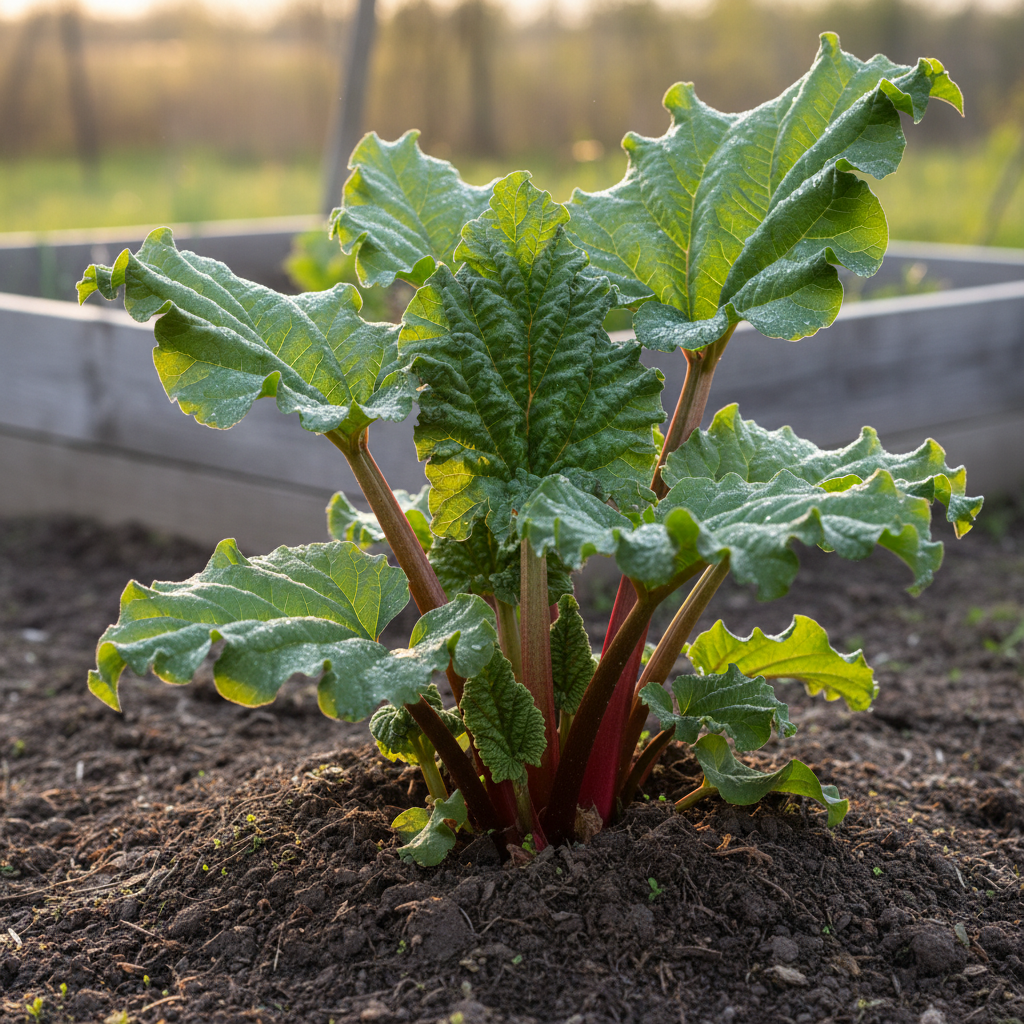
One healthy rhubarb crown, set in well-amended ground at the corner of a kitchen garden, can hand back stalks every spring for two decades and ask for nothing more than compost and the occasional bucket of water. That is the math most plant catalogs skip past: ten dollars for a bare-root crown, then twenty seasons of free pie filling, jam stock, and breakfast compote. Rhubarb is the rare edible perennial that genuinely outlives its planter.
This guide covers the practical decisions that separate a thriving patch from a tired one: cultivar choice, the chill-hour math that explains why southern gardeners struggle, the no-harvest year-one rule beginners always violate, oxalic-acid safety on the leaves, and the division schedule that resets a crown’s productive clock. In our zone 5 patch, two ‘Canada Red’ crowns planted along the north fence have produced six to eight pounds of stalks every May for the past nine springs, and they show no sign of slowing.
Two warnings up front. The leaves contain enough oxalic acid to cause kidney injury and should never be eaten or fed to animals; they belong in the compost pile. And rhubarb wants cold. If your winters do not drop below 40°F for at least six weeks, expect short-lived plants and small yields.
Where Does Rhubarb Grow Best?
Rhubarb thrives where winters are genuinely cold and summers stay relatively mild, which puts it firmly in USDA hardiness zones 3 through 8. Plants are treated as a true perennial through zone 6 and pushed toward annual treatment by the heat of zones 9 and 10. The reason is dormancy chemistry, not just frost tolerance.
Two temperature thresholds matter. Rhubarb needs winter temperatures below 40°F to break dormancy and stimulate spring growth; it also does best where summer temperatures average less than 75°F for vigorous vegetative growth. Plants need a substantial period of winter cold to set up a strong spring flush, below that threshold, crowns push weak, slow stalks and seed prematurely. Above 75°F average summer temperatures, plants bolt and the petioles turn stringy.
Soil follows the same preference for steady moisture and steady cool. Oregon State University Extension recommends a soil pH of 6.0 to 6.8, with full sun in northern zones and afternoon shade in the warmer half of the range. Heavy, slow-draining clay loosened with compost tends to outperform lighter sandy soil because rhubarb is shallow-rooted and dries out fast.
When Should You Plant Rhubarb Crowns?
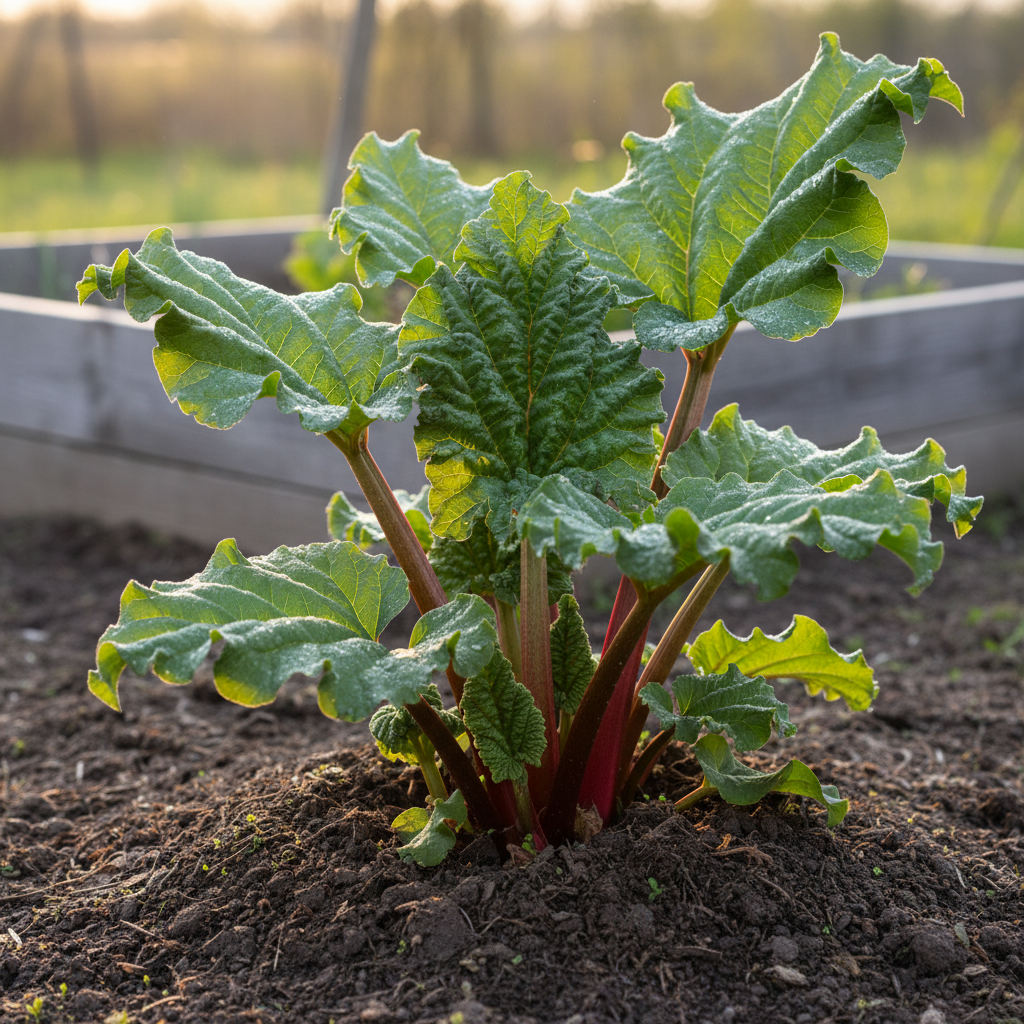
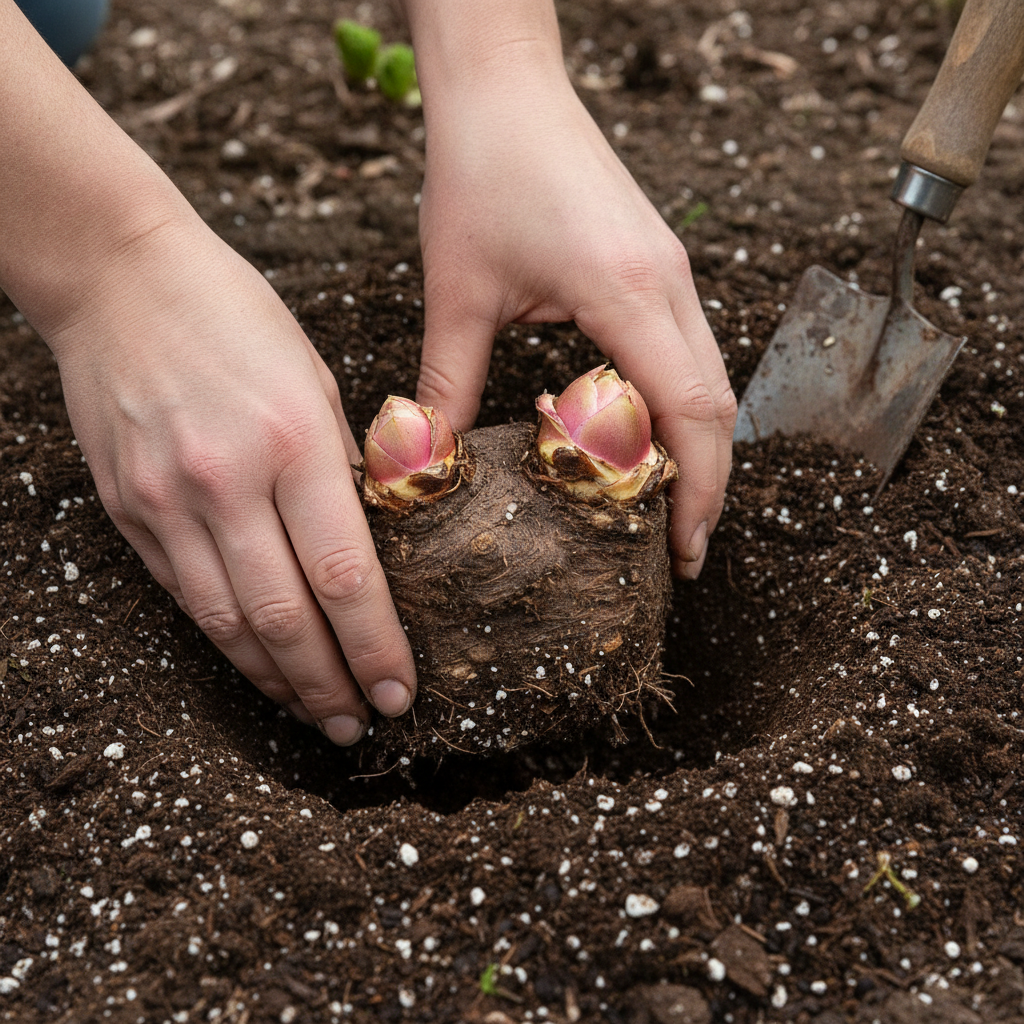
Plant dormant rhubarb crowns in early spring as soon as the ground can be worked, or alternatively in late fall after the first hard frost. Crowns establish best when soil temperatures are still cool and rain is reliable, which gives the new root system several weeks to anchor before the plant tries to push leaves. Ohio State recommends covering crowns with no more than an inch or two of soil, because planting rhubarb crowns too deep delays production. Depth is the single most common planting error.
Spacing matters as much as depth. Give each crown three to four feet of room in every direction. A mature plant will fill that space within three years and outgrow a tighter spacing, leaving you to dig and divide sooner than you planned. Dig the planting hole twice as wide as the crown, work in a generous shovelful of compost, and set the eye no deeper than two inches below the finished soil level.
Raised beds work beautifully for rhubarb because they warm faster in spring and drain better in fall. If you are still mapping the garden, our guide to raised bed gardening for beginners walks through the build. Water deeply at planting and keep the soil consistently moist (never soggy) through the first season.
Why Must You Skip the First-Year Harvest?
Resist pulling any stalks during the planting year, even if the plant looks vigorous. Illinois Extension is unambiguous on the schedule: “stalks may be harvested for 1 or 2 weeks during the second year and for 8 to 10 weeks (a full harvest season) during the third and subsequent years.” Newly set crowns need every leaf to manufacture the sugars that build a fat root system, and stripping stalks in year one trades a tiny pie for years of weak production.
Year two is a sampling year, not a harvest year. Take a small handful of the thickest stalks for a single pie or jam batch over a one- to two-week window, then leave the rest alone. The crown is still expanding, and a heavy second-year pull will stunt a plant that would otherwise hit full size by year three.
From year three forward, the patch can take a full eight- to ten-week harvest window, typically running from mid-April through late June depending on your zone. Pull stalks rather than cutting them: grip near the base, twist, and lift. Always leave at least a third of the stalks standing so the plant keeps photosynthesizing. Stalks that you do not eat fresh freeze beautifully for winter baking; see our preserver’s garden guide for batch-processing strategies.
Which Rhubarb Cultivar Should You Choose?
The cultivar you plant determines stalk color, sweetness, yield, and how often the plant will try to bolt. Iowa State University Extension recommends the red-stalked cultivars ‘Canada Red,’ ‘Crimson Red,’ ‘MacDonald,’ and ‘Valentine,’ along with the green-stalked heirloom ‘Victoria.’ Each one has a niche. ‘Victoria’ is the classic high-yielder, but it is tart and prone to seed stalks. ‘Canada Red’ is sweeter, redder, and slimmer. ‘MacDonald’ dominates the Northeast because of disease resistance.
Bolting tendency separates the heirlooms from the modern selections. University of Maryland Extension notes that “heirloom varieties like ‘MacDonald’ and ‘Victoria’ produce lots of seed stalks, while more modern varieties like ‘Valentine’ and ‘Canada Red’ are less likely to flower.” If you live in a zone with hot Junes, the modern red cultivars will reward you with longer harvest windows and less mid-season pruning.
The table below compares the cultivars home gardeners encounter most often, drawing on extension recommendations and a peer-reviewed cultivar trial published in Foods (Skupień et al., 2021) that measured petiole yield per hectare.
| Cultivar | Stalk color | Flavor | Bolting risk | Best fit |
|---|---|---|---|---|
| Victoria | Green with pink speckle | Tart, classic | High | High-yield heirloom, jam stock |
| Canada Red | Cherry-red throughout | Sweet, tender | Low | Dessert, fresh eating |
| Crimson Red | Deep red inside and out | Balanced, vigorous | Moderate | Cool, partly shaded sites |
| MacDonald | Bright red fading mid-season | Mild, juicy | High | Northeast, wilt-prone soils |
| Valentine | Pink-red | Mild, very tender | Low | Beginner gardens, hot summers |
Yields confirm what most home gardeners notice. The Skupień trial measured petiole yields ranging from 28.77 t/ha for ‘Canadian Red’ to 45.58 t/ha for ‘Red Champagne,’ with ‘Canada Red’ delivering a strong juice yield of roughly 75 to 85 percent depending on cultivar. Translate that to a backyard patch: two well-tended ‘Canada Red’ crowns will easily cover annual pie, jam, and freezer needs for a family of four.
How Do You Care for an Established Rhubarb Patch?
Established rhubarb wants three things: steady moisture, generous spring nitrogen, and quick removal of any flower stalks that appear. Oregon State University Extension recommends, “after the first year, add 3/4 to 1 cup of 10-10-10 or 1/2 to 3/4 cup of 16-16-16 fertilizer each spring along with compost to increase the available nutrients.” Top-dress two to three inches of finished compost around each crown as soon as the ground thaws, keeping the material away from the bud itself.
Water deeply through dry spells, particularly in May and June when stalks are bulking up. Shallow daily watering builds shallow roots; one long soak per week pushes roots deeper and toughens the patch against summer heat. A diluted weekly drench of compost tea during the harvest window noticeably plumps the stalks.
Bolting is the predictable mid-season problem. University of Maryland Extension reports that “temperatures above 75 degrees Fahrenheit (24°C)” frequently trigger flowering, and the fix is mechanical: cut every seed stalk down to the crown the moment it appears. Use sharp pruners, slice as low as you can reach, and dispose of the flower (it bolts faster the longer it sits in the patch). On our place I walk the rhubarb row every Saturday in late May and pull or cut anything that looks like a thickened, hollow flower scape.
Are Rhubarb Leaves Really Toxic?
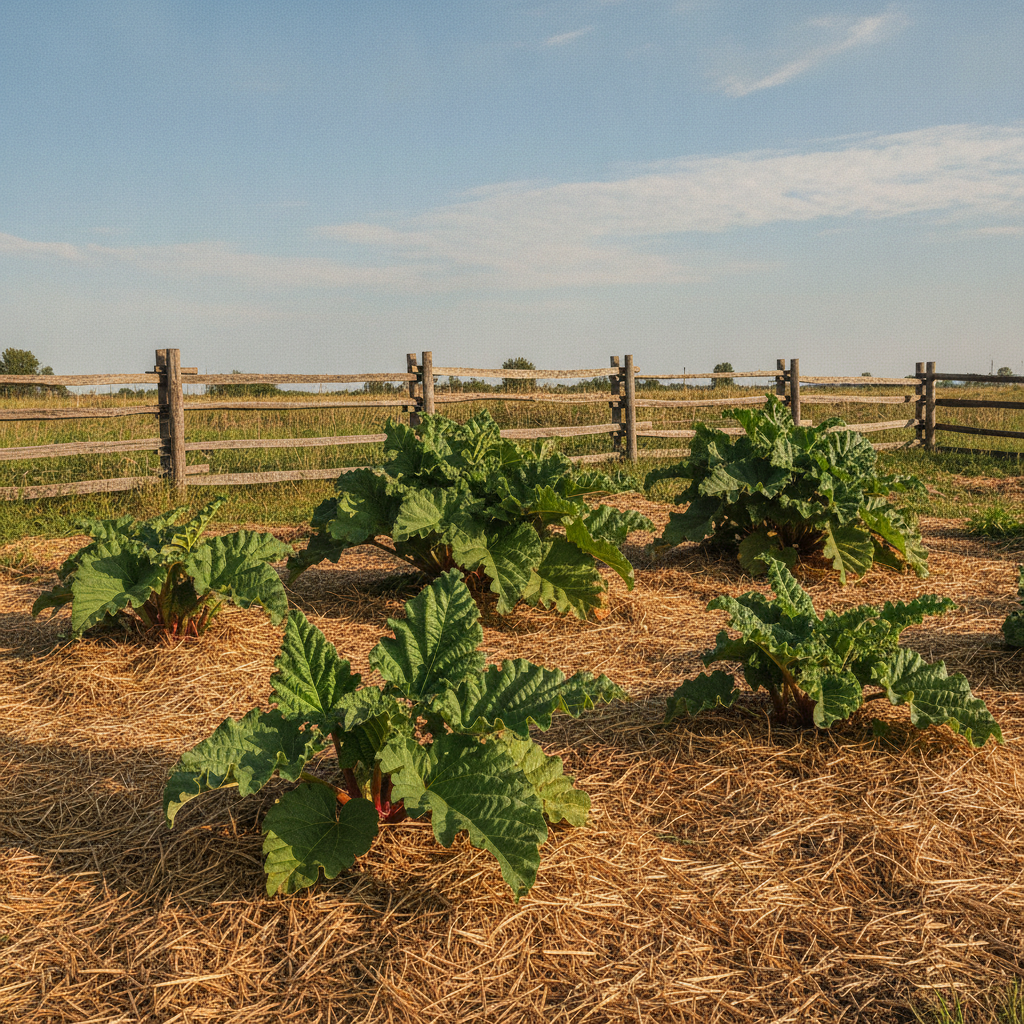
Yes. Rhubarb leaves contain oxalic acid (roughly 0.5% by weight) plus other compounds, and only the stalks are food. Eating the leaves can cause nausea, vomiting, and kidney irritation. According to North Dakota State University Extension, a truly fatal dose would require eating a very large quantity of leaves, on the order of 11 pounds, but they should never be eaten in any amount, since even smaller quantities cause illness. Treat the leaves as poisonous plant material, not a green to be used “carefully.”
Cooking does not make the leaves safe. Heat does not destroy oxalic acid, and the cooking liquid remains toxic. Recipes that suggest blanching rhubarb leaves for greens are dangerous folk advice and should be ignored.
Compost the leaves, do not feed them to chickens
Rhubarb leaves belong in the compost pile, not the chicken run or the goat pen. Oxalic acid breaks down in a properly heated compost system, and the calcium-rich leaf tissue actually improves the finished compost. Chickens, ducks, goats, pigs, and dogs are all sensitive to oxalates, and free-range birds that nibble fresh leaves can develop crop irritation or worse. Pile the leaves directly onto a hot compost heap, layer in browns, and turn within a week. The next time you build a batch for the garden, the leaves are no longer recognizable. For deeper preservation projects with the stalks themselves, see our water bath canning for beginners guide.
When Should You Divide Crowns, and How Long Will a Patch Produce?
A healthy rhubarb crown produces well for ten to twenty years, but yields drop noticeably without periodic division. Penn State Extension reports that “a healthy rhubarb plant will remain productive for 10 years or more,” while also noting that “productivity usually declines after 5 or 6 years.” Iowa State Extension is more specific: “rhubarb crowns often become overcrowded after eight to ten years, when the plant produces numerous small stalks and yields decrease.” Both statements point to the same management lesson.
Plan to divide on a five-to-ten-year cycle. The Alaska Cooperative Extension Service recommends that “rhubarb crowns should be split at least every four to five years, or whenever the plant begins to produce many small stalks rather than fewer large stalks.” The visible cue is reliable: stalks get noticeably thinner, more flower stalks appear, and the center of the crown dies out, leaving a doughnut of new growth around an empty core.
How to divide a crown without killing it
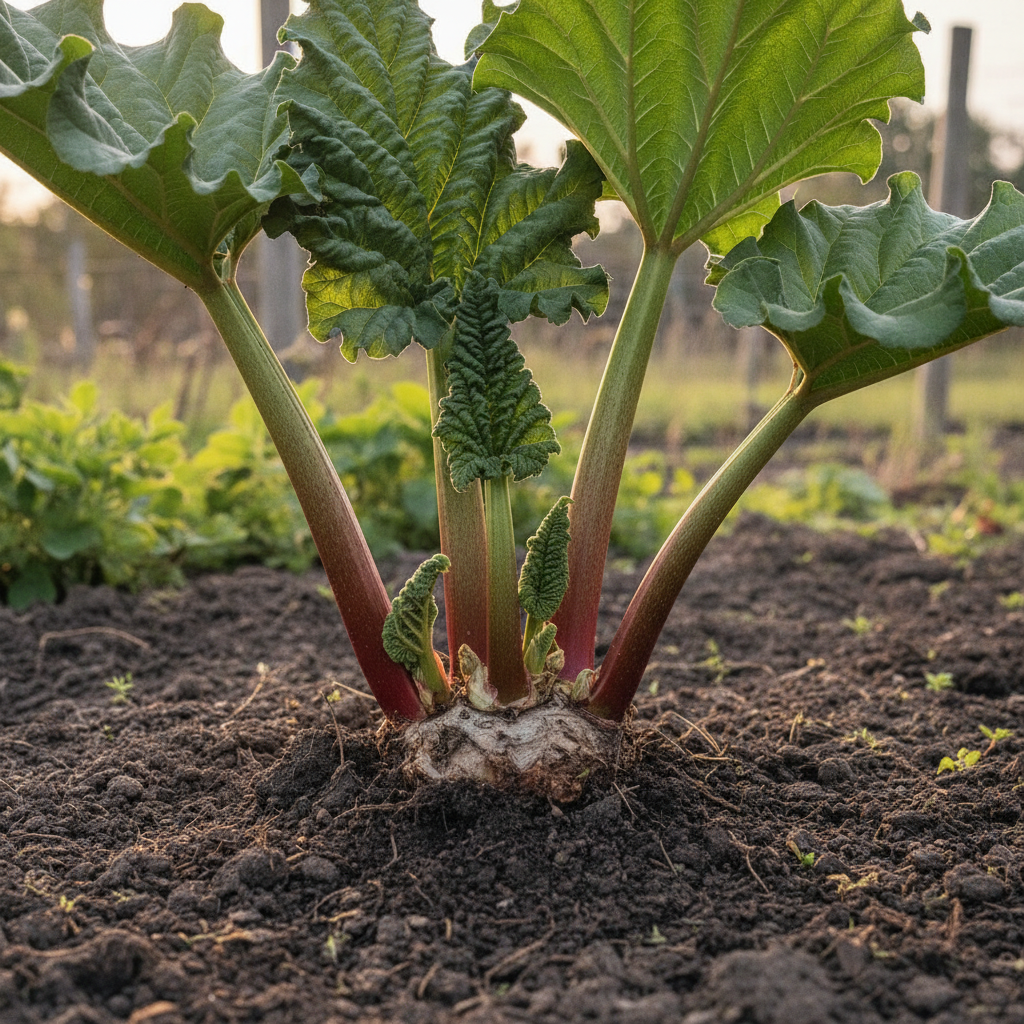
Divide in early spring just as the buds swell, or in late fall after the leaves die back. Use a sharpened spade to lift the entire crown, knock off loose soil, and split the root mass into pieces that each contain two or three healthy buds and a good chunk of fleshy root. Replant the divisions at the same two-inch depth, water them in, and treat them like new bare-root crowns: no harvest the next season, light harvest the year after, full harvest in year three. With a five-year division cycle, a single original purchase can keep producing for thirty years or longer, and the divisions you give away will keep neighbors in pie filling for another generation. Combine the harvest with strawberries for our homemade jam recipes beyond strawberry.
Frequently Asked Questions
How many chill hours does rhubarb need?
Rhubarb needs a substantial period of winter cold for reliable spring flush, temperatures below 40°F for at least six weeks. Most of zones 3 through 8 satisfy this requirement without effort. South of zone 8, plants run short on chilling, push thin stalks, and rarely live more than two or three seasons. Container culture with overwintering in a cold garage is a workaround for zone 9 and warmer.
Can I plant rhubarb from seed instead of crowns?
You can, but no university extension service recommends it for home gardeners. Seed-grown rhubarb is genetically variable, slower to establish, and bolts more readily than named cultivar crowns. Expect to wait an extra year before any harvest and accept that color and flavor will vary plant to plant. Bare-root crowns of a named cultivar (Canada Red, Victoria, MacDonald, or Valentine) deliver predictable color, sweetness, and yield, and they cost less in real terms once you factor in the extra year of waiting.
Why are my rhubarb stalks thin and stringy?
Three causes account for nearly every thin-stalk complaint: the patch is overdue for division, the plant is under-fed, or summer temperatures are running too hot. If the crown is older than five years and the center looks woody or dead, divide it next spring. If the soil has not been compost-topped recently, top-dress two inches of finished compost plus a measured spring fertilizer application. If your local Junes routinely top 80°F, expect smaller late-season stalks even with perfect care.
Should I let rhubarb flower if I want seeds?
No. Letting flower stalks mature pulls energy out of the edible petioles and shortens the harvest window. Per University of Maryland Extension, the recommended response is to “remove the flowering stalk… all the way down to the crown” as soon as it appears. Seed-grown rhubarb is also unpredictable, since most modern cultivars are vegetatively propagated to keep color and flavor stable. Stick to crown division if you want to expand the patch or share plants.
Is rhubarb safe for chickens or other livestock?
No. Rhubarb leaves, stems, and even leaf scraps contain oxalic acid at concentrations dangerous to chickens, ducks, goats, sheep, pigs, and dogs. Cooking does not reduce oxalate (and may concentrate it). Compost the leaves in a hot pile and keep poultry out of the rhubarb bed altogether. The cooked stalks themselves are non-toxic but offer no benefit to livestock and should not be used as a regular feed.
How do I store fresh rhubarb after harvest?
Trim the leaves off immediately (they pull moisture from the stalks), wrap the stalks loosely in a damp tea towel, and refrigerate in the crisper for up to two weeks. For longer storage, chop into half-inch pieces and freeze raw on a sheet pan, then transfer to freezer bags. Frozen rhubarb keeps a year and goes straight into jam, pies, or compote without thawing. Vacuum-sealed frozen rhubarb keeps closer to eighteen months without flavor loss.
Bringing It Home
Rhubarb is a long-term investment that asks for patience in year one and pays back for decades. Plant two named cultivar crowns at two inches deep, three to four feet apart, skip the first-year harvest, top-dress with compost every spring, and divide on a five-to-ten-year cycle. Cut every seed stalk down to the crown the moment it appears, compost (never feed) the leaves, and treat the patch like an heirloom asset that will outlive most other things in your garden.
If you do only three things from this guide: wait the full first year before harvesting, choose a low-bolt modern red cultivar over the classic Victoria if your summers run hot, and divide before the crown asks you to. Those three habits separate a patch that lasts six years from one that hands stalks to your grandchildren.